

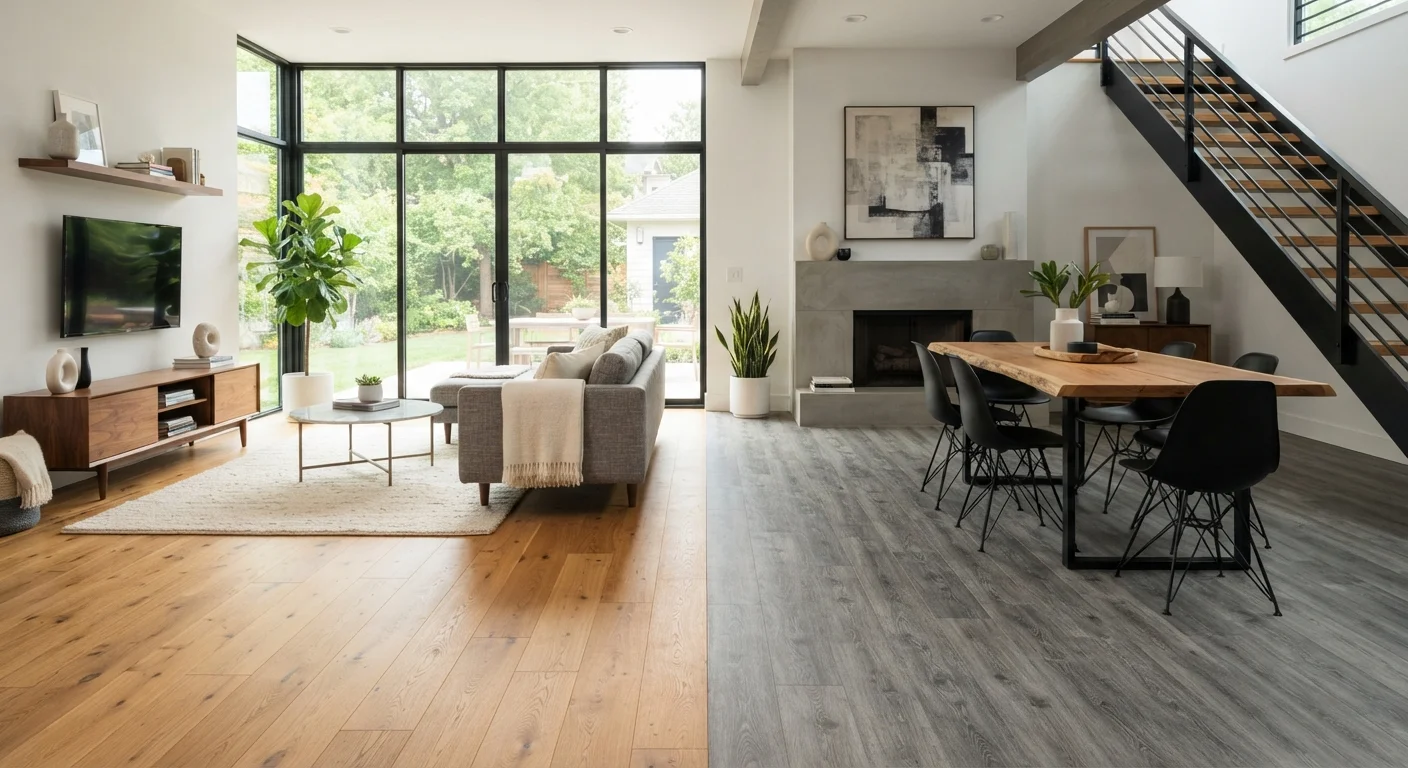
Option A
Hardwood Flooring
The time-tested, refinishable natural classic.
Best for: Dry living spaces where long-term resale value, aesthetics, and the ability to sand and refinish matter most.
Option B
Luxury Vinyl Plank (LVP)
The durable, waterproof modern alternative.
Best for: High-traffic or moisture-prone areas where waterproofing, comfort underfoot, and straightforward installation are top priorities.
Durability and Scratch Resistance
Hardwood's durability depends largely on species and finish. Harder species like white oak and hickory resist dents better than softer options like pine. Even so, hardwood scratches from pet claws, furniture legs, and grit tracked in from outside. The key advantage: hardwood can be sanded down and refinished — typically three to five times over its life — restoring its surface to near-original condition.
Luxury vinyl plank uses a wear layer — usually measured in mils — that resists scratching and scuffing. Thicker wear layers (12 mil and above) hold up well in high-traffic areas. However, once an LVP plank is deeply gouged, the only fix is replacing individual planks. LVP cannot be refinished, so its lifespan is effectively capped by how well its surface holds up.
| Criterion | Hardwood Flooring | Luxury Vinyl Plank (LVP) |
|---|---|---|
| Waterproof | No — moisture causes warping | Yes — fully waterproof core |
| Scratch resistance | Moderate (species-dependent) | Good (wear layer–dependent) |
| Refinishable | Yes — multiple times | No — planks must be replaced |
| Typical lifespan | 50–100+ years with refinishing | 15–25 years typical |
| Material cost (approx.) | $6–$12+ per sq ft | $2–$7 per sq ft |
| DIY-friendly installation | Difficult — usually needs pros | Yes — click-lock floating system |
| Suitable for basements | No | Yes |
| Resale value perception | High in traditional markets | Moderate and growing |
Moisture and Temperature Tolerance
This is where the gap between the two options is most clear-cut. Solid hardwood expands and contracts with humidity and temperature swings. Prolonged exposure to moisture — even from mopping too aggressively — can cause cupping, warping, or gapping. For this reason, hardwood is generally not recommended for below-grade spaces like basements or for bathrooms and laundry rooms.
Luxury vinyl plank is fully waterproof through its core. It can handle standing water, high humidity, and temperature fluctuations typical of most indoor environments. This makes LVP a practical option across virtually every room in a home, including spaces where hardwood would be unsuitable.
Engineered Hardwood: A Middle Ground
Engineered hardwood features a real wood veneer over a plywood core, making it more dimensionally stable than solid hardwood in moderate-humidity environments. It handles some of the moisture challenges better than solid wood, though it still isn't recommended for fully wet spaces. Engineered hardwood can typically be refinished once or twice depending on veneer thickness — fewer times than solid wood, but it offers more versatility in where it can be installed.
Installation, Cost, and Long-Term Maintenance
Hardwood installation typically requires nailing or stapling planks to a wood subfloor, a job usually handled by a flooring professional. Engineered hardwood (real wood veneer over a plywood core) offers slightly more flexibility and can sometimes be glued or floated, but solid hardwood installation is rarely a beginner DIY project. Material costs for solid hardwood vary widely by species, but solid oak commonly runs from around $6 to $12 per square foot for material alone — labor adds to that significantly.
LVP's click-lock floating installation is genuinely accessible to motivated DIYers with basic tools. Material costs are generally lower, with quality LVP often ranging from $2 to $7 per square foot. Maintenance for both floors comes down to regular sweeping and damp mopping with appropriate cleaners — but hardwood requires more caution: excessive water, steam mops, and harsh chemicals can damage the finish over time.
Thinking about your floors as part of a broader home upkeep plan makes sense. consistent maintenance protects home value over the long run, and flooring is one of the most visible components of that effort. Similarly, if you maintain other wood surfaces at home, the principles are related — see how wood deck maintenance works for a parallel perspective on caring for natural wood.
The content on this site is for informational purposes only and is not a substitute for professional advice. Always consult a qualified professional for guidance specific to your situation.