

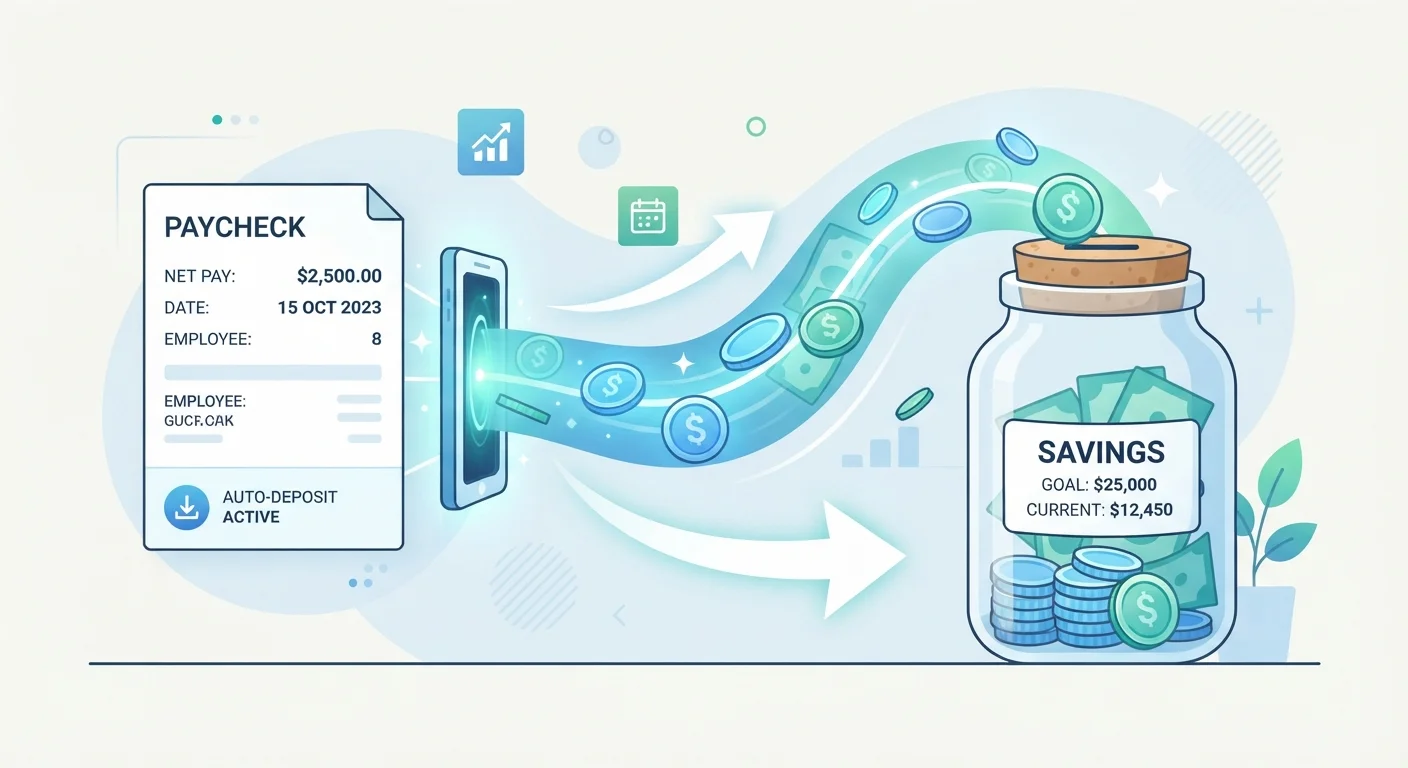
Why 'Pay Yourself First' Actually Works
Most people approach saving the same way: spend what's needed, then save whatever is left. The problem is that leftover money has a way of disappearing. Unexpected expenses arise, small purchases accumulate, and the month ends with little or nothing transferred to savings.
Paying yourself first flips that sequence. You move money to savings immediately — before groceries, before dining out, before any discretionary spending. What remains in checking becomes your spending budget. You're not deciding whether to save; you're deciding what to do with what's left after saving. It's a subtle but powerful reframe.
Automation enforces that reframe without relying on your motivation. Willpower is a limited resource. Automatic transfers don't get tired or make exceptions. They execute on schedule whether you're having a stressful week or a great one. That consistency is the real advantage.
For a broader look at how this habit fits into overall money management, see the complete overview of savings and debt management or explore why the order of spending decisions matters.
What You Need Before You Start
What you will need
Online banking portal or mobile app
Used to set up and manage recurring transfers between checking and savings accounts.
Employer payroll system (HR portal)
Allows direct deposit splits so a portion of each paycheck goes straight to savings.
High-yield savings account
Earns more interest on saved funds than a standard savings account, maximizing the benefit of automated contributions.
Once you have these in place, the actual setup takes less than 30 minutes in most cases. The preparation — knowing your numbers — is the step most people skip, and it's what causes automation to backfire.
Step-by-Step: Setting Up Automatic Savings
Decide how much to save each pay period
Look at your take-home pay and fixed monthly expenses — rent, utilities, minimum debt payments. Whatever is left after essentials is your starting point. A common guideline is to save at least 10–20% of take-home income, but there's no universal rule. If that feels out of reach right now, start with whatever you can — even $25 per paycheck — and increase it over time. The habit matters more than the amount when you're starting out.
Choose where the money will go
Pick a dedicated savings account that's separate from your everyday checking. Keeping your savings at arm's length — ideally in a different account, or even a different bank — reduces the temptation to dip into it. Consider an account without a debit card attached. The goal is mild friction: easy enough to access in a real emergency, but not so easy that casual impulse spending drains it.
Set up the automatic transfer
You have two main options:
- Through your employer's payroll: Many employers allow you to split your direct deposit between multiple accounts. Log into your HR or payroll portal and designate a fixed dollar amount — not a percentage, since percentages fluctuate with hours worked — to deposit directly into savings each pay period. This is the most powerful method because the money never enters your checking account.
- Through your bank: Log into your online banking account, navigate to transfers or automatic payments, and schedule a recurring transfer from checking to savings. Set it for the same day as payday or the day after.
Run your budget for one full month without adjusting
After setting up automation, give yourself one full pay cycle to see how your checking account holds up. Track your spending and watch your balance. This isn't about perfection — it's about gathering real data. Did you come up short? That tells you to reduce the automated amount temporarily. Did you end the month with a healthy cushion? That's a signal you may be able to increase the transfer.
Review and adjust twice a year
Automation works best when it stays current with your life. Set a calendar reminder every six months — January and July work well — to review your savings rate. Got a raise? Increase the transfer. Had a major expense shake your budget? Temporarily reduce it without guilt and return to your target amount once you stabilize. The goal is consistency over time, not rigidity.
Keep a Buffer Before You Automate
Automating transfers without enough cushion in your checking account can trigger overdrafts and fees. Before setting up any automatic transfer, confirm your account consistently holds enough to cover bills and essentials. Start with a small automated amount — even $25 — and increase it as your cash flow allows.
Match Your Transfer Date to Payday
Schedule automatic savings transfers for the same day — or the day after — your paycheck arrives. This ensures the money moves before it blends into your spending balance. Most banks let you set a specific date for recurring transfers at no cost.
Common Questions and Pitfalls
What if my income varies month to month?
If you're self-employed or work variable hours, a fixed-dollar automatic transfer can be risky. Instead, set a manual transfer rule: on the day you receive each payment, immediately transfer a set percentage to savings. Some people use a separate business or freelance account as a holding zone, then pay themselves a consistent amount on a regular schedule. The principle is the same — savings comes first — but the mechanics adapt to irregular income.
Should I automate retirement contributions separately?
Yes. If your employer offers a 401(k) or similar retirement plan with payroll deductions, that's a separate automation worth setting up alongside your general savings transfers. Employer matching — where your company adds funds when you contribute — is one of the clearest financial benefits available to workers who have access to it. Your budgeting basics should account for both retirement and short-term savings as line items.
What counts as an emergency fund versus other savings goals?
Financial educators generally recommend keeping three to six months of essential expenses in an accessible, liquid savings account as an emergency fund before aggressively funding other goals. Once that baseline is in place, you can set up separate automated transfers for other goals — a car, a vacation, a home down payment — in dedicated accounts labeled by purpose. This approach, sometimes called bucket savings, keeps goals distinct and progress visible.
This article is for general informational and educational purposes only and does not constitute personalized financial advice. Consult a qualified financial professional for guidance specific to your situation.
The content on this site is for informational purposes only and is not a substitute for professional advice. Always consult a qualified professional for guidance specific to your situation.