

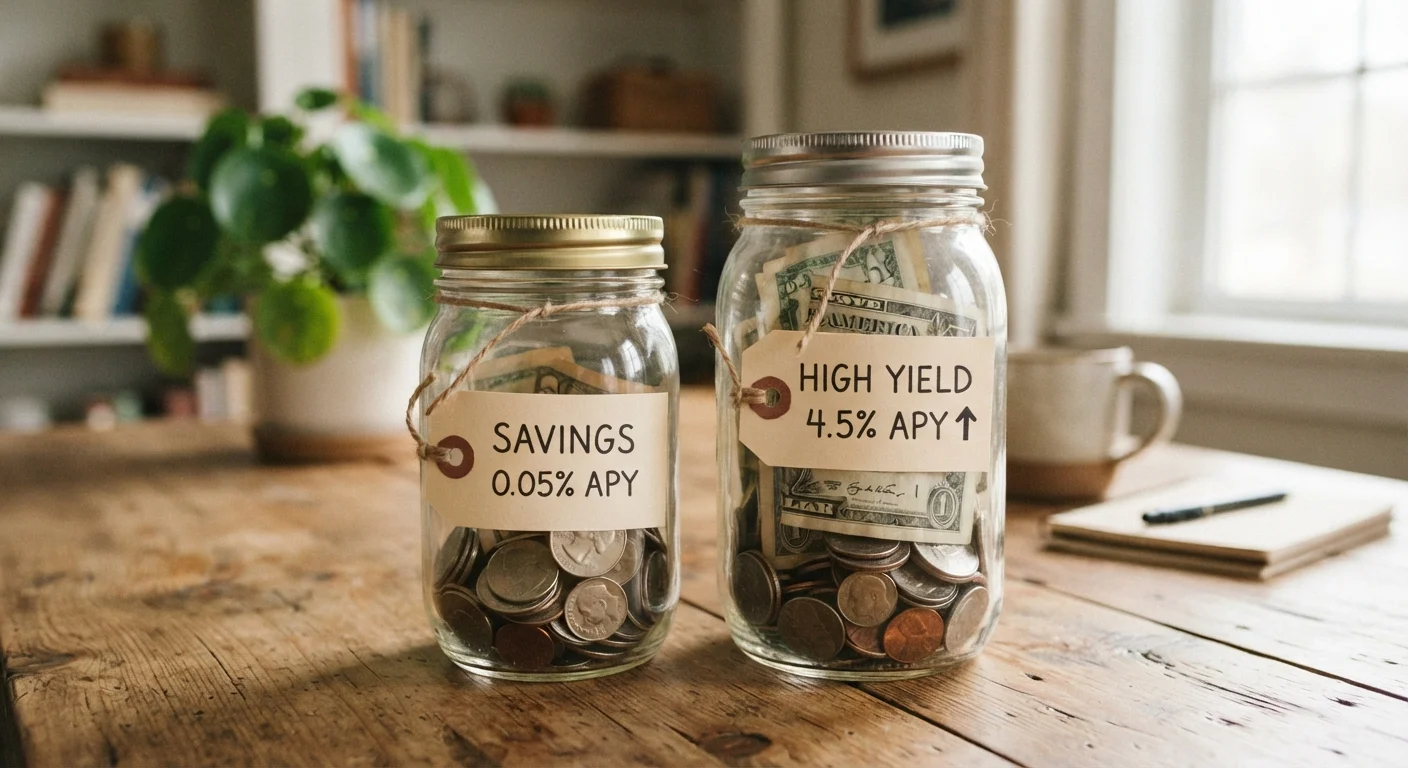
Option A
High-Yield Savings Account (HYSA)
The higher-interest alternative built for savers who want their money to work harder.
Best for: Anyone with an emergency fund or short-term savings goal who wants to earn significantly more interest without taking on investment risk.
Option B
Traditional Savings Account
The familiar, widely available option offered by most brick-and-mortar banks.
Best for: People who prioritize easy in-person access, existing banking relationships, or who are just starting to save and want simplicity.
What Sets These Two Accounts Apart
At their core, both a high-yield savings account and a traditional savings account do the same thing: hold your money safely while paying you interest. The difference comes down to how much interest you earn and where the account is held.
Traditional savings accounts are the kind most people open at a local bank or credit union. They're easy to set up, often linked directly to a checking account at the same institution, and widely familiar. The trade-off is that their interest rates — known as the APY — tend to hover near the national average, which has historically been quite low.
High-yield savings accounts (HYSAs) are functionally similar but typically offered by online banks or credit unions. Because these institutions don't maintain physical branches, their operating costs are lower — and they often pass those savings on to customers in the form of much higher APYs. It's not unusual for an HYSA to pay several times more than a traditional savings account at a major bank.
| Criterion | High-Yield Savings Account | Traditional Savings Account |
|---|---|---|
| Typical APY | Often several times the national average | Near or at the national average (historically low) |
| Federal deposit insurance | Yes — FDIC or NCUA up to $250,000 | Yes — FDIC or NCUA up to $250,000 |
| Where it's held | Usually online banks or credit unions | Brick-and-mortar banks and credit unions |
| In-person branch access | Typically none | Usually available |
| Transfer speed to external accounts | 1–3 business days (varies by bank) | Often instant within same institution |
| Minimum balance requirements | Varies; many have none | Varies; some require minimums |
This article is general financial education, not personalized advice. Consider speaking with a licensed financial professional about decisions specific to your situation.
Safety, Access, and Everyday Practicalities
One of the most common misconceptions about HYSAs is that a higher rate means higher risk. That's not the case. Both account types are federally insured — up to $250,000 per depositor, per institution — through the FDIC (Federal Deposit Insurance Corporation) for banks or the NCUA (National Credit Union Administration) for credit unions. Your money is equally protected in either account.
$250,000
Federal deposit insurance limit per depositor
The FDIC insures deposits at member banks up to this amount per depositor, per institution — applying equally to both account types.
~0.45%
National average savings account APY
According to FDIC data, the national average APY for savings accounts has remained a fraction of what many online banks offer on high-yield accounts.
Where they differ in practical terms is access. A traditional savings account at your existing bank often lets you move money instantly between accounts and gives you branch or ATM access if you need cash. With most HYSAs at online-only banks, transfers to an external bank account can take one to three business days, though many institutions now offer faster options.
If you're thinking about how a savings account fits into a broader money strategy, it can pair well with an approach like paying yourself first. Directing funds into a dedicated savings account — especially one earning a competitive rate — gives that habit more impact over time.
Which One Should You Choose?
The honest answer is: it depends on what you value most. If your goal is to maximize the interest your emergency fund or short-term savings earns, an HYSA is almost always the stronger option. The higher APY means your balance grows faster through compounding, without you having to do anything differently.
If convenience, familiarity, and keeping everything under one banking roof matters more to you — or if you simply aren't ready to manage a second financial relationship — a traditional savings account is a perfectly reasonable place to park your money. The habit of saving consistently matters more than the account type, especially when you're starting out. See our complete savings and debt overview for more on building that foundation.
It's also worth noting that savings accounts — regardless of type — serve a different purpose than investing. They're best suited for money you may need within the next few years, or funds you want to keep liquid and protected. For a clear explanation of where savings ends and investing begins, this breakdown of saving vs. investing covers the distinction plainly.
This article is for general informational and educational purposes only and does not constitute personalized financial advice. Consult a qualified financial professional for guidance specific to your circumstances.
The content on this site is for informational purposes only and is not a substitute for professional advice. Always consult a qualified professional for guidance specific to your situation.