

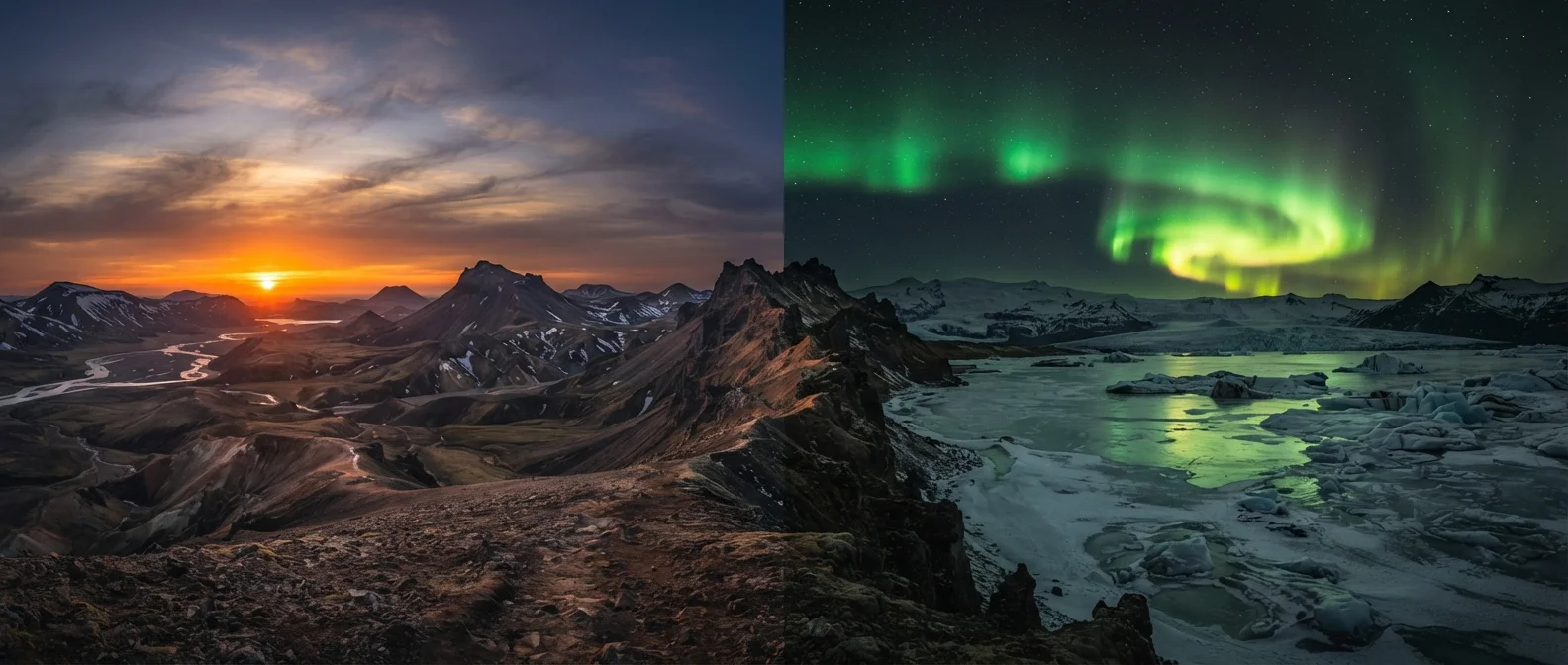
Option A
Iceland in Summer
The land of endless daylight and open roads.
Best for: Travelers who want accessible hiking, wildlife encounters, and round-the-clock exploration under the midnight sun.
Option B
Iceland in Winter
A moody, otherworldly escape under the auroras.
Best for: Travelers chasing the northern lights, ice cave adventures, and the drama of Iceland's raw, snow-covered interior.
Daylight, Weather, and What to Actually Expect
Iceland's seasons aren't just different — they're near opposites. In late June, Reykjavik sees approximately 22 hours of sunlight per day. The sun barely dips below the horizon, creating a perpetual golden hour that's simultaneously disorienting and extraordinary. In contrast, December delivers only four to five hours of usable daylight, with darkness dominating most of the day.
Temperature-wise, neither season is tropical. Summer in Iceland runs roughly 50–55°F (10–13°C) in the lowlands, cooler in the highlands. Wind and rain can show up without warning even in July, so layering is non-negotiable year-round. Winter temperatures hover between 28–35°F (-2–2°C) on average, but wind chill frequently makes it feel much colder. Snowfall is common but inconsistent — coastal areas near Reykjavik sometimes escape heavy accumulation while the interior is buried.
| Criterion | Summer | Winter |
|---|---|---|
| Daylight Hours | Up to 22 hours | 4–5 hours |
| Average Temperature | 50–55°F (10–13°C) | 28–35°F (-2–2°C) |
| Northern Lights | Not visible | Prime season (weather-dependent) |
| Glacier Ice Caves | Closed / unsafe | Nov–Mar access |
| Highland F-Roads | Open late June–Sept | Closed |
| Puffin Watching | May–August | Not available |
| Crowd Levels | Peak crowds in July–Aug | Quieter, fewer tourists |
| Driving Conditions | Generally accessible | Requires caution; 4x4 advised |
One key practical note: Iceland's Interior Highlands — including the legendary F-roads and areas like Þórsmörk — are only accessible from roughly late June through September. Winter travelers should plan itineraries firmly around the coastal Ring Road instead.
Signature Experiences by Season
Summer exclusives: Puffin watching is a genuine highlight — these charismatic seabirds nest along Iceland's cliffs from May through August, with colonies near the Westfjords and Látrabjarg being particularly accessible. The highland trails around Landmannalaugar open only in summer, rewarding hikers with obsidian lava fields and rhyolite mountains streaked in red, green, and gold. And the midnight sun itself is an experience — eating dinner outside at 11 p.m. in full daylight has a surreal quality that photos can't fully capture.
~2M
Annual tourist arrivals to Iceland
Iceland's tourism roughly doubled in the years following 2010, with summer months consistently drawing the largest share of visitors.
22 hrs
Peak daily sunlight near summer solstice
Around June 21st, Reykjavik experiences near-continuous daylight, with the sun setting briefly around midnight before rising again.
8,100 km²
Size of Vatnajökull glacier
Vatnajökull is Europe's largest glacier by volume and is home to the natural ice caves accessible only during winter months.
Winter exclusives: Natural glacier ice caves — carved each year by meltwater beneath Vatnajökull, Europe's largest glacier — are only safely toureable between roughly November and March when cold temperatures stabilize them. These electric-blue chambers are genuinely unlike anything else on Earth. Northern lights viewing peaks during these months too, especially in rural areas away from Reykjavik's light pollution. The key caveat: aurora sightings require clear skies, and Iceland's weather is notoriously unpredictable. Build in multiple nights and keep expectations flexible.
Both seasons share access to the Golden Circle (Geysir, Gullfoss, Þingvellir), the Blue Lagoon geothermal pools, and Reykjavik's vibrant food and cultural scene — giving each timing a solid foundation regardless of weather.
Practical Planning: Crowds, Costs, and Getting Around
Summer tourism in Iceland has grown substantially in recent years, with July and August seeing the heaviest visitor numbers. Popular spots like Seljalandsfoss waterfall and the Diamond Beach near Jökulsárlón can feel crowded mid-day. Booking accommodations and rental vehicles well in advance — sometimes months ahead — is strongly advisable for summer travel. Prices for lodging and car rentals typically reflect peak demand during these months.
Winter travel is comparatively quieter, and you'll often find more breathing room at major landmarks. That said, road conditions introduce a real planning variable. The Icelandic Road and Coastal Administration (Vegagerðin) provides live road condition updates at road.is, and checking it daily is standard practice for winter drivers. A 4x4 vehicle is recommended outside Reykjavik in winter, and some routes may close temporarily after storms. Travel insurance that covers weather-related disruptions is worth considering regardless of season.
Both seasons are best explored with a rental vehicle — Iceland's public transportation outside Reykjavik is limited, and the freedom to stop at unmarked waterfalls or pull over for a sheep crossing is a core part of the country's appeal. Verify all entry requirements, travel advisories, and road conditions through official Icelandic government and U.S. State Department sources before your trip, as conditions and regulations can change.
The content on this site is for informational purposes only and is not a substitute for professional advice. Always consult a qualified professional for guidance specific to your situation.