

Why Look Beyond the French Quarter
Bourbon Street delivers exactly what it promises — loud, concentrated, and unapologetically tourist-facing. For many visitors, that's a perfectly valid evening. But New Orleans is one of America's most layered cities, and its real character lives in the neighborhoods that stretch away from the visitor corridor. The city's food, music, history, and architecture didn't originate on a neon-lit strip; they grew block by block across communities that still thrive today.
This list isn't about avoiding crowds for its own sake. It's about following the story of New Orleans to where it actually lives — in front-porch conversations, second-line parades, corner po'boy shops, and murals painted on hurricane-shuttered walls. Whether you're a first-time visitor or returning to go deeper, these neighborhoods offer experiences that hold up long after the trip ends. Much like navigating a dense, unfamiliar city (see our guide to visiting New York without feeling overwhelmed), the key is breaking the destination into human-scaled pieces.
Tremé: The Cradle of American Music
Tremé (pronounced treh-MAY) sits just north of the French Quarter and is widely recognized as the oldest African American neighborhood in the United States. Its streets are inseparable from the origins of jazz — brass band traditions, social aid and pleasure clubs, and the Mardi Gras Indian culture all have deep roots here. Congo Square, where enslaved people gathered to maintain African cultural practices on Sundays, is now part of Louis Armstrong Park and remains one of the most historically significant public spaces in the country.
Walking through Tremé means passing historic Creole cottages, small corner bars where live music happens without cover charges, and community institutions that have anchored the neighborhood for generations. St. Augustine Church, one of the oldest African American Catholic parishes in the country, is worth a quiet visit.
Tremé's Congo Square is one of the most historically significant public spaces in America.
Bywater: Art, Color, and Creative Energy
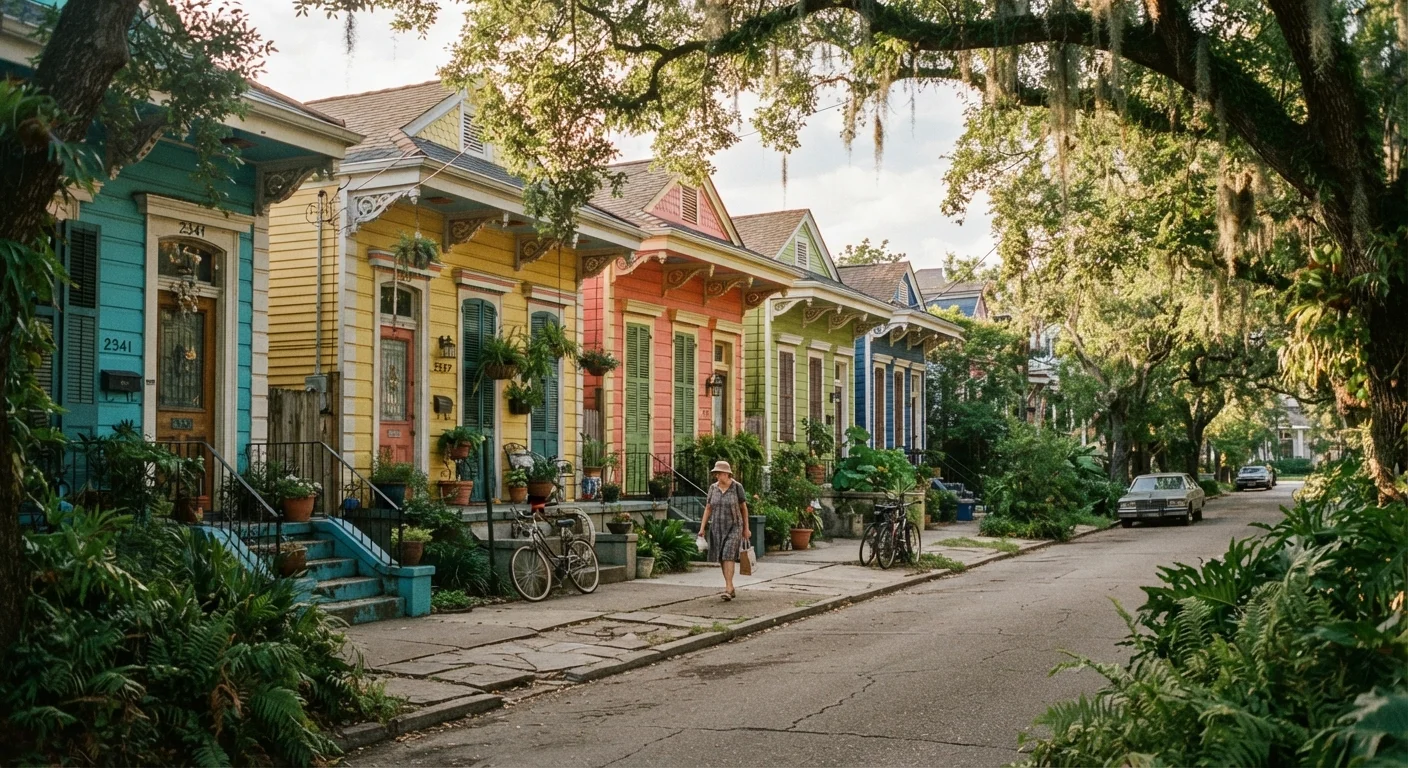
Bywater occupies a bend in the Mississippi River downriver from the French Quarter and has attracted artists, musicians, and independent business owners for decades. The neighborhood is known for its densely painted shotgun houses, community murals, and a walkable concentration of locally owned restaurants and coffee shops. It feels lived-in and creative without being performative about either quality.
The area around St. Claude Avenue functions as an informal arts corridor, with galleries, music venues, and pop-up markets clustering along a manageable stretch. Bywater is also home to The Country Club, a storied community gathering spot with an outdoor pool — though hours and access vary, so verify current information before visiting.
Bywater's St. Claude Avenue hosts a walkable concentration of galleries, music, and local food.
Faubourg Marigny: Live Music Without the Gloss
Directly adjacent to the French Quarter on its downriver side, the Marigny Triangle is compact and walkable, anchored by Frenchmen Street — a stretch that locals frequently cite as the place to hear live music in a less commercialized setting. On any given night, multiple venues within a single block feature jazz, funk, brass, and Afro-Caribbean sounds, often with no cover charge or a modest one.
The Marigny's housing stock — Creole cottages and double shotguns painted in vivid colors — makes simply walking the streets worthwhile. The neighborhood transitions easily into Bywater, so the two areas are often explored together in a single afternoon or evening.
Frenchmen Street offers nightly live music in an intimate, locally rooted setting.
Garden District: Architecture and Quiet Streets
The Garden District, developed primarily in the nineteenth century by wealthy American merchants who settled upriver from the Creole French Quarter, is defined by its grand antebellum mansions set behind elaborate wrought-iron fences and live oaks draped in Spanish moss. Magazine Street, which runs along its edge, is a long corridor of independent shops, cafés, and galleries worth a leisurely afternoon.
This neighborhood rewards slow walkers. The scale of the houses, the canopy of the trees, and the relative quiet compared to the Quarter make it a genuine counterpoint to the sensory intensity of downtown. The St. Charles Avenue streetcar provides a scenic and practical connection to other parts of the city.
The Garden District's live oak canopy and antebellum architecture reward slow, unhurried walking.
Mid-City: Local Life and City Park
Mid-City occupies the geographic center of New Orleans and functions as a working residential neighborhood with some of the city's most dependable neighborhood restaurants. It's also the gateway to City Park, a sprawling green space covering more than 1,300 acres — larger than Central Park in New York — containing the New Orleans Museum of Art, the Besthoff Sculpture Garden (free and open to the public), botanical gardens, and extensive walking and biking paths.
The Lafitte Greenway, a linear park converted from an old rail corridor, connects Mid-City to Tremé and provides a car-free route through several neighborhoods. Mid-City also hosts the beloved Mid-City Bayou Boogaloo festival each spring, though event details and dates should always be confirmed with local sources.
City Park's free sculpture garden alone makes Mid-City worth the detour from downtown.
Planning Your Neighborhood Exploration
Each of these neighborhoods is best explored on foot or by bicycle — New Orleans is notably flat, and many areas have dedicated bike infrastructure. Street parking is available in most residential districts, though public transit (the RTA streetcar lines) connects several of these neighborhoods directly to downtown. Always check local event calendars before you go; community festivals, second-line parades, and neighborhood markets happen throughout the year and can transform an ordinary afternoon into something genuinely memorable.
Getting Between Neighborhoods Easily
The RTA streetcar lines — particularly the St. Charles line and the Rampart-St. Claude line — connect several of these neighborhoods to each other and to downtown. Single-ride fares are modest, and a Jazzy Pass offers unlimited rides for a set period. Rideshare services are widely available but walking or cycling between Tremé, Marigny, and Bywater is entirely feasible given how compact this part of the city is.
Honest note on timing: summers in New Orleans are intensely hot and humid, and hurricane season runs June through November. Spring and fall generally offer more comfortable conditions for extended walking. Whatever season you visit, bring water, wear light layers, and pace yourself — this is a city meant to be savored, not rushed.
The content on this site is for informational purposes only and is not a substitute for professional advice. Always consult a qualified professional for guidance specific to your situation.