

Why Kitchen Myths Stick Around
Cooking lore travels efficiently — passed down through family kitchens, cooking shows, and decades of cookbooks that repeated each other. The problem is that some of those instructions were based on observation rather than rigorous testing, and once a compelling-sounding explanation takes hold, it is hard to dislodge even when the evidence says otherwise.
None of this means your grandmother cooked badly or that traditional wisdom has no value. It means that kitchen knowledge, like any other kind, benefits from occasional updating. Letting go of a myth does not make you a worse cook — it frees you to focus on techniques that actually deliver results. The myths below are among the most widely believed and worth examining closely.
Myth
Searing meat seals in the juices, keeping it moist during the rest of cooking.
Fact
Searing does not create a moisture barrier. Meat seared first loses just as much liquid as meat that is not seared.
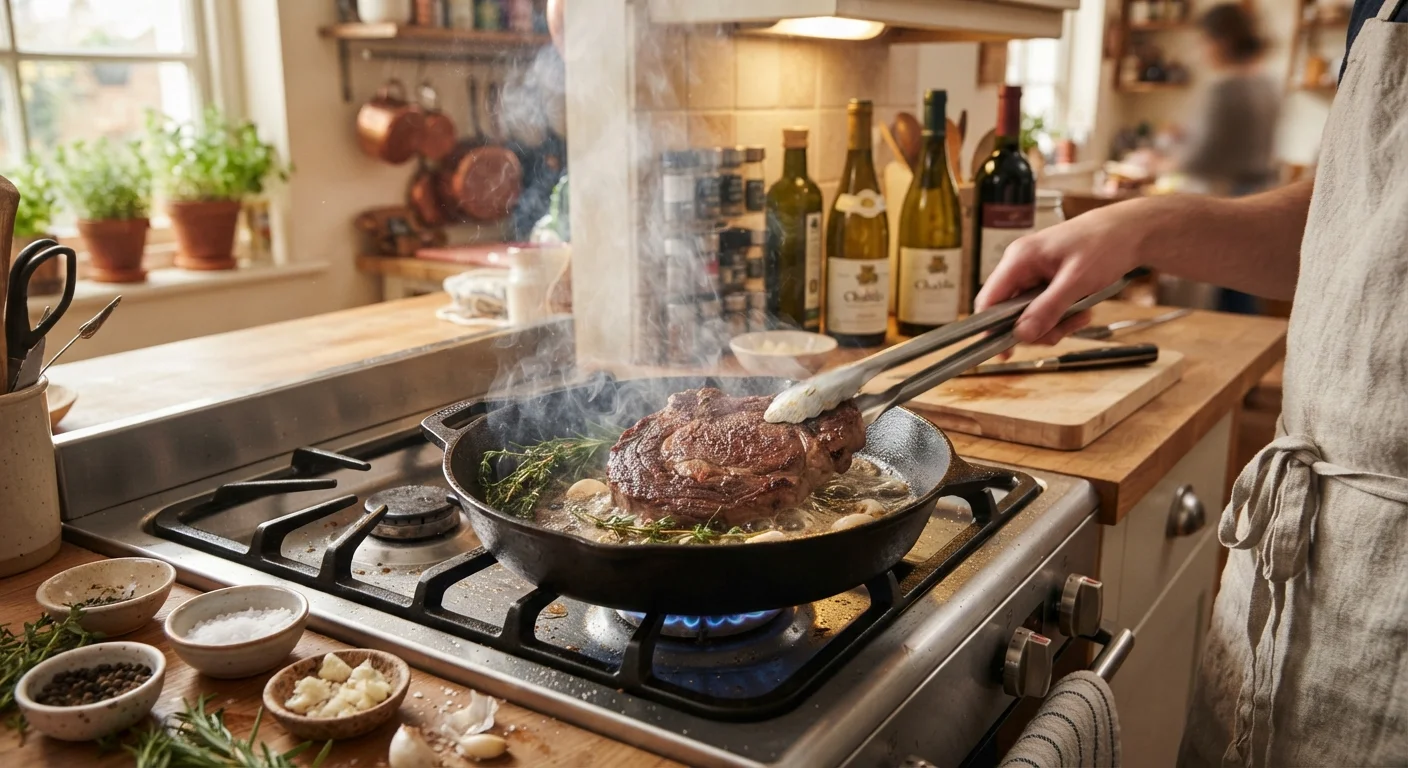
This is one of the most persistent myths in home cooking, and food scientists have tested it thoroughly. When you sear meat at high heat, you are triggering the Maillard reaction — a chemical process between amino acids and sugars that creates hundreds of new flavor compounds and that characteristic browned crust. That crust is genuinely valuable, but it is porous, not waterproof.
Studies measuring weight loss in seared versus unseared cuts consistently show no significant difference in moisture retention. The real case for searing is flavor and texture — reasons that are more than good enough. For a deeper look at what actually keeps meat juicy after cooking, see the science behind resting meat.
Myth
Adding salt to water makes it boil faster, so you should salt pasta water for that reason.
Fact
Salt raises the boiling point of water, but by such a negligible amount that it has no practical effect on boiling time.
At the salt concentrations used in home cooking, the boiling-point elevation is so small — often less than one degree Fahrenheit — that it is functionally irrelevant. The actual reason to salt pasta water generously is flavor: pasta absorbs water as it cooks, and salted water seasons the pasta from the inside out in a way that finishing salt on the plate cannot replicate.
A common guideline is to make pasta water taste pleasantly salty, similar to mild broth. This is one of the highest-impact, lowest-effort improvements you can make to a weeknight pasta dish. For more on how salt does its work in cooking, see understanding salt's many roles.
Myth
Rinsing cooked pasta under cold water is a smart step that stops it from sticking together.
Fact
Rinsing pasta washes away surface starch, which is exactly what helps sauce adhere and emulsify into a cohesive dish.
The starchy surface on freshly drained pasta acts like a glue and a thickener. When you toss pasta directly into a warm sauce, that starch helps the sauce cling to every strand and also thickens the sauce as it incorporates. Rinsing removes this advantage and leaves you with slippery pasta that sauce slides off of.
The one exception is pasta intended for cold salads, where you want the cooking to stop quickly and where sauce adhesion works differently. In nearly every hot pasta application, skip the rinse. Instead, reserve a cup of pasta cooking water before draining — that starchy liquid is one of the most useful tools in sauce-making. Learn more in why pasta water is worth saving.
Myth
Plastic cutting boards are more sanitary than wooden ones because wood harbors bacteria.
Fact
Research has found that wood and plastic boards present comparable sanitation risks when both are cleaned properly after each use.
Studies conducted at the University of California, Davis examined this question directly and found that bacteria introduced onto wooden boards did not multiply and were difficult to recover after being left overnight, while bacteria on plastic boards could sometimes survive even after washing. The key variable in both cases is cleaning practice, not material.
That said, heavily scored or deeply gouged boards of any material are harder to clean effectively. Both wood and plastic boards should be washed with hot soapy water after contact with raw meat, poultry, or fish. Neither material is a substitute for proper food safety habits — for a broader look at those habits, see kitchen food safety essentials.
Myth
Cooking with wine or other alcohol burns it all off, so the dish is alcohol-free by the time it's served.
Fact
Alcohol evaporates more slowly than most people assume. Significant amounts can remain in a finished dish even after extended cooking.
The U.S. Department of Agriculture has published data showing that a dish simmered for 15 minutes retains roughly 40% of its original alcohol content. Even after 2.5 hours of cooking, approximately 5% may remain. Factors like pan size, whether the dish is covered, and heat level all affect how quickly alcohol dissipates.
For most adults, the residual alcohol in a serving of a wine-braised dish is minimal. However, this is worth knowing if you are cooking for children, people in recovery, or others who need to avoid alcohol entirely. Substituting broth or fruit juice preserves the liquid volume and acidity without the alcohol content.
Putting Better Technique Into Practice
Understanding why a technique works is more useful than memorizing rules. Once you know that searing is about flavor rather than moisture, you can make smarter decisions — like choosing the right cooking method for a given cut rather than defaulting to habit. Once you understand that pasta water is an asset, you stop draining it away.
~40%
Alcohol remaining after 15 minutes of cooking
According to USDA data on alcohol retention in cooked dishes, simmering for 15 minutes leaves roughly 40% of the original alcohol content in the dish.
<1°F
Boiling point change from typical cooking salt amounts
At normal home-cooking salt concentrations, the elevation in water's boiling point is less than one degree Fahrenheit — a negligible practical difference.
The same principle applies across the kitchen. If you have been avoiding wooden cutting boards out of sanitation concern, that worry can now be redirected toward the practices that actually matter: washing boards thoroughly, replacing heavily scarred boards, and keeping raw proteins separate from ready-to-eat foods.
Building genuine kitchen confidence comes from replacing guesswork with understanding. For everyday cooks, that often means unlearning a handful of well-intentioned rules and replacing them with cleaner, evidence-backed habits. The everyday recipes section applies these principles across a range of meals worth cooking regularly.
Residual Alcohol in Cooked Dishes
If you are cooking for children, pregnant individuals, people in recovery from alcohol use disorder, or anyone who must avoid alcohol for religious or medical reasons, do not assume that cooking eliminates all alcohol from a dish. Substitute with broth, stock, or juice to achieve comparable results without the alcohol content.
The content on this site is for informational purposes only and is not a substitute for professional advice. Always consult a qualified professional for guidance specific to your situation.