

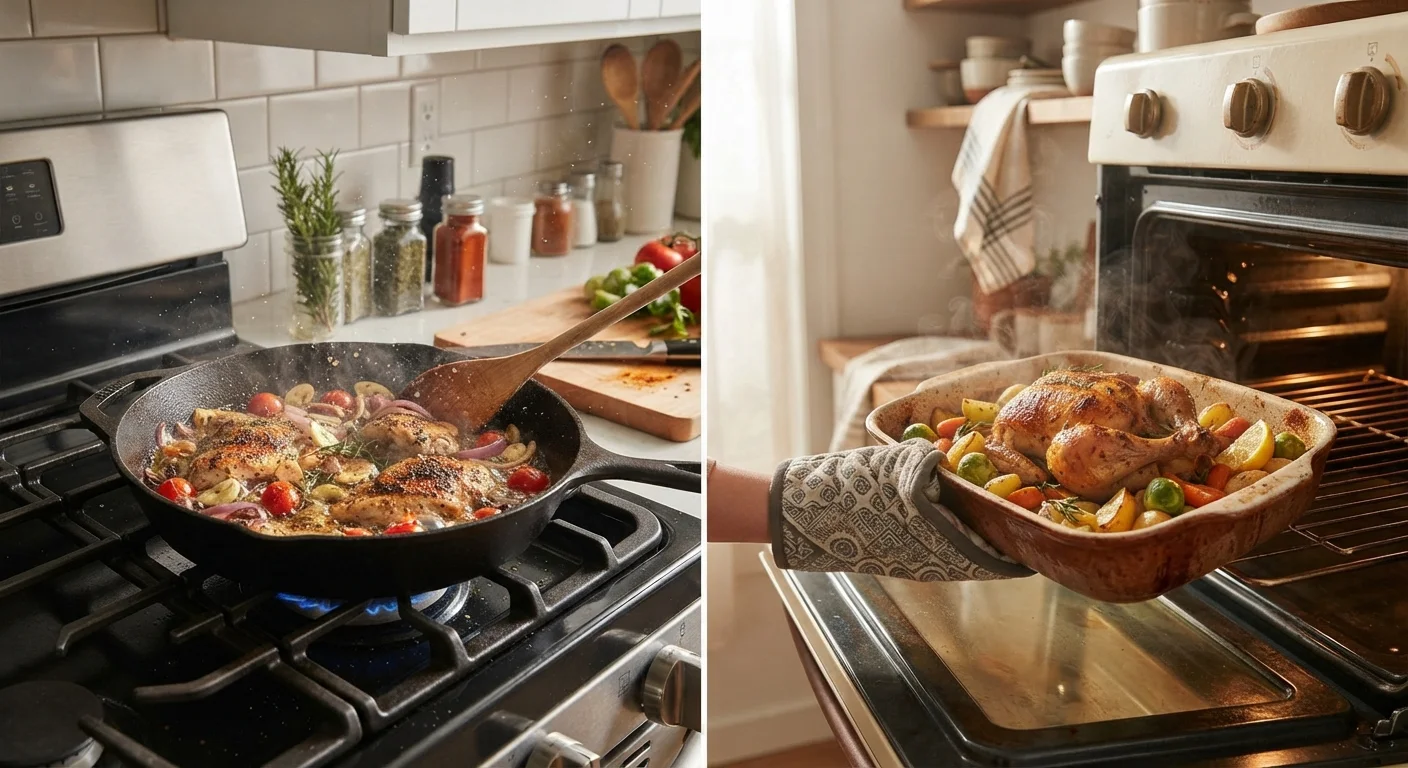
Option A
Stovetop Cooking
The fast, hands-on method for quick weeknight meals.
Best for: Best for dishes that cook quickly, need direct heat control, or require constant attention and stirring.
Option B
Oven Cooking
The patient, hands-off method for deep flavor and even heat.
Best for: Best for dishes that benefit from surrounding heat, longer cook times, or unattended roasting and braising.
How Each Method Actually Works
Understanding why a method works helps you choose it confidently, rather than guessing. Stovetop cooking applies heat directly through a burner to the bottom of your pan. That direct contact is intense and immediate — a skillet gets screaming hot in minutes, and you can dial it down just as fast. This makes the stovetop the natural home for sautéing, pan-frying, and stir-frying, all of which rely on high, responsive heat.
Oven cooking works differently. Heat radiates from burners or elements on multiple sides of the cavity, surrounding food rather than attacking it from below. That even, ambient heat penetrates thick cuts uniformly and creates the dry-air environment responsible for browning, crisping, and caramelizing surfaces over time. For a deeper look at how dry oven heat is applied differently across dishes, see roasting vs. baking.
Neither method is universally superior — they solve different cooking problems.
| Criterion | Stovetop | Oven |
|---|---|---|
| Heat source | Direct, from below | Surrounding, ambient |
| Speed | Fast (minutes) | Slower (30 min to hours) |
| Hands-on attention | High — constant monitoring | Low — largely hands-off |
| Best proteins | Thin cuts, fish, shrimp, eggs | Thick roasts, whole poultry |
| Browning ability | Excellent (direct sear) | Good (slow surface caramelization) |
| Even cooking | Moderate — hot spots possible | Excellent — heat from all sides |
| Energy use | Lower for short cook times | Higher due to preheat and cavity size |
When the Stovetop Is the Right Tool
The stovetop wins whenever speed and control matter most. Thin proteins — fish fillets, chicken cutlets, shrimp — cook through before you can set a timer. Eggs, stir-fried vegetables, and pan sauces all demand the kind of moment-to-moment adjustment only a burner provides. If something is going wrong, you can lift the pan off the heat instantly.
Stovetop cooking is also the right choice when you want to build flavor through searing. A hard sear on a steak or pork chop creates a browned crust through the Maillard reaction (the same chemical process that makes toast golden) that an oven alone cannot replicate quickly. Getting that sear right depends heavily on knowing your heat level — understanding low, medium, and high on the stovetop is a skill worth developing early.
Grains and pasta cook on the stovetop because they need boiling water — something the oven can't provide. For specifics on getting grains right, stovetop rice technique is a good place to start.
When the Oven Does a Better Job
Shift to the oven when time, size, or patience is your ally. Thick roasts, whole poultry, and dense root vegetables all benefit from the steady ambient heat an oven provides. Attempting to cook a bone-in chicken breast through on the stovetop risks a burned exterior and raw center — the oven solves that problem by applying gentle heat from all sides simultaneously.
Braising — cooking in a small amount of liquid in a covered pot — is one of the oven's greatest strengths. While a pot can braise on the stovetop, the oven's surrounding heat means you don't have to manage hot spots or worry about scorching the bottom. Tough, inexpensive cuts like chuck roast and chicken thighs become fork-tender after a few hours at a moderate temperature. This is the same principle behind slow cooker cooking, though the oven offers higher possible temperatures and the ability to develop a browned crust first. See slow cooker cooking from start to finish for a comparison of these low-and-slow approaches.
Oven Temperature Matters More Than You Think
Most everyday roasting happens between 375°F and 425°F. Lower temperatures (300–325°F) are used for braises and slow roasts where you want the interior to cook through gently before the exterior browns too fast. Higher temperatures (425–450°F) are ideal for vegetables and thin cuts where you want quick surface browning. Getting into the habit of matching temperature to the dish — not just following a recipe blindly — makes oven cooking much more intuitive.
Casseroles, baked pasta dishes, and gratins are oven-only by nature — they need even heat distribution to set and brown across the entire surface, which a stovetop burner simply cannot deliver.
The Case for Using Both Together
Many of the most satisfying everyday meals use the stovetop and oven as a team. The classic approach: sear on the stovetop first, then finish in the oven. A pork tenderloin seared in a hot oven-safe skillet for two minutes per side, then transferred to a 400°F oven, gets the flavor of direct browning plus the even internal cooking that only ambient heat can provide.
This combined approach is central to what culinary professionals call the "reverse sear" (finish in oven first, sear on stovetop second) as well as traditional braises. Understanding which stage each method handles — and why — gives you genuine flexibility in the kitchen. For a broader foundation in technique, the cooking basics hub covers the skills that make these decisions intuitive over time.
The simplest rule: if something is thin and fast, start and stay on the stovetop. If it's thick, large, or benefits from unattended time, the oven is your ally. When you want the best of both, use them in sequence.
165°F
Safe internal temp for poultry
The USDA recommends an internal temperature of 165°F for all poultry, regardless of cooking method — always verify with a meat thermometer.
~20 min
Average oven preheat time
Most conventional home ovens take 15–20 minutes to fully reach a set temperature, which affects total cook time planning for oven-based meals.
The content on this site is for informational purposes only and is not a substitute for professional advice. Always consult a qualified professional for guidance specific to your situation.