

Our Verdict
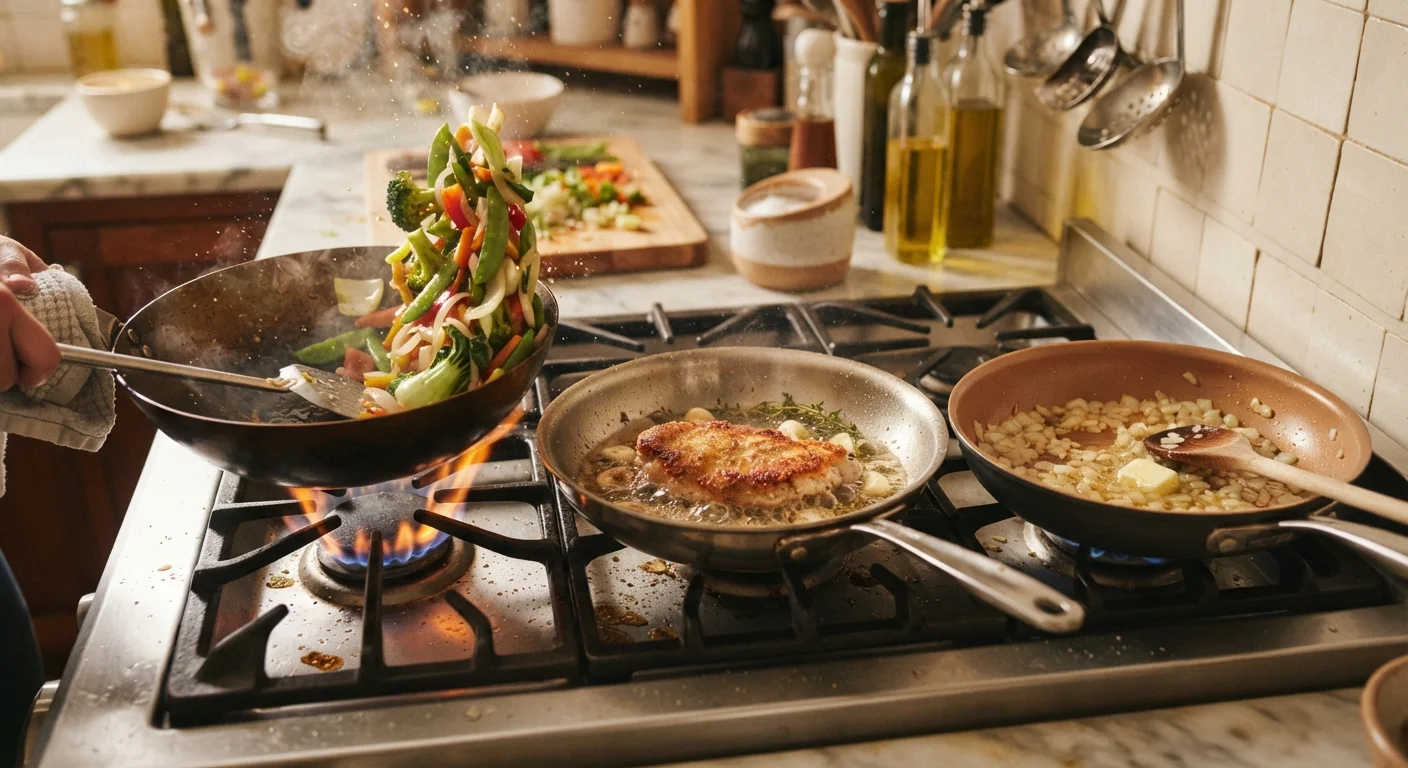
Sauté, pan-fry, and stir-fry are distinct techniques shaped by three variables: heat level, fat quantity, and how much you move the food. Sautéing suits tender vegetables and thin cuts; pan-frying works best for thicker proteins needing a crisp crust; stir-frying excels at fast, high-heat cooking of small, uniform pieces. Match the method to the ingredient and the result you want.
| Best for | Recommended |
|---|---|
| Quick weeknight vegetables or thin cuts of meat | Sauté |
| Achieving a golden, crispy crust on thicker proteins | Pan-Fry |
| Fast, high-heat meals with small, uniform pieces | Stir-Fry |
Why These Three Methods Get Confused
All three techniques happen on the stovetop in a skillet or wok, use oil, and involve some degree of direct dry heat — so it's easy to see why home cooks blur them together. But sautéing, pan-frying, and stir-frying produce noticeably different textures and flavors, and the reasons come down to three variables: heat level, amount of fat, and how often you move the food.
Understanding these differences gives you real control in the kitchen. Instead of guessing why a chicken breast turned out pale instead of golden, or why vegetables went limp in a pan, you can diagnose and fix the problem. For a broader look at how heat behaves on your stove, see our guide to stovetop heat levels.
| Sauté | Pan-Fry | Stir-Fry | |
|---|---|---|---|
| Heat Level | Medium-high | Medium to medium-high | Very high |
| Fat Used | Thin film | Shallow pool (partial submersion) | Small amount, high smoke point |
| Food Movement | Frequent tossing or stirring | Minimal — let crust form | Constant stirring or tossing |
| Best For | Thin cuts, diced vegetables | Thick proteins needing a crust | Small, uniform pieces |
| Typical Cook Time | 3–8 minutes | 8–20 minutes | 2–5 minutes |
| Ideal Pan | Skillet or sauté pan | Cast iron or stainless skillet | Wok or wide skillet |
| Texture Goal | Tender, lightly golden | Crispy exterior, moist interior | Slightly charred, firm-tender |
Sautéing: Quick Heat, Minimal Fat, Gentle Movement
The word sauté comes from the French verb meaning "to jump" — a clue that motion is part of the method. Sautéing uses medium-high heat, a thin film of oil or butter, and frequent stirring or tossing to cook food quickly without much browning.
It's best suited for foods that are already small or thin: sliced mushrooms, diced onions, minced garlic, shrimp, or chicken cutlets pounded flat. The pan should be hot before the food goes in, but not scorching. You're aiming for even cooking with a light golden color — not a deep sear.
The most common mistake is overcrowding the pan. Too much food lowers the pan temperature and traps steam, turning a sauté into a braise. Work in batches if needed, and keep things moving to prevent burning.
Dry Food Browns Better
Moisture is the enemy of browning in all three techniques. Pat proteins dry with paper towels before they hit the pan, and avoid washing vegetables right before cooking without time to dry them. Surface moisture creates steam, which lowers pan temperature and prevents the Maillard reaction — the browning process responsible for deep flavor.
Pan-Frying: More Fat, Less Movement, Better Crust
Pan-frying uses significantly more fat than sautéing — enough to come partway up the side of the food, but not enough to submerge it (that would be deep-frying). The heat is typically medium to medium-high, and crucially, you don't move the food much. You let it sit and develop a crust.
This technique is ideal for thicker cuts: bone-in chicken pieces, pork chops, fish fillets, or breaded cutlets like schnitzel. The fat conducts heat evenly around the lower portion of the food while the direct contact with the pan creates that golden, crispy exterior. Flipping once — maybe twice — is usually enough.
Pan temperature matters enormously here. Too low and the food absorbs oil and turns greasy; too high and the crust burns before the interior is done. Cast iron and stainless steel skillets hold heat well and are reliable choices for this method. This approach is quite different from hands-off sheet pan cooking, which uses dry oven heat instead.
Stir-Frying: Highest Heat, Least Fat, Constant Motion
Stir-frying is the most demanding of the three — not because it's complicated, but because it moves fast. It uses very high heat, a small amount of oil with a high smoke point (like vegetable or peanut oil), and nearly constant stirring or tossing. Ingredients are cut into small, uniform pieces so they cook in seconds, not minutes.
A wok is the traditional vessel and works best because its curved shape allows ingredients to be tossed from the hot center to the cooler edges. A large, wide skillet can substitute, but results may vary. The goal is a dry, slightly charred exterior on each piece — a quality sometimes called wok hei (breath of the wok) — which comes only from genuinely high heat.
Prep everything before turning on the heat. Once a stir-fry starts, there's no time to chop garlic or measure sauce. Add ingredients in order of how long they take to cook — denser vegetables first, leafy greens or proteins last. For more on how stovetop methods compare to oven-based approaches, see stovetop vs. oven cooking.
Choosing the Right Method for Your Meal
The simplest way to decide: think about the food's size and thickness, and the texture you want.
- Thin, small, or tender ingredients → Sauté. Fast, light, versatile.
- Thick cuts needing a golden crust → Pan-fry. Patient, fat-assisted browning.
- Small uniform pieces, fast results, high heat → Stir-fry. Requires prep and a genuinely hot pan.
None of these methods is inherently harder than the others — they just reward different habits. Sautéing rewards attentiveness; pan-frying rewards patience; stir-frying rewards preparation. Once you internalize those cues, you'll find yourself switching between them intuitively based on what's in the fridge. And if you want to see how these methods fit into complete meals, our everyday recipes section puts them in practical context.
The content on this site is for informational purposes only and is not a substitute for professional advice. Always consult a qualified professional for guidance specific to your situation.