

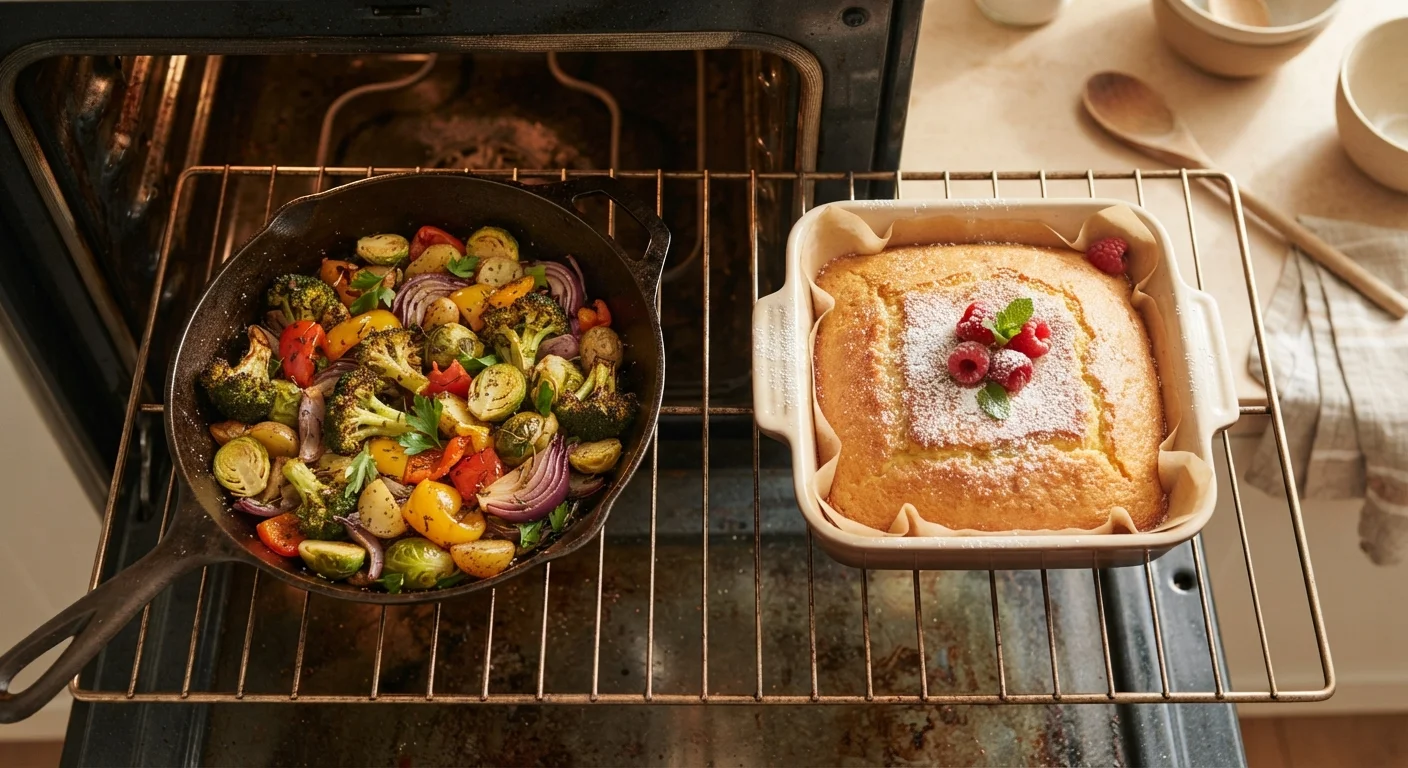
Option A
Roasting
High heat for browning, caramelization, and texture.
Best for: Best for proteins, dense vegetables, and any food where a browned, slightly crisp exterior is the goal.
Option B
Baking
Precise, gentler heat for structure and rise.
Best for: Best for doughs, batters, and delicate foods that need to set from liquid or soft into a firm, structured form.
Same Oven, Different Logic
Open almost any cookbook and you'll see recipes that instruct you to "roast" chicken thighs at 425°F and "bake" a casserole at 350°F. Both use a dry oven environment with no added liquid cooking medium, so what's actually different? The answer involves temperature, food type, and the result you're aiming for — not just the number on the dial.
Roasting is oriented around a surface effect: the high heat drives off surface moisture fast, enabling the Maillard reaction (the browning of proteins) and caramelization (the browning of sugars). These reactions build the crust on a roast chicken, the char on broccoli florets, and the sweetness concentrated in roasted carrots. The food starts out firm and structurally complete — a vegetable, a piece of meat — and the oven's job is to transform its exterior while cooking it through.
Baking takes a different approach. The food typically starts as something soft, liquid, or doughy — a bread batter, a cookie dough, a quiche filling — and the oven's steady, moderate heat triggers a cascade of chemical reactions. Gluten develops and sets. Starches gelatinize. Leavening gases expand and get trapped in a firming structure. The result is food that has fundamentally changed its form: from liquid batter to spongy cake, from shaggy dough to chewy bread.
For a broader look at how oven and stovetop methods compare day-to-day, see our guide to stovetop vs. oven cooking.
| Criterion | Roasting | Baking |
|---|---|---|
| Typical temperature range | 400–450°F | 325–375°F |
| Primary goal | Browning and caramelization | Structure and rise |
| Food starting state | Solid (meat, vegetables) | Liquid or doughy (batters, doughs) |
| Key reactions | Maillard reaction, caramelization | Starch gelatinization, gluten setting, leavening |
| Pan choice | Heavy rimmed pan or roasting pan | Light-colored baking pans, glass, or ceramic |
| Role of added fat | Essential for surface browning | Incorporated into recipe; not always a surface coat |
| Result texture | Browned exterior, concentrated flavor | Set interior, even crumb or custard |
Where the Overlap Creates Confusion
The blurriest territory is vegetables and some proteins. A sweet potato can be baked whole at 375°F — skin on, no added fat, heat penetrating slowly until the interior softens — or it can be roasted at 425°F after being cubed and tossed in oil, producing caramelized edges and a denser, more intensely flavored result. Both use the oven. The method you choose depends entirely on the texture and flavor profile you want.
Fish sits in similar ambiguity. A salmon fillet baked at 300°F in a covered dish stays moist and silky; the same fillet roasted at 450°F for a shorter time develops a crispier exterior. Culinary convention tends to call gentler, moisture-preserving oven cooking "baking" even for proteins, while high-heat, open-pan cooking is "roasting."
~300°F
Minimum temperature for Maillard browning to occur
Food science educators generally cite around 280–330°F as the threshold at which surface browning reactions begin in earnest, which is why roasting temperatures stay well above that range.
25°F
Typical home oven temperature variance
Consumer Reports and culinary educators commonly note that home ovens can run 25°F or more above or below their set temperature, making an oven thermometer particularly valuable for baking.
Some professional kitchens draw the line purely by temperature — anything above roughly 400°F is considered roasting — but home cooking usage is less rigid. What matters more in practice is understanding the goal: are you trying to brown and concentrate, or set and structure? Once you anchor to that question, the right method becomes clearer. You can also explore related dry-heat distinctions — like when to sauté versus pan-fry — in our breakdown of stovetop high-heat methods.
Practical Implications for Home Cooks
Once you understand the distinction, a few practical habits follow naturally. For roasting, use a heavy, rimmed sheet pan or roasting pan that conducts heat efficiently, avoid crowding (crowded pans steam instead of roast), and don't skip the fat — oil helps conduct heat to the food's surface and promotes browning. Higher oven temperatures, typically 400–450°F, are standard.
For baking, oven calibration matters more. Batters and doughs react to precise temperatures; an oven running 25°F hot can mean dense muffins or under-set custard. An inexpensive oven thermometer is a useful check. Pan material also affects outcome — dark pans absorb more heat and can over-brown bottoms, while lighter pans reflect heat more evenly.
Both methods benefit from understanding how your specific oven behaves. If you're batch-cooking proteins and vegetables for the week, knowing when to roast versus bake can help you plan efficiently — a topic worth exploring in our realistic look at weekend batch cooking. And if you want to deepen your vocabulary around oven and cooking terms more broadly, a complete glossary of common cooking terms is a helpful reference to bookmark.
The bottom line: both roasting and baking are dry-heat oven methods, but they are aimed at different transformations. Roasting is about the surface. Baking is about the structure. Keep that distinction in mind and you'll choose the right method — and understand why a recipe works — with much more confidence.
When Recipes Use the Terms Loosely
Not every cookbook or recipe writer draws a strict line between roasting and baking — you'll see "baked chicken" and "roasted chicken" used almost interchangeably in some sources. In those cases, look at the temperature and the pan setup rather than the label. A high temperature, uncovered pan, and oil-coated food signals roasting logic regardless of what the recipe calls it.
The content on this site is for informational purposes only and is not a substitute for professional advice. Always consult a qualified professional for guidance specific to your situation.