

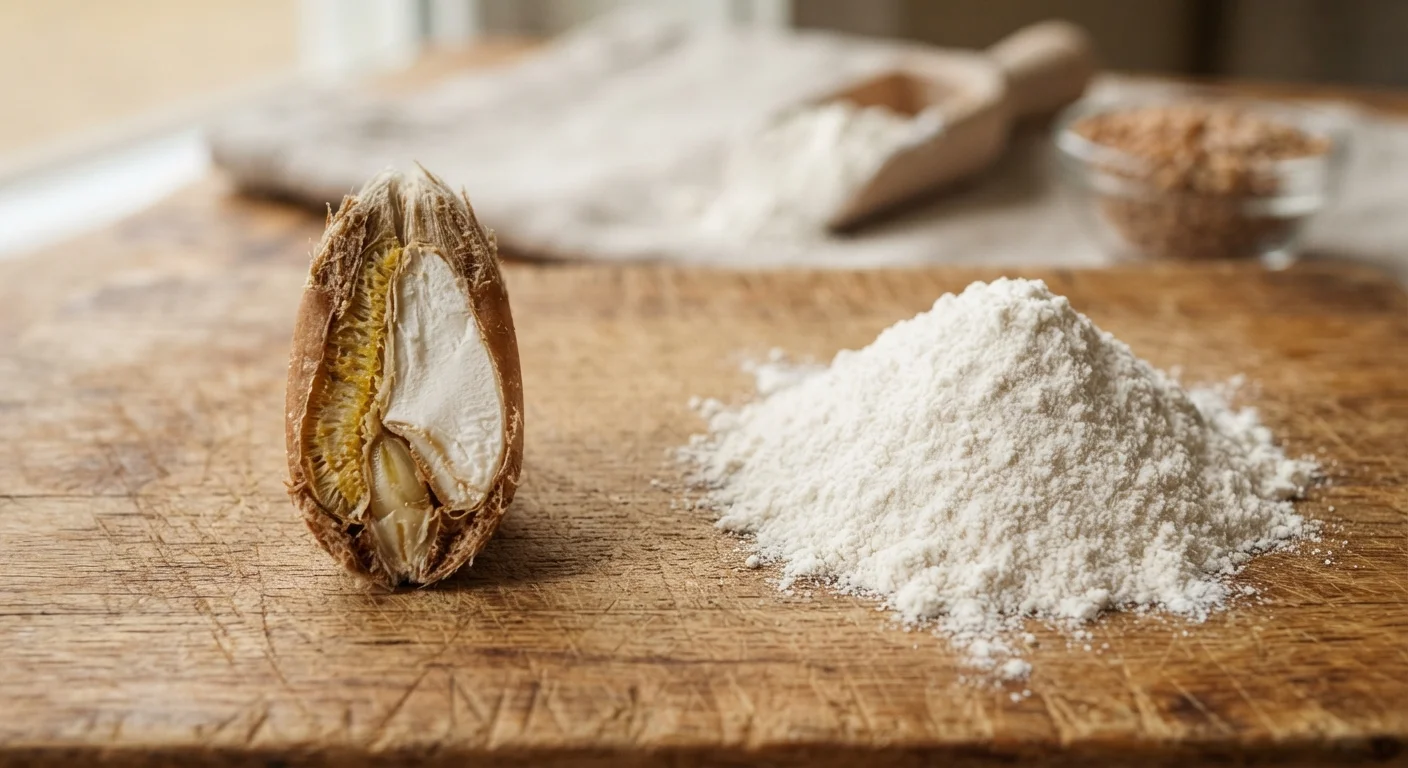
Option A
Whole Grains
The complete, minimally processed kernel.
Best for: Anyone looking to maximize fiber intake and retain naturally occurring vitamins and minerals from grain-based foods.
Option B
Refined Grains
The stripped-down, shelf-stable staple.
Best for: Situations where a softer texture, longer shelf life, or lighter flavor profile is the culinary priority.
What Makes a Grain 'Whole' in the First Place
A grain kernel is made up of three distinct layers, each with a specific nutritional role. The bran is the tough outer layer packed with fiber, B vitamins, and minerals like iron and zinc. The germ is the embryo of the plant, rich in healthy fats, vitamin E, and additional B vitamins. The endosperm, the starchy middle section, makes up the bulk of the kernel and supplies carbohydrates and some protein.
A grain qualifies as whole when all three parts are present in their original proportions — whether the kernel is intact, cracked, flaked, or ground into flour. Common whole grains include whole wheat, oats, brown rice, bulgur, farro, and popcorn.
Understanding this structure matters because it tells you exactly what you're getting — or what's been taken away — before a grain ever reaches your plate.
What the Refining Process Actually Removes
Milling refines a grain by mechanically removing the bran and germ, leaving only the starchy endosperm. The result is a smoother, finer product — white flour, white rice, or degerminated cornmeal — that cooks more quickly and has a milder flavor. But the nutritional trade-off is significant.
| Criterion | Whole Grains | Refined Grains |
|---|---|---|
| Kernel parts present | Bran, germ, and endosperm | Endosperm only |
| Dietary fiber | High (bran intact) | Very low (bran removed) |
| B vitamins | Naturally occurring | Mostly removed; some added back via enrichment |
| Minerals (magnesium, zinc) | Well retained | Significantly reduced |
| Shelf life | Shorter (oils in germ go rancid) | Longer (germ removed) |
| Texture in cooking | Denser, chewier | Lighter, finer |
| Satiety effect | Higher (slower digestion) | Lower (faster digestion) |
According to the USDA, the refining process can eliminate roughly 25% of a grain's protein and strip away the majority of at least 17 key nutrients, including dietary fiber, folate, magnesium, and vitamin E. Fiber, in particular, is almost entirely removed, since it lives in the bran.
To partially address this, the U.S. government has required since 1941 that certain refined grain products be enriched — meaning thiamin, riboflavin, niacin, folic acid, and iron are added back in. However, enrichment does not restore fiber or the full spectrum of minerals and phytochemicals found in the original grain. It's a partial correction, not a full restoration.
~25%
Protein lost during refining
The USDA notes that milling whole wheat into white flour can reduce protein content by roughly a quarter.
17+
Nutrients reduced by refining
According to USDA data, at least 17 nutrients are substantially reduced when whole grains are milled into refined flour.
½
Recommended grain intake that should be whole
The Dietary Guidelines for Americans recommend that at least half of all grains consumed come from whole grain sources.
How to Spot Whole Grains on a Label
Packaging can be misleading. A loaf of bread labeled "multigrain," "stone-ground," or "wheat bread" may still be made primarily from refined flour. The most reliable indicator is the ingredient list: look for a whole grain listed as the first ingredient, such as "whole wheat flour," "whole oat flour," or "whole grain corn."
Color is not a reliable guide — brown bread can get its color from molasses or caramel coloring rather than whole grain flour. Similarly, just because a product contains some whole grain doesn't mean it's predominantly whole grain.
The same principle applies when thinking about how to read ingredient lists for sugars — what's listed first carries the most weight, and marketing terms on the front of the package don't tell the full story.
What 'Enriched' Actually Means
When you see 'enriched flour' on an ingredient label, it means the refining process has removed natural nutrients and a limited set has been added back — specifically thiamin, riboflavin, niacin, folic acid, and iron. This is a legal standard in the U.S., not a marketing claim. Enrichment improves the nutritional profile of refined flour but does not make it equivalent to whole grain flour, particularly when it comes to fiber and the full range of minerals.
Making Practical Swaps Without Overhauling Your Kitchen
You don't have to eliminate refined grains to eat well — dietary guidelines generally suggest making at least half your grains whole, not replacing all of them. That's a realistic target for most households.
Some straightforward starting points: swap white rice for brown rice or farro in grain bowls, choose oatmeal over sweetened refined-flour cereals for breakfast, and look for pasta labeled "whole wheat" or "whole grain" as your default. When baking at home, replacing half the all-purpose flour in a recipe with whole wheat flour is often undetectable in flavor while meaningfully increasing fiber.
The key is consistency over perfection. A diet that regularly includes whole grains alongside a variety of vegetables, legumes, and lean proteins will naturally deliver the fiber and micronutrients that refining removes — without requiring you to count every gram or audit every meal.
The content on this site is for informational purposes only and is not a substitute for professional advice. Always consult a qualified professional for guidance specific to your situation.