

Option A
Natural Sugar
The sugar that comes packaged with nutrients.
Best for: Understanding sugars inherently present in whole foods like fruit, vegetables, and dairy — where fiber, vitamins, and minerals accompany the sweetness.
Option B
Added Sugar
The sweetener introduced during processing or preparation.
Best for: Identifying sweeteners manufacturers incorporate into food and beverages during production — the type the updated Nutrition Facts label now separately reports.
What Makes a Sugar 'Natural' or 'Added'?
The words natural and added describe where a sugar comes from — not what it chemically is. Glucose, fructose, and sucrose behave similarly at the molecular level, yet the food matrix they arrive in makes a meaningful nutritional difference.
Natural sugars are inherent to a whole food. The lactose in a cup of milk and the fructose in a fresh apple are both natural sugars. They come alongside fiber (in fruit), protein (in dairy), and a range of vitamins and minerals that affect how your body absorbs and uses the sweetness.
Added sugars are any sugars or caloric sweeteners — including honey, maple syrup, high-fructose corn syrup, and plain white table sugar — incorporated into a food or beverage during manufacturing or home preparation. When a manufacturer stirs corn syrup into a flavored yogurt, that is added sugar. When you spoon sugar into your coffee, so is that. The resulting food delivers sweetness without the accompanying nutritional package found in whole foods.
This distinction is why two foods can show identical numbers on the Total Sugars line yet differ dramatically in nutritional quality. Plain whole-milk yogurt and a heavily sweetened low-fat yogurt might read similarly on a quick scan, but their Added Sugars lines will tell very different stories. For a broader look at how food processing changes nutritional profiles, see our piece on why ultra-processed food is its own category in nutrition research.
How the Nutrition Facts Label Separates the Two
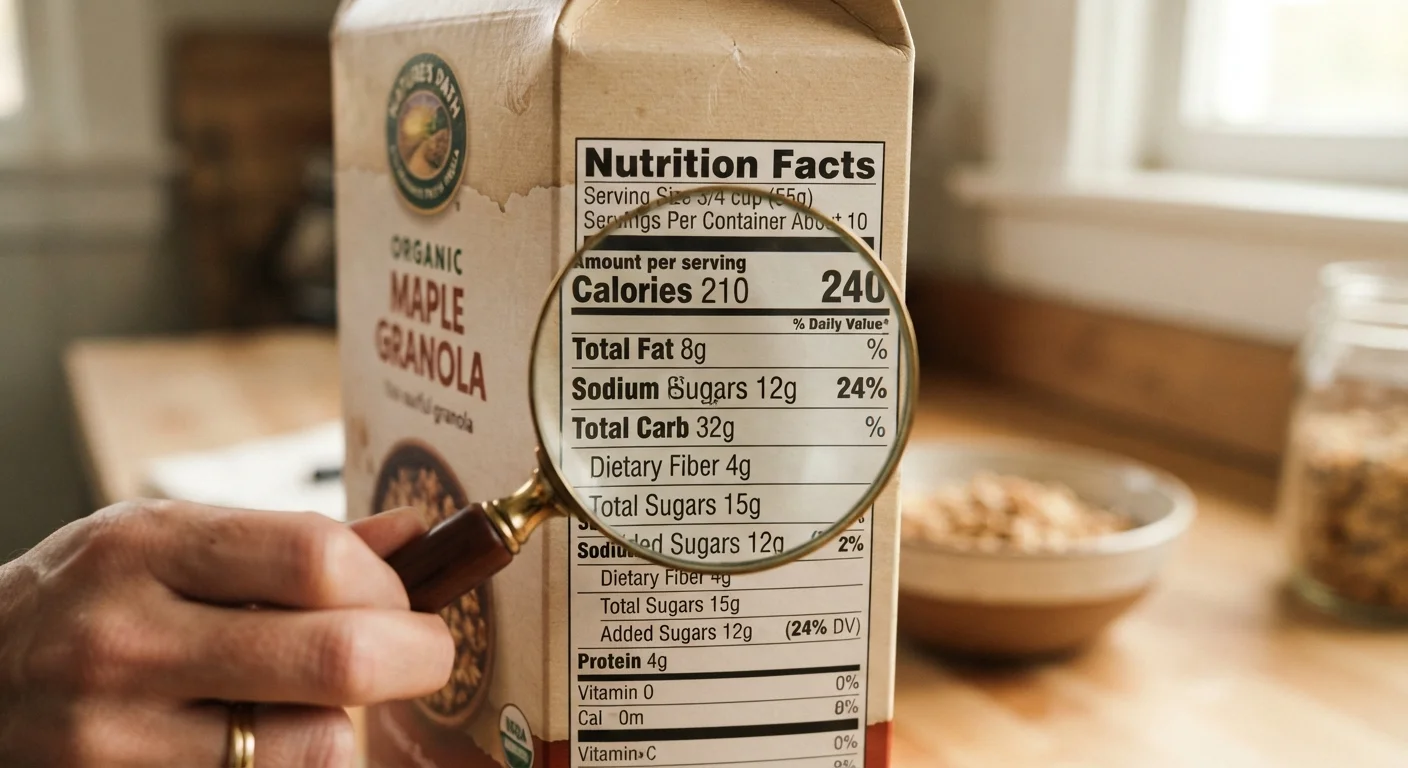
Before 2016, U.S. Nutrition Facts labels listed only Total Sugars — leaving consumers unable to distinguish naturally occurring from added sweetness. The FDA's updated label format, phased in through 2021, requires manufacturers to list Added Sugars as a sub-line below Total Sugars, complete with a percent Daily Value (%DV).
| Criterion | Natural Sugar | Added Sugar |
|---|---|---|
| Origin | Inherent to the whole food | Added during processing or prep |
| Examples | Lactose in milk, fructose in fruit | Corn syrup, honey, table sugar, agave |
| Appears on label as | Part of Total Sugars only | Total Sugars AND Added Sugars sub-line |
| Comes with nutrients? | Yes — fiber, vitamins, minerals | Generally no additional nutrients |
| Dietary limit set? | No specific guideline limit | Less than 10% of daily calories (USDA) |
| % Daily Value shown? | No | Yes — based on 50g/day reference |
The %DV for added sugars is based on a reference of 50 grams per day for a 2,000-calorie diet — equivalent to the 10% limit recommended by the Dietary Guidelines for Americans. This single number lets you judge a food's added-sugar contribution quickly: a %DV of 5% or less is generally considered low; 20% or more is high.
One practical caveat: the label doesn't name which sweetener was added. For that, you need the ingredient list. Added sugars hide under more than 60 names — look for words ending in -ose (maltose, dextrose), syrups (brown rice syrup, agave syrup), and concentrated fruit juices used as sweeteners. Our related article on understanding added sugar and where it hides walks through this ingredient-list detective work in detail.
For a full tour of every section on the label, see reading a Nutrition Facts label without getting lost in the fine print.
Why the Distinction Matters for Health
Current dietary research consistently focuses its concern on added sugars rather than the sugar present in whole fruits, vegetables, or plain dairy. The practical reasons relate to nutrient density and eating patterns, not a difference in the sugar molecule itself.
10%
Daily calorie limit for added sugars
The Dietary Guidelines for Americans recommend keeping added sugars below 10% of total daily calories for adults and children over age 2.
17 tsp
Average daily added sugar intake (U.S. adults)
CDC data indicates U.S. adults consume roughly 17 teaspoons of added sugar per day on average, well above the recommended ceiling.
60+
Names for added sugar on ingredient lists
The American Heart Association notes that added sugars appear under more than 60 different names in ingredient lists, making label literacy essential.
When you eat a whole orange, roughly 12 grams of natural sugar arrive with fiber that slows digestion, vitamins C and B1, potassium, and antioxidants. The sugar load is moderate, and the fiber-slowed absorption prevents a sharp blood glucose spike. When the same amount of sugar appears in a sweetened beverage, it's stripped of that matrix — digested quickly and providing no accompanying micronutrients.
Research associations between high added-sugar consumption and metabolic health concerns relate largely to this pattern: added sugars tend to appear in foods that deliver calories with limited nutritional return. Whole foods that naturally contain sugar don't share that profile.
It's worth noting that fruit juice, even unsweetened, occupies a middle ground. The FDA counts 100% fruit juice — when used in excess of what would be expected in a product — as an added sugar source in some contexts, because concentration and processing can remove much of the fiber benefit. This is an area where food label language can be genuinely misleading without careful reading.
This article is for general informational purposes only and is not a substitute for advice from a qualified healthcare or registered dietitian professional.
The content on this site is for informational purposes only and is not a substitute for professional advice. Always consult a qualified professional for guidance specific to your situation.