

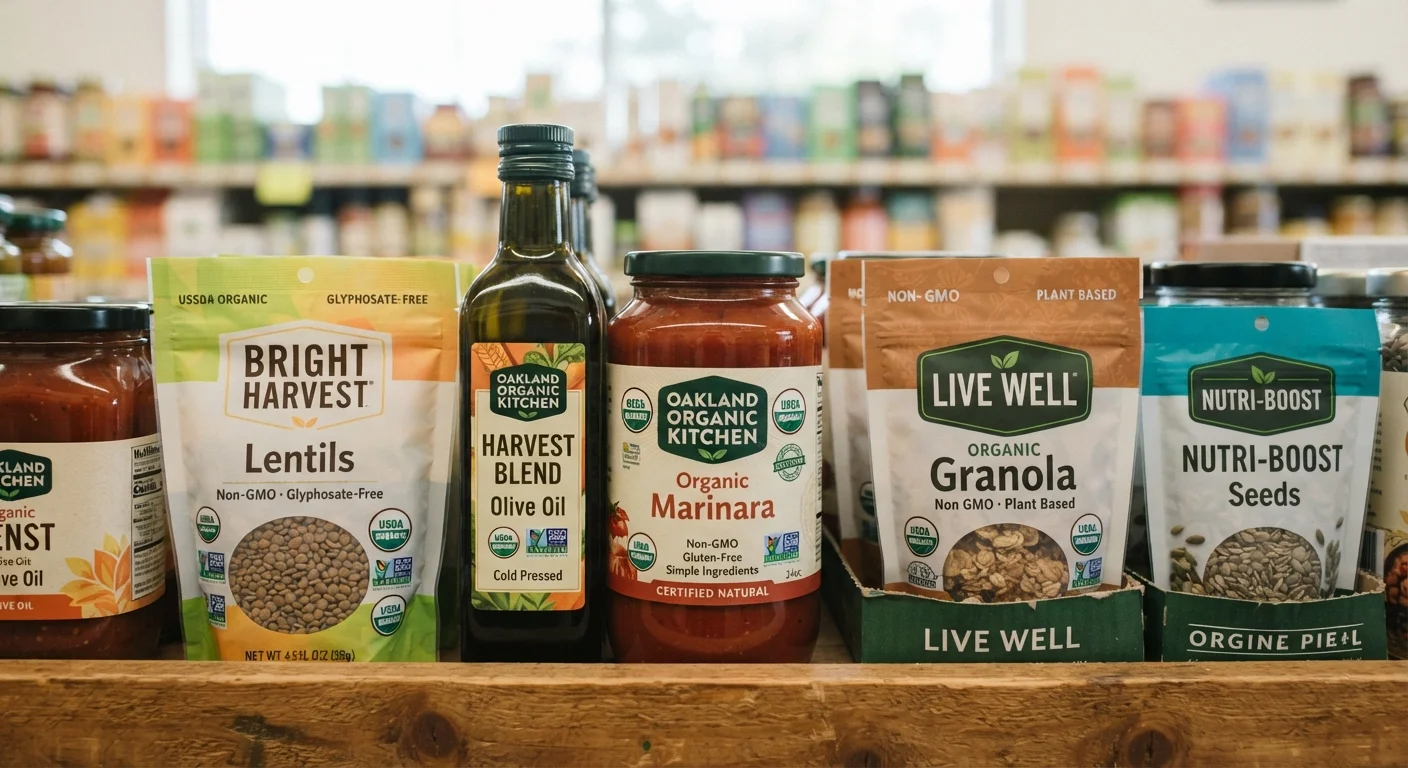
Three Labels, Three Very Different Standards
Walk the aisles of any grocery store and you'll spot the same trio of claims repeated across hundreds of packages: Organic, Natural, and Non-GMO. They're often grouped visually — green fonts, leaf icons, earthy tones — creating an impression that they mean roughly the same thing. They don't.
Each label has a distinct regulatory origin, a different scope, and a different set of guarantees (or lack thereof). Understanding how they differ helps you decide how much weight to give each one at the shelf.
| "Organic" Regulated By | USDA (National Organic Program) (USDA Agricultural Marketing Service) |
| "Natural" Regulated By | No formal federal definition — FDA guidance only (FDA, informal policy) |
| "Non-GMO" Regulated By | No federal mandate; voluntary third-party seals available (Non-GMO Project; USDA BE disclosure law) |
| Organic % Required for "Organic" Label | At least 95% organic content (USDA NOP regulations) |
| Does Organic Prohibit GMOs? | Yes (USDA National Organic Program standards) |
| Does Non-GMO Mean Pesticide-Free? | No (Non-GMO Project certification scope) |
"Organic" Is a Federally Regulated Certification
Of the three, USDA Organic carries the most defined federal standard. Managed by the U.S. Department of Agriculture under the National Organic Program (NOP), the certification requires that crops be grown without most synthetic pesticides, synthetic fertilizers, sewage sludge, or ionizing radiation, and that they be non-GMO. Livestock must be raised with access to pasture, without the routine use of antibiotics or synthetic growth hormones.
Products labeled 100% Organic must contain only organically produced ingredients. Products labeled simply Organic must be at least 95% organic by weight. Those labeled Made with Organic need at least 70% organic content. These percentages refer to ingredients by weight, excluding water and salt.
Third-party certifying agents — accredited by the USDA — inspect farms and handlers before granting certification. That audit trail is what separates Organic from a marketing claim. See our guide to reading ingredient lists if you want to understand how organic ingredients appear within a product's full formula.
USDA Organic
A federally regulated certification administered by the U.S. Department of Agriculture. It requires crops to be grown without most synthetic pesticides or fertilizers and prohibits the use of GMOs, sewage sludge, and ionizing radiation.
National Organic Program (NOP)
The USDA regulatory framework that sets and enforces standards for organic agricultural products in the United States, including rules for labeling, certification, and allowed substances.
GMO (Genetically Modified Organism)
An organism whose DNA has been altered using genetic engineering techniques. In food labeling, the term typically refers to crop varieties developed through biotechnology rather than conventional breeding.
Third-Party Certification
Verification by an independent organization that a product or process meets a defined standard. It differs from a self-declared claim, which is made by the manufacturer without external audit.
Synthetic Pesticide
A manufactured chemical used to control insects, weeds, or fungal growth on crops. Distinct from naturally derived pest-control substances, some of which are permitted under organic standards.
"Natural" Has Almost No Regulatory Teeth
This is where many shoppers are surprised. The FDA has not established a formal regulatory definition for the term natural on food labels. The agency has historically exercised enforcement discretion, generally allowing the term when a food contains no added color, artificial flavors, or synthetic substances — but this is not a codified standard, and it has not been consistently enforced.
What "natural" does not mean: organic, pesticide-free, minimally processed, or non-GMO. A highly processed product can legally carry a "natural" label. There are no third-party inspections, no mandatory certifications, and no minimum criteria a manufacturer must meet before printing the word on a package.
The USDA applies a slightly stricter informal standard for meat and poultry — products must be minimally processed and contain no artificial ingredients — but this still falls well short of the Organic standard. When you see "natural" on a package, treat it as a marketing phrase rather than a regulatory promise. For a fuller picture of what labels on packaged foods do and don't communicate, see what the Nutrition Facts label is actually telling you.
"Non-GMO" Sits in the Middle Ground
Non-GMO refers to products made without genetically modified organisms — ingredients that have had their DNA altered using genetic engineering techniques. Unlike "natural," Non-GMO labels can be backed by third-party certification. The most widely recognized is the Non-GMO Project Verified seal, which requires testing and supply-chain auditing for high-risk ingredients.
However, Non-GMO certification does not address pesticide use, farming practices, animal welfare, or processing methods. A product can be Non-GMO and still be heavily processed, grown with synthetic pesticides, or contain artificial additives. The label is narrowly focused on one specific characteristic of ingredient sourcing.
It's also worth noting that the USDA's Organic standard already prohibits GMOs, so a certified Organic product is automatically non-GMO — but a Non-GMO product is not automatically organic. The two can overlap, but they address different concerns.
USDA Bioengineered Disclosure Law
Since 2022, the USDA's National Bioengineered Food Disclosure Standard (NBFDS) requires most packaged foods containing detectable bioengineered material to carry a disclosure — either text, a symbol, or a QR code. This is a mandatory disclosure requirement, not a quality or safety certification. It applies to a defined list of commodities and does not cover highly refined ingredients where bioengineered DNA is no longer detectable.
For a broader look at how processed food is categorized in nutrition science, our article on why ultra-processed food is its own category adds useful context.
How to Use These Labels Practically
None of these labels is a reliable proxy for overall nutrition quality. A certified organic cookie is still a cookie. A Non-GMO chip is still a chip. Labels describe how or what something was made from — not whether it's a sound nutritional choice.
A practical approach: use label claims as one input among several. Cross-reference with the ingredient list and the Nutrition Facts panel. Ask what the label is specifically certifying, who enforces that claim, and what it leaves unaddressed. That framing keeps the information useful without letting any single claim do more interpretive work than it legitimately can.
This article is for general informational and educational purposes. It does not constitute dietary or medical advice. Consult a registered dietitian or qualified healthcare professional for guidance specific to your health needs.
The content on this site is for informational purposes only and is not a substitute for professional advice. Always consult a qualified professional for guidance specific to your situation.