

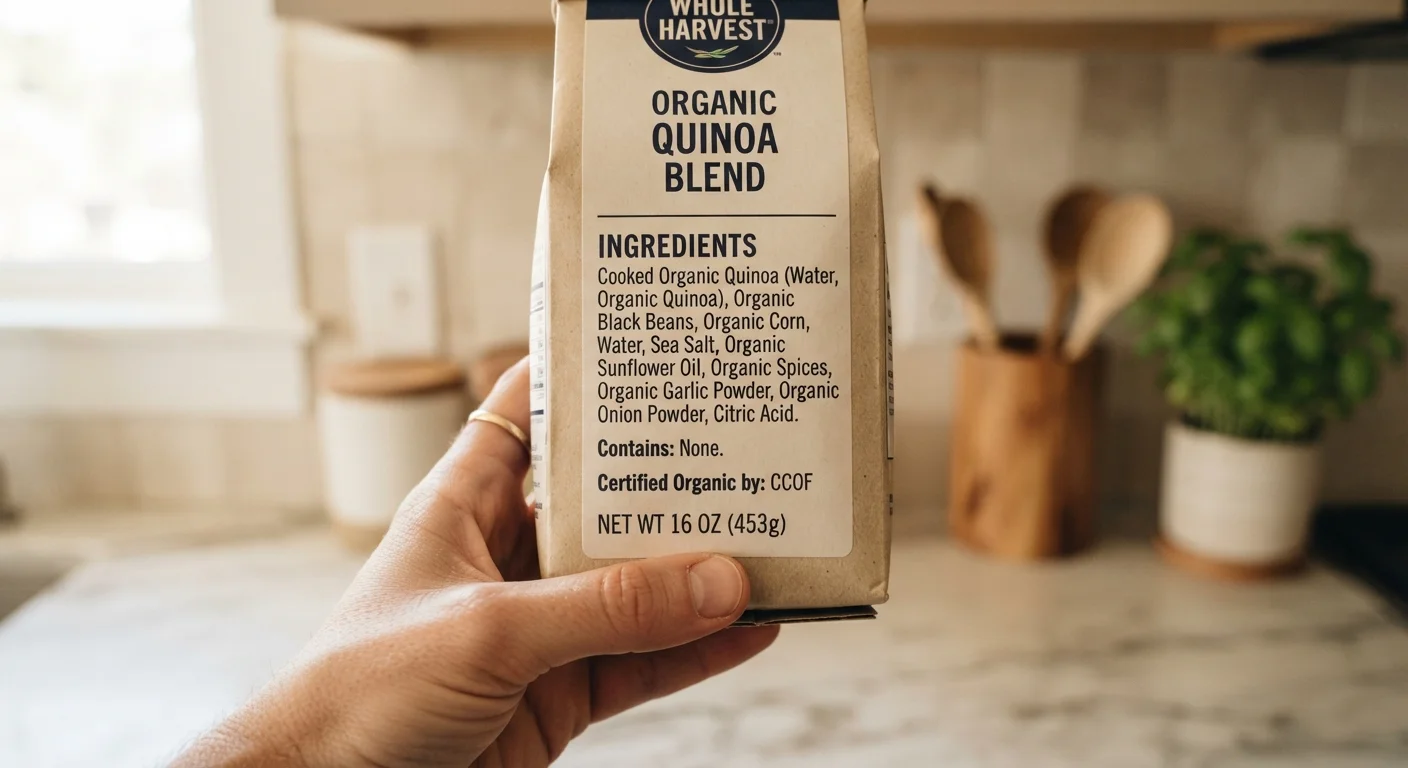
Why the Ingredient List Is Worth Your Attention
The Nutrition Facts panel gets most of the attention on a food package — but the ingredient list often tells a more complete story. It shows you the actual components of a food in plain (if sometimes technical) language, and it's governed by federal rules that give it a level of reliability front-of-package marketing claims don't have.
Reading an ingredient list fluently takes only a few minutes to learn, but it's a skill that pays off every time you shop. Understanding how the list is structured — and what certain patterns signal — allows you to evaluate packaged foods with considerably more confidence. This is especially useful when front-of-package language is vague or potentially misleading.
Front-of-Package Claims Don't Tell the Whole Story
Words like 'natural,' 'made with whole grains,' or 'low fat' on the front of a package are marketing claims, not nutritional summaries. A product can carry these phrases and still list sugar as its second ingredient. Always flip to the ingredient list to verify what's actually inside. Our article on what 'organic,' 'natural,' and 'non-GMO' actually certify covers the regulatory details.
The steps below walk you through the process systematically. If you also want to make sense of the panel above the ingredient list, our guide to reading a Nutrition Facts label covers that in the same level of detail.
What you will need
How to Read an Ingredient List
Locate the ingredient list on the package
U.S. food manufacturers are required by the FDA to include an ingredient list on virtually all packaged foods. It's typically found on the back or side panel, usually just below or adjacent to the Nutrition Facts panel. On smaller packages, it may wrap around an edge or appear in smaller print. Look for the heading "Ingredients:" — it will always be labeled.
Understand that order equals proportion
Ingredients are listed in descending order by weight — the ingredient present in the greatest amount appears first, and the ingredient present in the least amount appears last. This is federally mandated and applies to every packaged food in the U.S. So if a bread lists enriched flour first and whole wheat flour fifth, the product contains significantly more refined flour than whole wheat, regardless of what the front label implies.
Pay particular attention to the first three to five ingredients. They collectively represent the bulk of what you're eating.
Decode compound ingredients and sub-ingredient lists
When a product contains a processed component — a sauce, a seasoning blend, a filling — that component is listed as a single ingredient followed by its own sub-ingredients in parentheses. For example: Seasoning (Salt, Sugar, Garlic Powder, Paprika, Natural Flavors). This nesting can make a list look longer than it actually is in practice, but it also reveals what's inside multi-part components.
Read through parenthetical sub-lists carefully. Sugar, sodium, and certain additives often appear within these nested sections and can be easy to overlook at first glance.
Recognize the many names for added sugar
Sugar is one of the most frequently disguised ingredients in packaged foods. A single product can contain multiple forms of sugar — each listed separately — which collectively add up to a significant amount while appearing individually lower on the list. Common names include: high-fructose corn syrup, cane juice, dextrose, maltose, agave nectar, brown rice syrup, molasses, turbinado sugar, and fruit juice concentrate, among others.
If you spot several of these across the ingredient list — especially in the first half — it's worth cross-referencing the "Added Sugars" line on the Nutrition Facts panel for the actual gram total.
Check for allergen declarations
After the main ingredient list, look for a "Contains:" statement listing the major allergens present in the product. The FDA's list of major allergens — which manufacturers must disclose — includes milk, eggs, fish, shellfish, tree nuts, peanuts, wheat, soybeans, and sesame. Alternatively, allergens may be bolded or otherwise highlighted within the ingredient list itself rather than listed separately.
Also look for voluntary advisory statements such as "May contain traces of peanuts" or "Manufactured in a facility that also processes tree nuts." These are not legally required but indicate shared-equipment or shared-facility risk.
Evaluate additives and preservatives in context
Additives — including preservatives, emulsifiers, colorings, and flavor enhancers — are required to be listed by their FDA-approved names or permitted abbreviations. Terms like sodium benzoate, carrageenan, lecithin, xanthan gum, and annatto are common and may look alarming simply because they're unfamiliar. The presence of an additive doesn't automatically indicate a health concern, but understanding what category it falls into can help you make informed decisions.
For context, additives that appear near the end of the ingredient list are typically present in very small amounts by weight, as required by the ordering rule.
Compare ingredient lists across similar products
Once you're comfortable reading a single label, the most practical skill is comparison. Pick two similar products — say, two loaves of sandwich bread or two cans of tomato soup — and place the ingredient lists side by side. Notice: Which product lists whole food ingredients higher up? Where does sugar appear on each list? Which has more sub-ingredient groupings?
This comparison approach is particularly useful in the packaged goods aisles. For a broader framework on applying these skills while shopping, see our practical grocery store walkthrough.
Allergen Information Is Legally Required
The FDA requires manufacturers to clearly declare the nine major food allergens — milk, eggs, fish, shellfish, tree nuts, peanuts, wheat, soybeans, and sesame — either within the ingredient list or in a separate 'Contains' statement immediately after it. If you or someone in your household has a food allergy, always read this section carefully on every product, every time, even for familiar brands. Formulas can change without obvious packaging updates.
Use the Ingredient List Alongside the Nutrition Facts Panel
The ingredient list tells you what's in the food; the Nutrition Facts panel tells you how much of it matters nutritionally. Reading both together gives you a much clearer picture than either one alone. See our guide to reading a Nutrition Facts label for a parallel walkthrough of that panel.
Putting It All Together
Ingredient lists reward a little patience. Once you understand that order means proportion, that sugar travels under many aliases, and that parenthetical groupings reveal what's inside compound components, the list becomes far less intimidating — and far more informative.
No single ingredient or additive should be read as a pass-or-fail verdict on a food. The goal is a clearer overall picture. A product with a short ingredient list of recognizable whole foods and one with a longer list containing a seasoning blend with sub-ingredients are not automatically equivalent — or automatically different in quality. Context matters.
If you're working on making more nutrition-aware choices more broadly, our aisle-by-aisle grocery store walkthrough applies these label-reading skills to an actual shopping trip. And if you're building toward more balanced eating overall, building a balanced plate is a practical next step.
The content on this site is for informational purposes only and is not a substitute for professional advice. Always consult a qualified professional for guidance specific to your situation.