

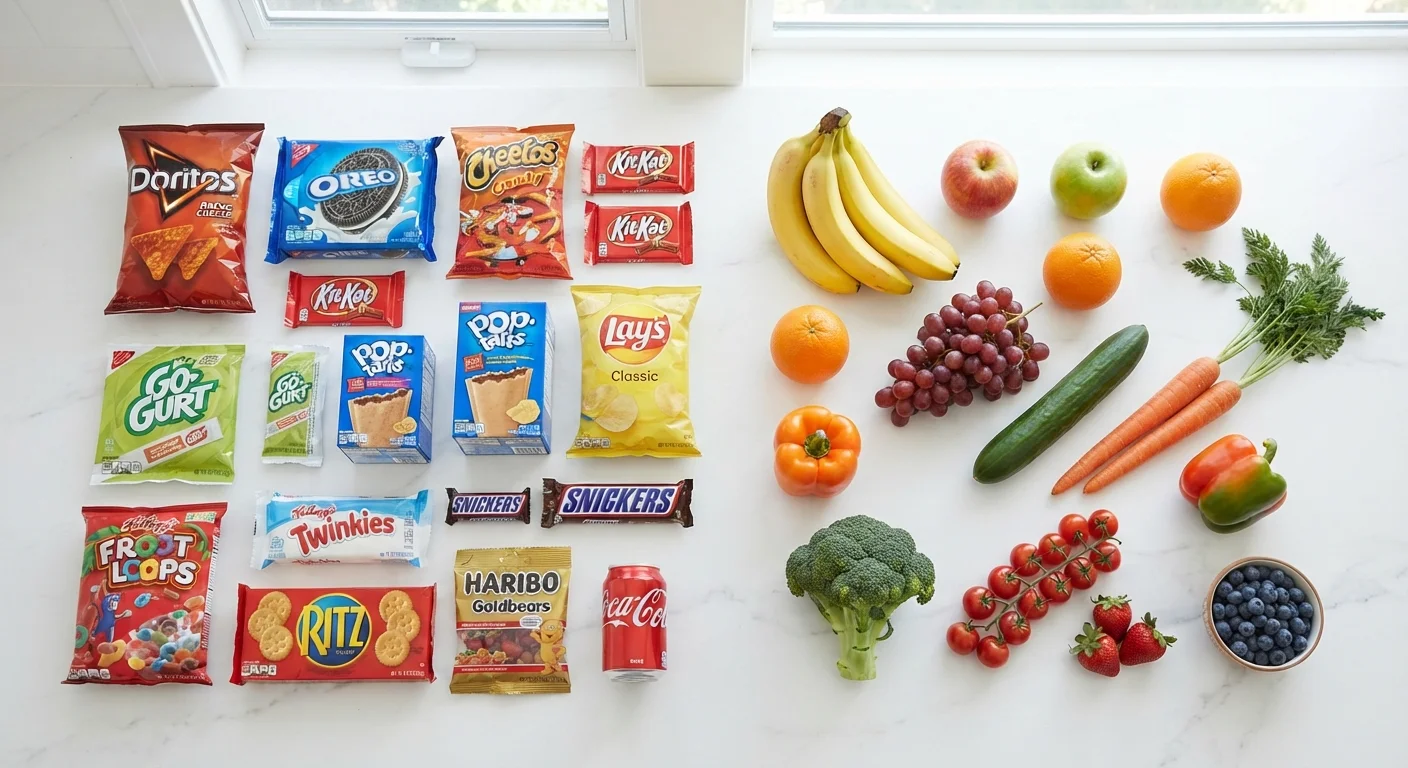
Why 'Processed' Alone Isn't a Useful Category
Almost every food humans eat has been processed in some way. Washing, chopping, cooking, fermenting, and freezing are all forms of processing. Labeling a food simply as 'processed' tells us very little about what it actually is or how it was made.
That ambiguity is one reason nutrition researchers developed sharper language. The NOVA classification system, created by a team at the University of São Paulo, groups foods into four categories based on the extent and purpose of industrial processing — not primarily on nutrient content. This distinction matters because two products can share a similar calorie or sodium count while having very different ingredient structures and roles in a dietary pattern.
NOVA's four groups move from minimally altered to heavily reformulated: Group 1 covers unprocessed or minimally processed foods (fresh fruit, plain frozen vegetables, eggs); Group 2 covers culinary ingredients extracted from Group 1 foods (oils, flours, sugar); Group 3 covers processed foods made by combining Groups 1 and 2 (canned beans, cheese, cured meats); and Group 4 — ultra-processed foods — is where the category becomes genuinely distinct.
What Specifically Defines NOVA Group 4
Ultra-processed foods are not defined by convenience or shelf life alone. The defining characteristic is industrial formulation using substances rarely, if ever, used in home cooking — combined with additives whose primary purpose is cosmetic, sensory, or preservation-related rather than nutritional.
These substances include:
- Protein isolates and hydrolyzed proteins
- Chemically modified starches
- Emulsifiers (such as lecithin or carrageenan)
- Flavor enhancers and artificial flavors
- Synthetic colorings and artificial sweeteners
- Anti-caking agents and foaming agents
The result is a product whose ingredient list contains items you would not find in a pantry or use in a recipe. A loaf of homemade bread uses flour, water, yeast, and salt. A mass-market packaged bread may contain dough conditioners, calcium propionate, and soy protein isolate — ingredients that extend shelf life and standardize texture at industrial scale.
NOVA Is a Research Tool, Not a Dietary Prescription
The NOVA classification was designed for population-level nutritional epidemiology research. While it is a useful framework for understanding food environments, it is not a rigid dietary rulebook. Nutrition professionals generally recommend looking at overall dietary patterns rather than categorizing every individual food as acceptable or off-limits.
Being able to read an ingredient list critically is one of the most practical skills a nutrition-aware shopper can develop. Our guide to reading a Nutrition Facts label walks through each section of the U.S. label in plain terms.
Why Researchers Treat This Category Separately
The NOVA framework emerged from an observation: standard nutrient analysis was not capturing meaningful differences in how food related to health outcomes at the population level. Two breakfast options might have comparable fiber content, but one could be oats cooked with fruit (Group 1) and the other a sweetened, flavored granola bar with fifteen additives (Group 4). Their nutrient profiles might look similar on paper; their ingredient structures are very different.
~58%
Share of U.S. adult caloric intake from ultra-processed foods
A study published in the BMJ (2016) analyzing NHANES dietary data estimated that ultra-processed foods accounted for approximately 57.9% of energy intake among U.S. adults.
4 Groups
NOVA classification categories for all foods
The NOVA system, developed at the University of São Paulo, sorts all foods and beverages into four groups based on the extent and purpose of processing.
Studying ultra-processed foods as their own category has allowed researchers to ask questions that nutrient-by-nutrient analysis could not: Does the degree of industrial formulation independently predict dietary patterns associated with chronic disease risk — even when nutrient variables are accounted for? A growing body of observational research suggests there may be such a relationship, though experts note the research is ongoing and causality is difficult to establish in dietary studies.
This is why the category has attracted sustained interest: it operates as a systems-level variable, capturing something about the modern food environment that individual nutrient metrics miss. It does not replace nutrient analysis — it adds a different lens.
For a practical application of these ideas in a shopping context, see our grocery store walkthrough for nutrition-aware shoppers.
Applying This Knowledge Without Oversimplifying
The NOVA framework is a research tool, not a pass/fail grading system for every food in your kitchen. Nutrition scientists themselves caution against using it as an absolute dietary rule. A person's overall eating pattern — variety, quantity, and context — matters more than whether any single product falls into Group 4.
That said, understanding what defines ultra-processed foods gives consumers a more specific vocabulary when reading ingredient labels. The question to ask is not simply 'Is this packaged?' but 'Does this contain substances I would not cook with at home, and do those substances serve a primarily industrial rather than culinary purpose?'
Labels that carry terms like 'natural' or 'organic' do not automatically place a product outside Group 4 — industrial additives can coexist with organic certification. Understanding what food label terms like organic and natural actually certify helps clarify that distinction.
The NOVA category gives researchers — and curious consumers — a more precise way to describe the modern food supply. That precision is valuable precisely because it resists the oversimplification of reducing food quality to a single nutrient or a single claim on a package.
Frequently Asked Questions
Processing exists on a spectrum. Minimally processed foods — like plain yogurt or bagged salad — undergo simple preservation steps. Ultra-processed foods go further: they are industrially formulated with substances rarely used in home cooking, such as emulsifiers, flavor enhancers, and synthetic colorings. The distinction is about formulation purpose and ingredient origin, not just the degree of handling.
No. Many packaged foods fall into NOVA Groups 1, 2, or 3 — for example, canned tomatoes, frozen edamame, or natural cheese. Ultra-processed foods (Group 4) are specifically those formulated with industrial additives not typically found in a home kitchen. Packaging alone does not determine the category.
Nutrient-by-nutrient analysis misses patterns that emerge at the whole-diet level. Two products can have similar calorie or sugar counts but very different ingredient matrices and physiological effects. NOVA allows researchers to study how the degree of industrial processing relates to health outcomes independently of a food's nutrient profile.
Nutritional science rarely deals in absolutes. Current research associates high consumption of ultra-processed foods with certain health risks, but context, quantity, and overall dietary pattern matter. The NOVA category is a research and analytical tool, not a binary 'safe vs. unsafe' label for individual foods.
Look for ingredients that you would not typically find in a home kitchen: things like 'modified starch,' 'soy protein isolate,' 'carrageenan,' 'artificial flavors,' or numbered food dyes. The presence of multiple such additives is a practical signal that a product likely falls in the ultra-processed category. See our <a href="/food-cooking/food-and-nutrition/added-sugar-vs-natural-sugar-why-the-distinction-matters-on-a-label">guide on added sugars</a> for a related look at label reading.
The content on this site is for informational purposes only and is not a substitute for professional advice. Always consult a qualified professional for guidance specific to your situation.