

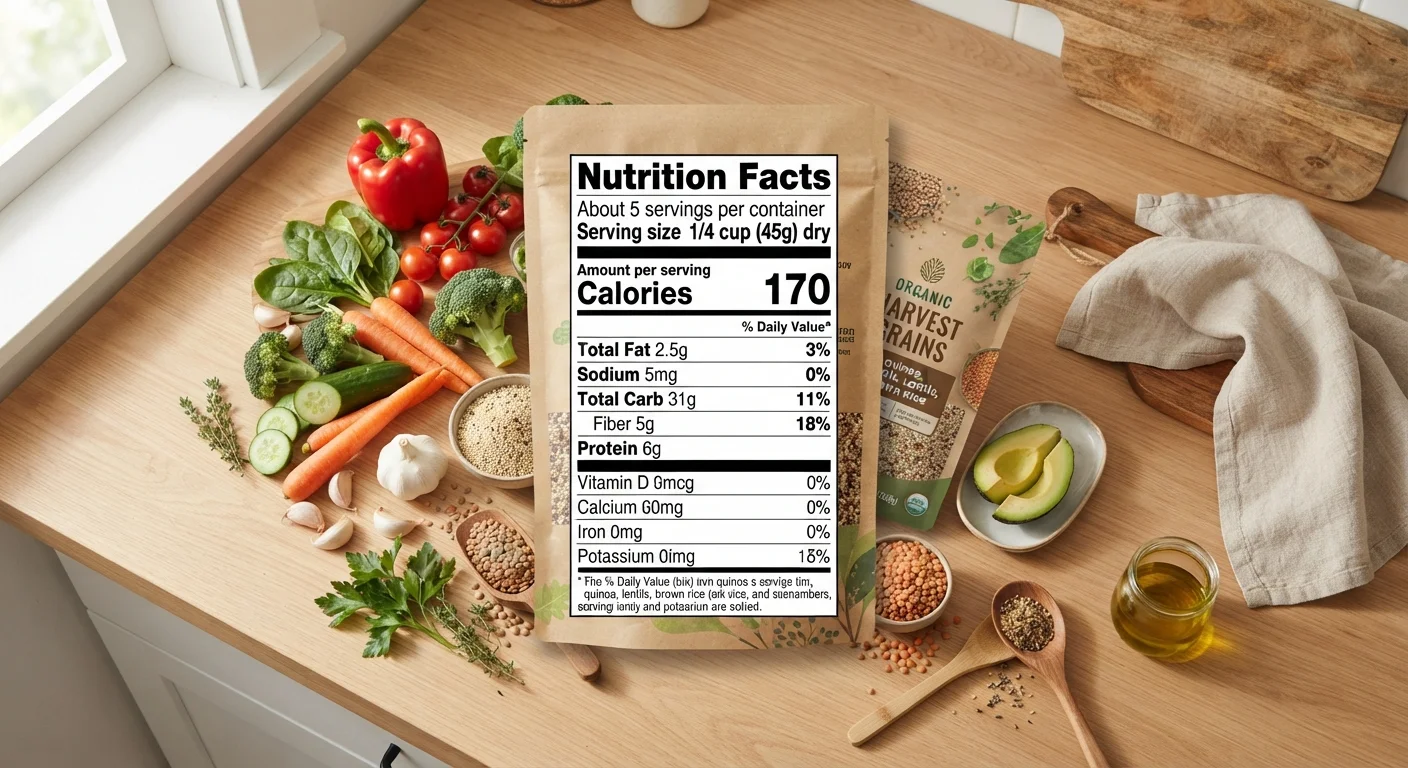
Start at the Top: Serving Size and Servings Per Container
The two lines at the very top of the label — serving size and servings per container — are the foundation for everything that follows. Every calorie count and nutrient amount listed below applies to one serving only, not to the whole package.
Serving sizes are set by the FDA based on how much of a food people typically consume in a single eating occasion, expressed in familiar household units (like cups or pieces) alongside the metric equivalent. This standardization means you can compare a serving of one brand of yogurt to another fairly accurately.
Where this trips people up: many packages contain two, two-and-a-half, or even more servings in what looks like a single-serving container. If you consume the entire package, you need to multiply every number on the label by the number of servings inside. For a closer look at how this plays out in practice, see common serving size misreads and how they skew the numbers you're relying on.
Calories and Macronutrients: What's Actually Being Measured
Below serving information, the label displays calories per serving in large, bold type — a deliberate design choice from the FDA's 2016 update to make this figure easier to spot.
Beneath calories, you'll find the three macronutrients:
- Total Fat — broken down into saturated fat and trans fat. Saturated fat has a %DV; artificial trans fat has been largely eliminated from the U.S. food supply, but trace amounts can appear.
- Total Carbohydrate — broken into dietary fiber, total sugars, and the critical sub-line for added sugars. Fiber has a %DV because adequate intake is associated with digestive and cardiovascular health; added sugars have a %DV because dietary guidance recommends limiting them.
- Protein — listed in grams but without a required %DV for most foods, since protein deficiency is uncommon in the U.S. population.
Cholesterol and sodium appear between fat and carbohydrates. Both carry %DV figures and are worth monitoring, particularly for individuals managing blood pressure or cardiovascular health — though any decisions about personal nutrient targets should be made in consultation with a healthcare provider.
5% or less
%DV considered low for any nutrient
The FDA uses this threshold as a consumer reference guide printed at the bottom of every Nutrition Facts label.
20% or more
%DV considered high for any nutrient
The FDA's official %DV guide defines this as a high amount, useful for identifying both nutrients to seek and nutrients to limit.
2,000
Calorie reference diet for %DV calculations
The FDA selected 2,000 calories as a standardized baseline for %DV; individual calorie needs differ based on age, sex, and activity level.
Understanding % Daily Value
The % Daily Value (%DV) column runs down the right side of the label and is one of the most useful — and most misunderstood — parts of the panel. It tells you how much of the recommended daily amount of each nutrient a single serving provides, calibrated to a 2,000-calorie reference diet.
A simple rule of thumb endorsed by the FDA: 5% DV or less is low for a nutrient; 20% DV or more is high. This lets you make quick comparisons without doing math.
“The % Daily Value is a tool for comparing foods and seeing how a food fits into an overall diet — not a rigid prescription for how much of each nutrient every person needs every day.”
— U.S. Food and Drug Administration, Federal agency responsible for U.S. food labeling regulations
Context matters when applying %DV. For nutrients you want to limit — saturated fat, sodium, added sugars — look for lower %DV figures. For nutrients you want to get enough of — dietary fiber, vitamin D, calcium, iron, potassium — higher %DV figures are generally favorable. Note that the 2,000-calorie baseline is a reference point, not a universal prescription; your actual needs vary based on age, sex, activity level, and health status.
Vitamins, Minerals, and the Ingredient List
The bottom section of the Nutrition Facts panel lists four nutrients the FDA specifically requires: vitamin D, calcium, iron, and potassium. These were selected because Americans tend to fall short on them as a population. Only the %DV is required here, though many manufacturers also include the absolute amount in milligrams or micrograms.
Just below (or adjacent to) the Nutrition Facts panel on packaged foods, you'll find the ingredient list — technically separate from the label but equally important. Ingredients are listed in descending order by weight, meaning the first ingredient is present in the greatest quantity. If added sugar appears among the first three ingredients, for instance, it's a significant component of that product. The ingredient list also reveals allergens, additives, and preservatives that don't appear in the nutrition panel itself.
For terms you'll encounter on the front of the package — words like "organic," "natural," or "non-GMO" — those carry their own regulatory meanings that are distinct from what the Nutrition Facts panel certifies. See what food label terms actually mean for a breakdown of those distinctions.
Use %DV to Compare, Not Just Count
When choosing between two similar products, line up their %DV figures side by side rather than trying to interpret raw gram amounts. A quick scan of sodium, saturated fat, fiber, and added sugars %DVs gives you a meaningful snapshot in seconds. This works especially well when comparing cereals, snack foods, or packaged meals.
The Nutrition Facts label applies specifically to packaged foods. When eating at chain restaurants, calorie and some nutrition information may appear on menus under separate federal rules — with important limitations. What menu calorie counts tell you — and what they leave out explains those differences.
This article provides general nutrition education and is not intended as medical or dietary advice. Consult a registered dietitian or qualified healthcare provider for guidance tailored to your individual health needs.
Frequently Asked Questions
% Daily Value (%DV) tells you what percentage of the recommended daily amount of a nutrient one serving of the food provides, based on a 2,000-calorie daily diet. It's a quick reference tool: 5% DV or less is low, and 20% DV or more is high. Most people don't eat exactly 2,000 calories, so use %DV as a general guide rather than a precise target.
No. The serving size reflects the amount people typically eat in one sitting, according to FDA reference data — it's a standardized measurement, not a dietary recommendation. If you eat more or less than the listed serving, you'll need to adjust all nutrient numbers accordingly.
Total sugars includes all sugar in the food — both naturally occurring (like lactose in milk or fructose in fruit) and sugars added during processing. Added sugars are only those introduced during manufacturing, such as cane sugar, honey, or corn syrup. Dietary guidelines suggest limiting added sugars, so that separate line helps you distinguish between the two.
Raw fruits, vegetables, and fish are not required to carry Nutrition Facts panels under FDA rules, though many stores voluntarily provide this information. Very small businesses and certain other categories may also be exempt. Foods sold in restaurants typically display calorie information on menus instead under separate labeling laws.
Check the 'servings per container' line near the top of the label. If a package contains three servings and you eat the whole thing, multiply every listed nutrient amount by three. This is one of the most common places where people unintentionally underestimate calorie and nutrient intake.
The content on this site is for informational purposes only and is not a substitute for professional advice. Always consult a qualified professional for guidance specific to your situation.