

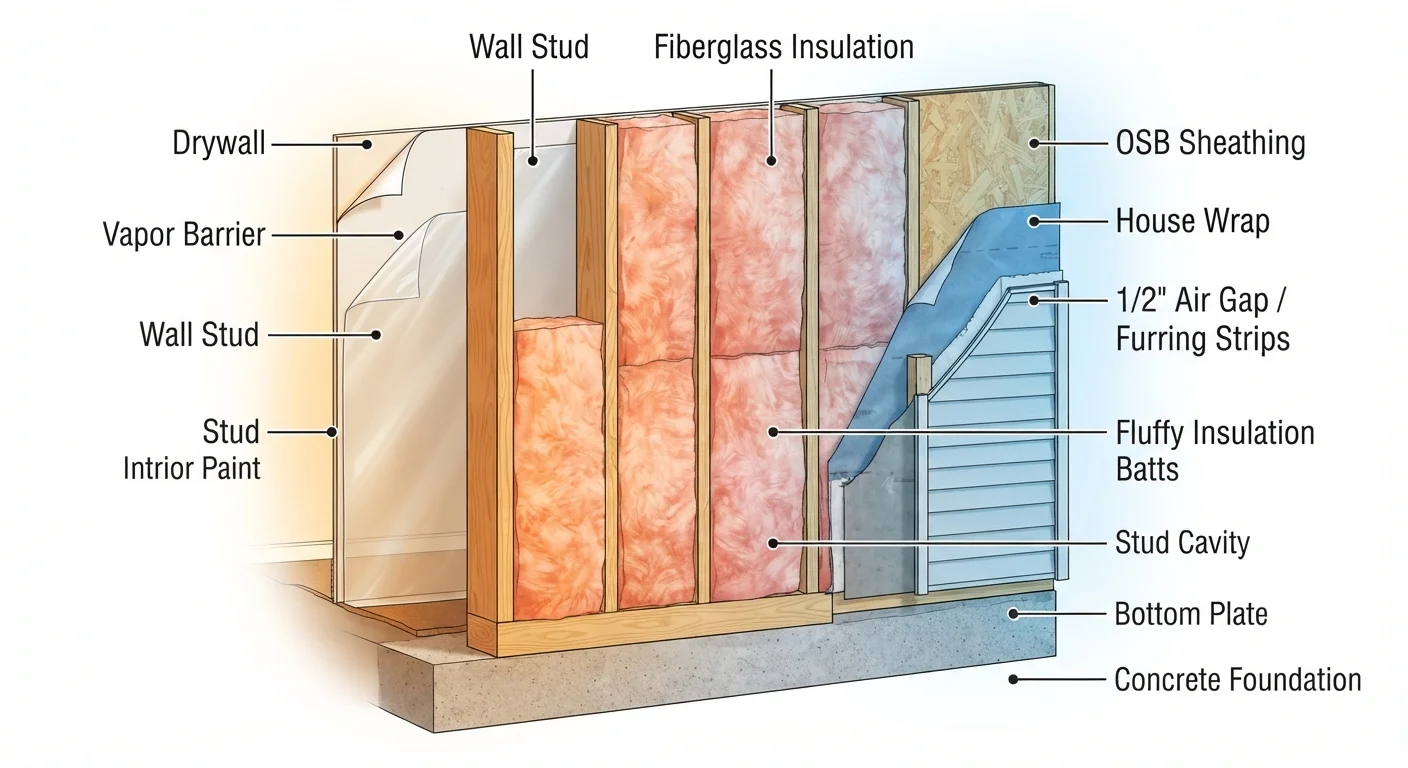
The Core Idea: Heat Wants to Move
Heat naturally flows from warm spaces to cooler ones. In winter, that means heat generated inside your home constantly tries to escape through walls, ceilings, and floors. In summer, outdoor heat pushes inward. Insulation is the barrier that slows this movement down — and R-value is simply the number that tells you how effective that barrier is.
Think of R-value like a dam holding back water. A higher dam (higher R-value) holds back more. A lower one lets more through. The "R" stands for resistance — resistance to heat flow, specifically.
R-Value Requirements Vary by Location
The United States is divided into climate zones numbered 1 through 7, ranging from hot-humid Southern climates to very cold Northern ones. The U.S. Department of Energy publishes specific R-value recommendations for each zone and each part of the home. Always check your zone before purchasing insulation to make sure you're targeting the right performance level.
R-Value Numbers in Practice
One of the most practical things to understand is that R-values are additive. If you have two layers of insulation, each rated at R-19, their combined resistance is roughly R-38. This means you can improve your home's insulation in stages rather than all at once.
Different parts of your home also need different R-values. Because heat rises, attics are the most critical area and usually call for the highest values. Exterior walls and floors over unheated crawl spaces have their own recommendations. Here's a general framework:
- Attics: R-30 to R-60, depending on climate
- Exterior walls: R-13 to R-21 in most regions
- Floors over unheated spaces: R-19 to R-30
- Basement walls: R-11 to R-15 at minimum in colder zones
These ranges come from U.S. Department of Energy climate zone guidelines. Your specific zone determines where in that range you should aim.
90%
U.S. homes that are under-insulated
According to the North American Insulation Manufacturers Association (NAIMA), approximately 90% of existing U.S. homes lack adequate insulation.
Up to 30%
Home energy lost through the attic
The U.S. Department of Energy estimates that a significant share of heating and cooling energy escapes through an inadequately insulated attic.
R-6 to R-7
R-value per inch of closed-cell spray foam
Closed-cell spray foam offers among the highest R-value per inch of commonly available insulation materials, per DOE material comparisons.
How Insulation Type Affects R-Value Per Inch
Not all insulation materials reach the same R-value per inch of thickness. This matters when space is limited — for example, in a wall cavity that's only 3.5 inches deep.
| Material | Approx. R-Value per Inch |
|---|---|
| Fiberglass batt | R-2.9 to R-3.8 |
| Mineral wool batt | R-3.0 to R-3.3 |
| Blown-in cellulose | R-3.2 to R-3.8 |
| Open-cell spray foam | R-3.5 to R-3.7 |
| Closed-cell spray foam | R-6.0 to R-7.0 |
| Rigid foam board (polyiso) | R-5.6 to R-8.0 |
When wall space is at a premium, closed-cell spray foam or rigid foam board can achieve a higher total R-value in a thinner layer than standard batts.
Why Installation Quality Is Half the Battle
A product's labeled R-value is its rated performance under ideal conditions. Real-world performance can fall short if the insulation is installed poorly. Compressed fiberglass batts, for instance, lose a meaningful portion of their rated R-value because the trapped air pockets — which do much of the insulating work — are squeezed out.
Common installation mistakes that reduce effective R-value include:
- Gaps or voids around wiring, pipes, or framing
- Compression from being forced into too-small a space
- Missing insulation in hard-to-reach corners
- Ignoring air sealing before adding insulation
Air sealing deserves special mention. Even high-R-value insulation won't perform well if air is moving freely through cracks and gaps — warm air carries heat with it, bypassing the insulation entirely. Always address air leaks before or alongside adding insulation.
Seal Air Leaks Before You Insulate
Before adding or upgrading insulation, use caulk or spray foam to seal gaps around recessed lights, plumbing penetrations, and wall top plates. Air moving through these gaps bypasses insulation entirely. Addressing air leaks first means your new insulation delivers its full rated R-value.
Putting It All Together for Your Home
For most homeowners, the attic is the best place to start when improving insulation, because it typically offers the greatest heat-loss surface area and is accessible without opening walls. Once you know your climate zone, you can calculate roughly how much insulation you need to meet recommended R-values for your region.
If you're planning to improve attic insulation, keep in mind that insulation and ventilation work as a system — adding insulation without understanding your attic's airflow can create moisture problems. Learn more in our guide to attic insulation and ventilation.
For walls or complex areas like rim joists and crawl spaces, consulting a qualified insulation professional is a smart step. They can perform an energy audit, measure current performance, and recommend the most cost-effective path forward for your specific home.
Frequently Asked Questions
It depends on your climate zone and which part of the home you're insulating. The U.S. Department of Energy provides zone-based recommendations — attics in colder climates often call for R-49 to R-60, while milder zones may need R-30. Check DOE guidelines or consult a local insulation contractor for specifics.
Generally yes, but only up to a practical point. Drastically over-insulating beyond your climate zone's recommendation offers diminishing returns. Installation quality also matters — even a high-R-value batt that's compressed or has gaps around it performs below its rated value.
Yes, and R-values are additive, so layering insulation increases total resistance. A common approach is adding unfaced batts or blown-in insulation over existing attic insulation. Make sure any existing insulation is dry and free of mold before adding more.
No. Different materials achieve different R-values per inch. Spray foam typically offers a higher R-value per inch than fiberglass batts, while loose-fill cellulose falls in between. Compare materials by their R-value per inch, not just the total, to judge efficiency.
Most insulation materials maintain their R-value for decades if kept dry and undisturbed. Moisture is the biggest threat — wet insulation can lose much of its effectiveness and may need replacement. Regular attic checks can help catch moisture problems early.
The Federal Trade Commission (FTC) requires insulation manufacturers to disclose R-value information on product labels. The Department of Energy publishes climate-zone recommendations for where and how much insulation homes need.
The content on this site is for informational purposes only and is not a substitute for professional advice. Always consult a qualified professional for guidance specific to your situation.