

Our Verdict
Manual budgeting gives you full control and deeper engagement with your money, while app-based budgeting reduces friction and saves time. Both can be genuinely effective — the deciding factor is usually which method you'll maintain without burning out.
| Best for | Recommended |
|---|---|
| People who want maximum control and awareness of every dollar | Manual budgeting |
| Busy households with multiple accounts and income streams | App-based budgeting |
| Those with strong privacy concerns about sharing financial data | Manual budgeting |
| Beginners who need structure without a steep learning curve | App-based budgeting |
What Each Approach Actually Involves
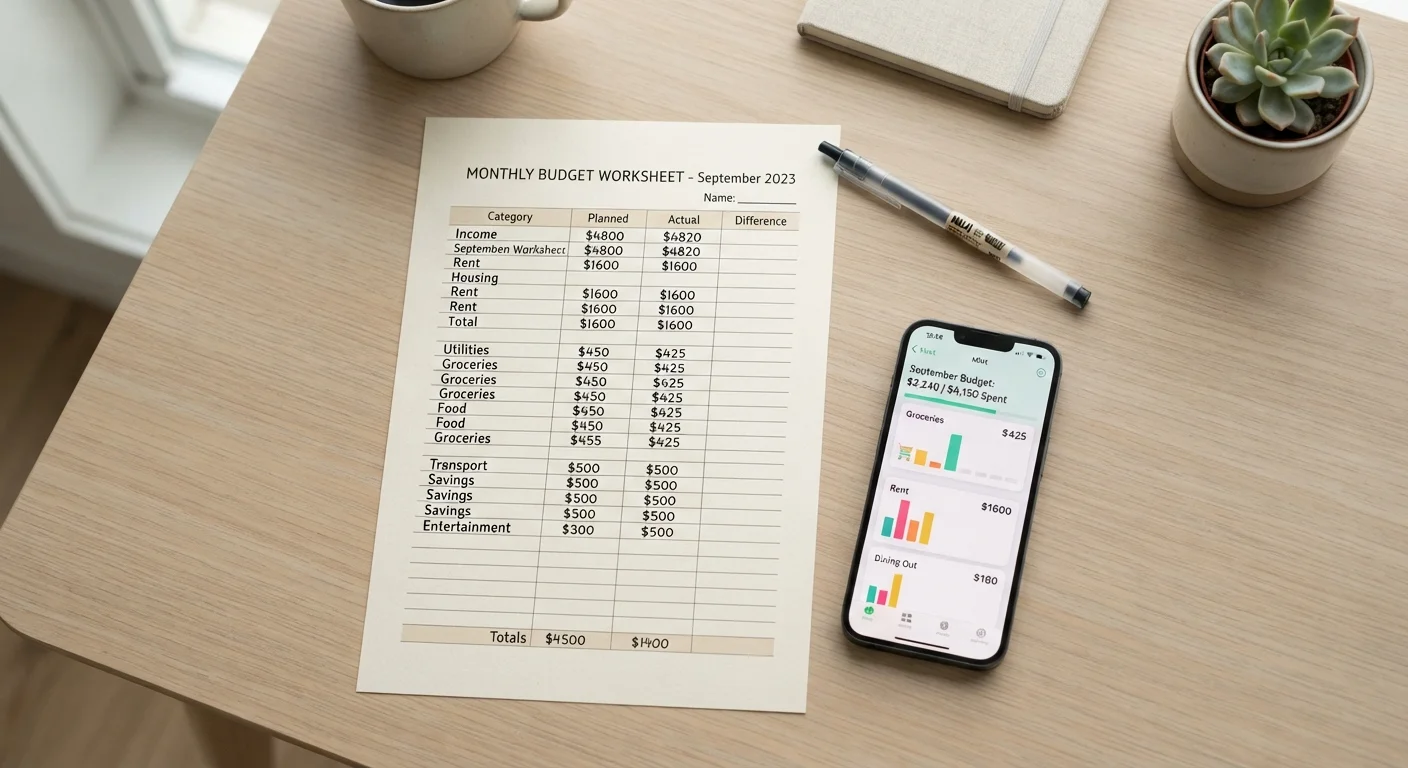
Manual budgeting means tracking your income and expenses yourself — using a notebook, a printed spreadsheet, or even a simple piece of paper. You record transactions by hand, categorize spending, and update your totals regularly. It takes time, but that hands-on process is part of the point.
App-based budgeting connects to your bank accounts and credit cards, automatically pulling in transactions and sorting them into categories. You review what the app captures, adjust miscategorized items, and check your progress against spending targets. Some apps also send alerts when you're nearing a limit or a bill is due.
Both methods are trying to solve the same problem — helping you spend intentionally — but they take very different paths to get there. If you're curious how specific methods like envelopes or spreadsheets compare, see our comparison of envelope and spreadsheet budgeting.
The Case for Manual Budgeting
Writing things down by hand forces you to confront numbers you might otherwise glide past. Research in behavioral psychology consistently suggests that physically recording information improves retention and attention — and that principle applies to spending habits, too. When you manually log a $60 dinner, you feel it more concretely than when an app quietly categorizes it overnight.
Manual budgeting also requires zero data sharing. Your financial information stays entirely in your control — no third-party servers, no login credentials handed to an outside company, no risk of a data breach exposing your bank account details.
The tradeoff is effort. Manual tracking demands regularity. Miss a few days and you're scrambling to reconstruct purchases from memory or receipts. It also scales poorly — juggling multiple accounts, irregular income, or a lot of expense categories gets unwieldy fast.
Start Simple Before Adding Complexity
If you're new to budgeting, don't try to track 15 categories from day one. Whether you go manual or use an app, start with three to five broad buckets — housing, food, transportation, savings, and everything else. Get consistent with that before adding more detail. Complexity is easier to add than consistency is to rebuild.
The Case for App-Based Budgeting
The strongest argument for budgeting apps is consistency. Because syncing happens automatically, you always have a current picture of your finances without sitting down to enter data manually. For people with irregular schedules or little patience for administrative tasks, that automation removes a major barrier.
Apps also make it easier to spot patterns. Seeing three months of restaurant spending in a chart is more revealing than a handwritten tally, and that visibility can motivate real changes. Many apps also include features like bill tracking, savings goal progress, and net worth dashboards — tools that go beyond basic budgeting.
The concern most people overlook is privacy. Connecting a budgeting app requires granting it read access to your financial accounts, typically through a data aggregation service. That information is valuable and, in the event of a breach, sensitive. It's worth reading an app's privacy policy carefully before linking your accounts. For a broader look at what financial automation involves, see our piece on the tradeoffs of automating your finances.
| Manual Budgeting | App-Based Budgeting | |
|---|---|---|
| Time investment | High — daily or weekly entry required | Low — automatic transaction syncing |
| Spending awareness | High — deliberate, hands-on engagement | Moderate — passive unless you review actively |
| Privacy / data risk | Low risk — no data shared externally | Higher risk — credentials shared with third party |
| Accuracy | Depends on user discipline | High, but miscategorization can occur |
| Scalability | Harder with many accounts or categories | Handles complexity well |
| Cost | Free (pen, paper, or free spreadsheet) | Free tiers exist; advanced features often paid |
| Best for | Detail-focused, privacy-conscious users | Busy users who want low-friction tracking |
Making the Decision — or Combining Both
If you're detail-oriented, value privacy, or are just starting out and want to build real money awareness, manual budgeting is a solid foundation. It's also worth considering if you've tried apps before and found yourself passively watching numbers without changing behavior.
If your financial life involves several accounts, a variable income, or you simply know you won't maintain a manual system, an app is likely to serve you better. The key is choosing one you'll actually open regularly — automation only helps if you're reviewing what it captures.
A hybrid approach works well for many people: use an app to capture and categorize transactions automatically, then do a manual weekly or monthly review where you write down key numbers and adjust your plan. That monthly budget audit checklist is a useful framework for that kind of structured review, regardless of how you track day-to-day.
If you're still feeling hesitant about starting at all, it may help to first examine the budgeting myths that keep people from starting. The method matters less than actually beginning.
This article is for general informational purposes only and does not constitute personalized financial advice. Consider consulting a qualified financial professional for guidance specific to your situation.
The content on this site is for informational purposes only and is not a substitute for professional advice. Always consult a qualified professional for guidance specific to your situation.