

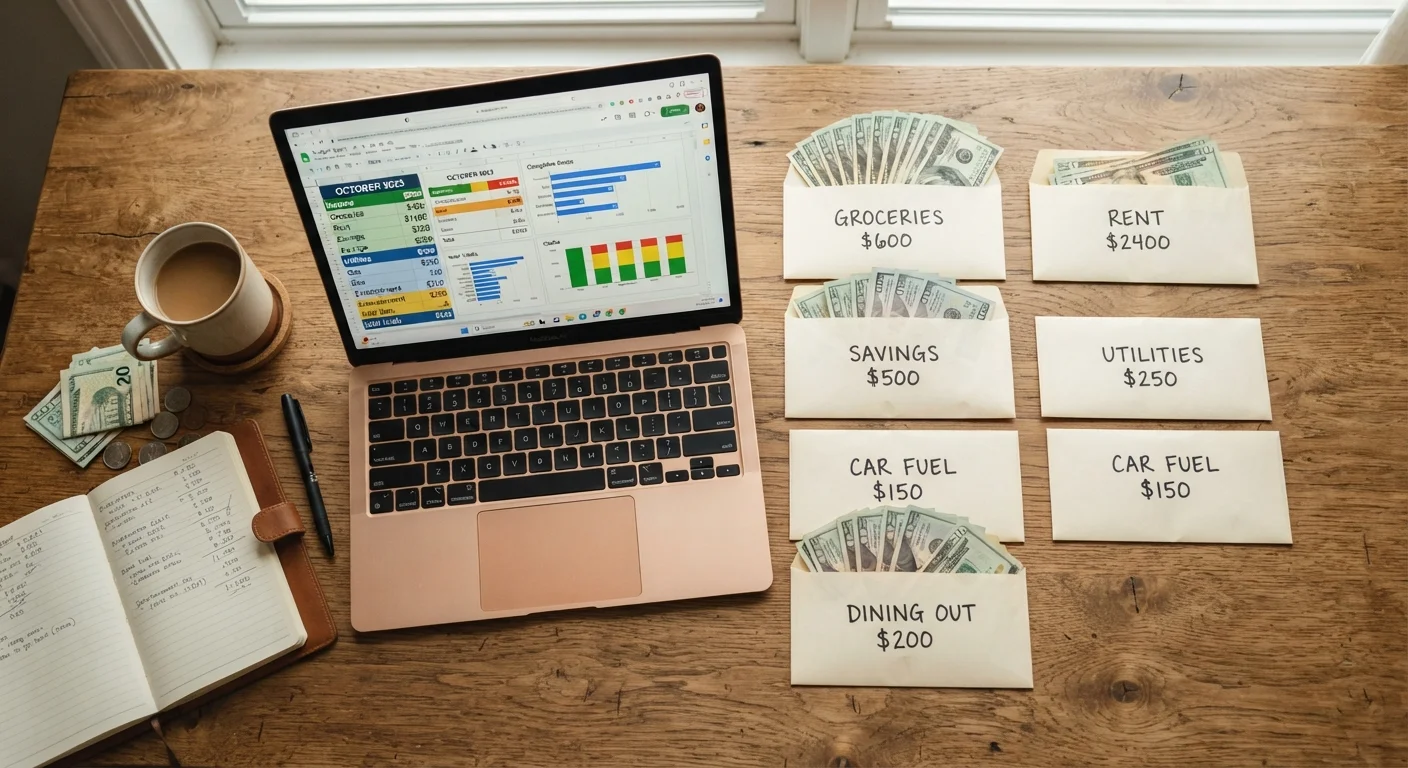
Option A
Envelope Budgeting
The tactile, cash-first method that makes limits impossible to ignore.
Best for: People who overspend on discretionary categories and want a physical spending boundary they can feel.
Option B
Spreadsheet Budgeting
The flexible, data-driven method that rewards detail-oriented planners.
Best for: People who are comfortable with numbers, use digital payments regularly, and want a full financial picture in one place.
How Each Method Actually Works
Envelope budgeting is straightforward: at the start of each pay period, you withdraw cash and divide it into labeled envelopes — one for groceries, one for gas, one for dining out, and so on. When an envelope is empty, you stop spending in that category until the next cycle. It's a physical system with a built-in hard stop.
Spreadsheet budgeting works differently. You build a digital document — in a program like Excel or Google Sheets — that lists your income, every spending category, and what you plan to allocate to each. As money comes in and goes out, you log the amounts. The spreadsheet does the math and shows you where you stand at any moment. There are no cash withdrawals involved; it works with however you actually pay for things.
Understanding the difference between fixed and variable expenses is useful before choosing either method, since envelopes work best on variable spending while spreadsheets can handle both types with ease.
| Criterion | Envelope Budgeting | Spreadsheet Budgeting |
|---|---|---|
| Medium | Cash withdrawal + labeling envelopes | Building and maintaining a digital file |
| Works with digital payments | No — cash only | Yes — any payment type |
| Spending enforcement | Hard stop when envelope empties | Self-enforced based on logged data |
| Tracks savings and debt | Not easily | Yes, with full detail |
| Ease of use | Very simple, no tech needed | Requires comfort with spreadsheets |
| Monthly time commitment | Low — count and divide cash | Moderate — consistent logging required |
| Best spending type | Discretionary variable expenses | All expense types |
| Psychological impact | High — cash feels more real | Lower — numbers on screen feel abstract |
Where Envelope Budgeting Has a Real Edge
The biggest strength of the envelope method is psychological. Research on consumer behavior has long shown that people tend to spend less when paying with cash compared to cards — the physical act of handing over bills makes the cost feel more concrete. For anyone who struggles with impulse spending, that friction is genuinely useful.
Envelopes also require zero technology. If you're uncomfortable with computers or spreadsheets, or you just don't want to maintain a digital system, envelopes are a viable low-barrier alternative. And there's a simplicity to the accountability — you never have to wonder whether you logged a transaction correctly, because the money is either in the envelope or it isn't.
~83%
Americans who primarily use cards over cash
According to Federal Reserve payment study data, the vast majority of U.S. consumer transactions are now made with cards or digital methods rather than cash.
~33%
Adults without a working monthly budget
Surveys by the National Foundation for Credit Counseling have consistently found that roughly one-third of U.S. adults do not track spending or maintain a formal budget.
The trade-off is real, though. Envelope budgeting doesn't naturally accommodate online shopping, automatic bill payments, or situations where you forget your envelope at home. It also doesn't give you a bird's-eye view of your full financial life — savings goals, debt balances, and irregular expenses require more structure than labeled envelopes can provide on their own.
Where Spreadsheets Give You More Control
A spreadsheet budget's main advantage is completeness. You can track every dollar across every category — every household budget category from rent and utilities to subscriptions and emergency savings — in one place. You can see month-over-month trends, project future expenses, and run scenarios ("what if I cut dining by $100 and put it toward my car loan?") without touching any physical money.
Spreadsheets also adapt easily as your life changes. New income stream? Add a row. Irregular expense coming up? Build in a column. They don't care whether you pay by cash, card, or automatic transfer.
The limitation is that a spreadsheet only reflects what you put into it. If you forget to log a transaction, or wait two weeks to update it, the numbers become unreliable. Consistency is the cost of entry. Anyone choosing this method should build a regular habit of tracking spending — ideally a few minutes every day or two rather than a big monthly catch-up session.
Which Approach Is Right for You?
Neither method is universally better. The right choice depends on how your brain processes money, how you actually spend day to day, and how much maintenance you're realistically willing to do.
If your biggest problem is overspending on discretionary categories like food and entertainment, the envelope method's hard physical limit tends to be more effective than a spreadsheet entry you make after the fact. If you're more analytical, pay for almost everything digitally, or want to track debt and savings alongside spending, a spreadsheet is probably the stronger fit.
Some people use a hybrid approach: a spreadsheet handles the full budget and financial overview, while cash envelopes cover the two or three categories where they're most prone to overspending. That combination captures the strengths of both systems. For a related comparison, see manual budgeting vs. app-based budgeting if you're wondering where digital tools fit into the picture.
Whatever method you choose, a monthly review is essential. Use a structured monthly budget audit checklist to catch overages, adjust category amounts, and make sure your system is still working for your actual life — not the life you had when you set it up.
This article provides general financial education and is not personalized financial advice. For guidance specific to your situation, consider consulting a qualified financial professional.
The content on this site is for informational purposes only and is not a substitute for professional advice. Always consult a qualified professional for guidance specific to your situation.