

Why Indoor Rabbit Housing Requires More Thought Than Most People Expect
Rabbits are the third most common household pet in the United States, yet they're frequently misunderstood. Many people bring a rabbit home expecting a low-maintenance animal that lives happily in a small cage — and quickly discover that's not the case. Rabbits are intelligent, curious, and physically active animals with needs that are much closer to those of a cat or small dog than to a hamster. If you're weighing the differences between small mammal pets, our small mammal care comparison outlines what distinguishes rabbits, guinea pigs, and other species.
Getting housing right from the start directly affects your rabbit's physical health and emotional wellbeing. An undersized enclosure, hazardous environment, or inconsistent routine is a common root cause of behavioral problems — excessive chewing, thumping, and aggression — that owners often misread as personality issues.
What you will need
Setting Up, Rabbit-Proofing, and Building a Daily Routine
The steps below walk you through selecting the right enclosure, securing your home, stocking it properly, and establishing the kind of predictable daily schedule that rabbits depend on to thrive. Gather your tools and materials before you begin.
Large Rabbit Enclosure or Pen
Provides the rabbit a safe home base with enough room to stand upright, stretch, and move — minimum 12 square feet of floor space.
Cable Management Conduit or Cord Covers
Protects electrical cords from chewing, preventing electrocution risk during free-roam time.
Grass Hay (e.g., Timothy or Orchard Grass)
Forms the bulk of the rabbit's diet, supports gut motility, and provides essential fiber.
Litter Box and Paper-Based Litter
Supports litter training and keeps the enclosure clean; topped with hay to encourage natural feeding behavior.
Enrichment Items (tunnels, cardboard boxes, chew toys)
Provides mental stimulation and physical activity during both enclosure time and free-roam sessions.
X-Pen or Baby Gate
Creates a safe, rabbit-proofed free-roam zone without requiring a fully secured room.
Fleece or Foam-Topped Mats
Provides traction on hard floors and cushions a rabbit's hocks, reducing the risk of sore hocks (pododermatitis).
Electrical Cords Are a Serious Hazard
Rabbits instinctively chew, and exposed electrical cords can cause electrocution or fires. Before allowing any free-roam time, route all cords through cable management conduit or behind furniture. Never assume a rabbit will avoid a cord — prevention is the only reliable safeguard.
Choose and Set Up the Right Enclosure
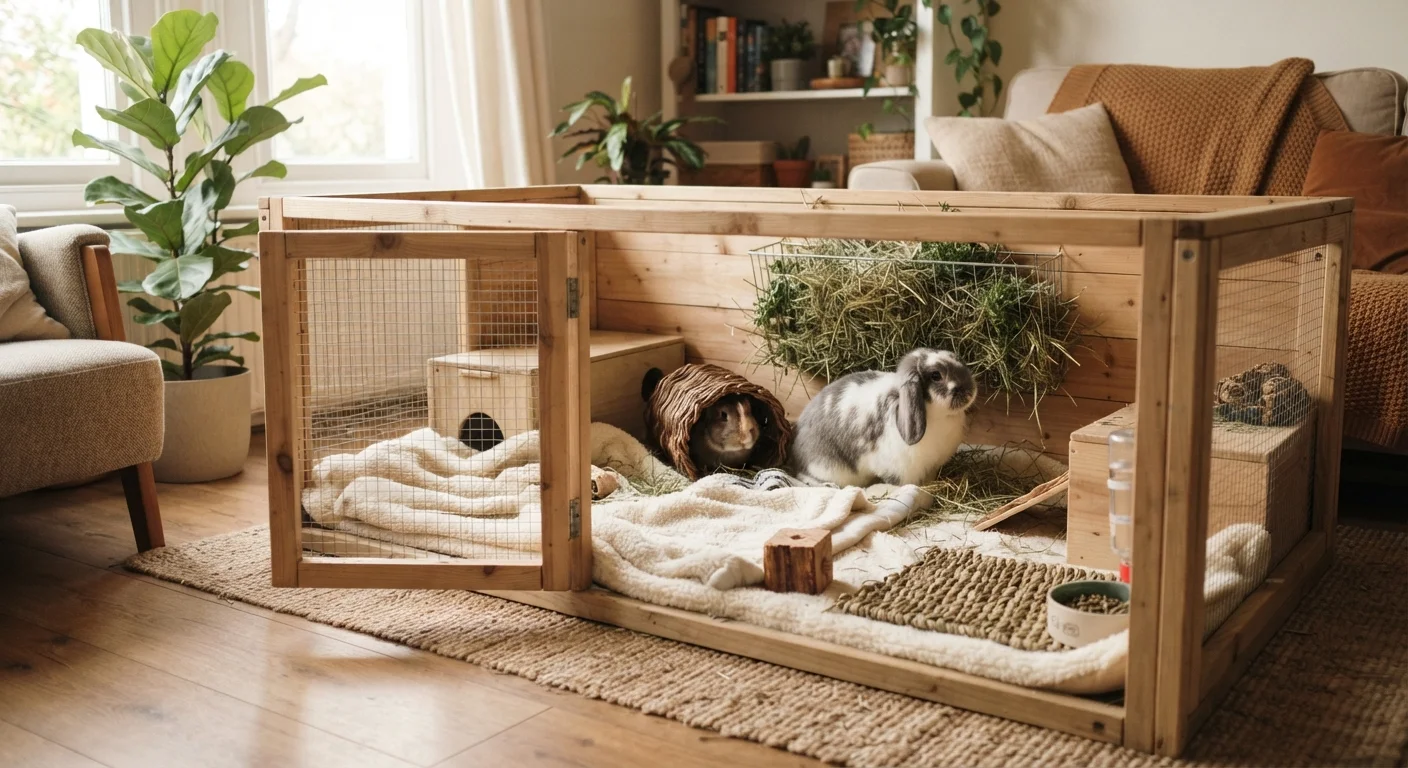
Select an enclosure that gives your rabbit room to stand fully upright on hind legs, take three to four consecutive hops in at least one direction, and lie down fully stretched. A minimum of 12 square feet of floor space is a widely cited guideline from rabbit welfare organizations, though more is always better. Avoid wire-bottomed cages — solid or slatted floors covered with a mat are much safer for a rabbit's feet.
Place the enclosure in a quiet, temperature-stable room away from direct sunlight, drafts, and loud noise. Rabbits are sensitive to heat and can develop heatstroke at temperatures above roughly 80°F.
Rabbit-Proof the Free-Roam Area
Rabbits need a minimum of three to four hours of free-roam time outside the enclosure each day — ideally spread across morning and evening, when rabbits are naturally most active (they are crepuscular). Before any unsupervised time, thoroughly inspect and secure the roaming area.
- Cover or conceal all electrical cords using conduit or cord protectors
- Block access to under-bed or sofa gaps where a rabbit can hide and chew undetected
- Remove or elevate toxic houseplants (many common plants are dangerous to rabbits)
- Use an x-pen or baby gate to limit roaming to a manageable, secured zone
Stock the Enclosure with Essentials
Every rabbit enclosure should contain the following at all times:
- Unlimited hay: Grass hay (timothy for adults, orchard grass, or oat hay) must be available 24/7. It makes up roughly 80% of a rabbit's diet and keeps the digestive system functioning.
- Fresh water: Provide a heavy ceramic bowl or a sipper bottle — many rabbits prefer bowls. Change it daily.
- Litter box: Placed in a corner, filled with paper-based litter and topped with a layer of hay.
- A hide or enclosed space: Rabbits need somewhere to retreat — a cardboard box or wooden hideaway works well.
- Enrichment: Rotate chew toys, tunnels, and foraging items regularly.
Establish a Consistent Feeding Routine
Hay is always available, but other dietary components should follow a schedule. Offer fresh leafy greens once or twice daily — roughly one to two packed cups per five pounds of body weight is a commonly cited guideline, though you should confirm appropriate amounts with your veterinarian. Safe options include romaine lettuce, cilantro, and flat-leaf parsley. Avoid iceberg lettuce and high-sugar vegetables.
Pellets, if fed, should be plain grass-hay-based pellets, measured according to your vet's guidance. Avoid pellet mixes with dried fruit or seeds — these are high in sugar and low in nutritional value for rabbits. Fresh water must be refilled and the bowl cleaned daily.
Build a Daily Interaction and Exercise Routine
Rabbits are social animals. Without regular human interaction and adequate movement, they can develop stress, boredom-related destructive behaviors, and in some cases, physical health problems from inactivity. Structure your day to include:
- Morning free-roam session: 1.5–2 hours in a rabbit-proofed space with opportunities to run, explore, and interact with you
- Evening free-roam session: Another 1.5–2 hours, ideally around dusk when rabbits are naturally more active
- Gentle handling and socialization: Sit at floor level rather than picking the rabbit up — most rabbits prefer to approach on their own terms
For more ideas on keeping your rabbit mentally engaged during enclosure time, see our enrichment guide for small pets.
Maintain Cleanliness and Monitor Health Daily
Spot-clean the litter box daily, removing soiled litter and topping up hay. Do a full litter box change every two to three days. Check the enclosure for uneaten food and remove fresh greens that haven't been eaten within a few hours to prevent spoilage.
Each day, take a moment to observe your rabbit's behavior, appetite, and droppings. Healthy droppings are round, dry, and relatively uniform. Soft, misshapen, or absent droppings — especially combined with reduced appetite or a hunched posture — are signs that warrant prompt veterinary attention. Gastrointestinal stasis (a slowdown or stoppage of gut movement) is a serious and potentially life-threatening condition in rabbits.
Use a Litter Box to Simplify Cleanup
Rabbits can be litter-trained relatively easily, especially when a box filled with paper-based litter and topped with fresh hay is placed in a corner of their enclosure. Combining litter and hay encourages natural feeding-while-toileting behavior. This also makes daily spot-cleaning quick and straightforward.
Rabbits Require Rabbit-Savvy Veterinary Care
Rabbits are classified as exotic animals in veterinary medicine, and not all general practitioners are trained to treat them. Locate an exotic or rabbit-experienced vet before problems arise. Annual wellness exams are strongly recommended, and any signs of illness — loss of appetite, lethargy, or changes in droppings — should be treated as urgent.
This article provides general pet care information and is not a substitute for advice from a qualified exotic animal or rabbit-savvy veterinarian. Always consult a professional for guidance specific to your rabbit's health and individual needs.
The content on this site is for informational purposes only and is not a substitute for professional advice. Always consult a qualified professional for guidance specific to your situation.