

Start here
Getting Your Bearings in the City
Next
The Loop and Lakefront: Chicago's Public Core
Explore further
Neighborhoods Worth Exploring
Plan your logistics
Getting Around Chicago
Eat well
Eating and Drinking Like a Local
Final prep
Practical Tips Before You Arrive
Getting Your Bearings in the City
Chicago is easier to navigate than its size suggests. The city runs on a remarkably logical street grid anchored by two fixed points: Lake Michigan to the east and the elevated train loop downtown. Street addresses radiate outward from State and Madison Streets in the Loop, so once you understand the numbering system, you can estimate distances with surprising accuracy.
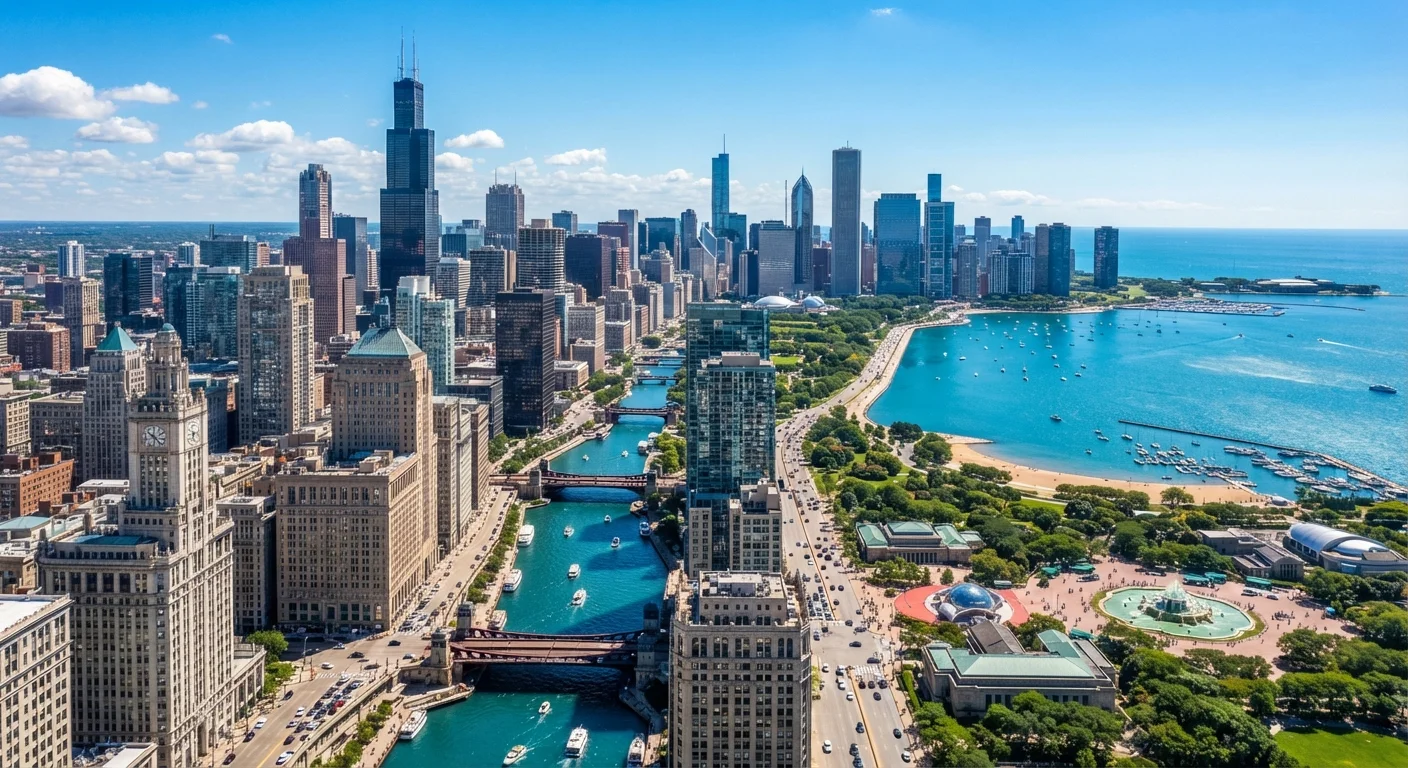
The lakefront runs the entire length of the city's eastern edge and is almost entirely public green space — a feature that distinguishes Chicago from most other major American cities. Orienting yourself toward the lake is the fastest way to reset your bearings at any point during your visit.
The Loop
Chicago's central downtown business district, named for the elevated 'L' train tracks that form a rectangle around it. Most major attractions and transit lines connect through or near this area.
The 'L' Train
Chicago's urban rail network, operated by the Chicago Transit Authority (CTA). 'L' stands for elevated, reflecting how much of the track runs above street level on steel structures.
Ventra Card
A reloadable transit card used to pay for CTA trains and buses in Chicago. You can load money or passes onto it at station kiosks and pay a lower fare than single-use options.
Museum Campus
A lakefront area just south of Millennium Park that clusters three major institutions — the Field Museum, Shedd Aquarium, and Adler Planetarium — within easy walking distance of each other.
Magnificent Mile
A stretch of North Michigan Avenue running from the Chicago River to Oak Street. It's one of the city's primary commercial and architectural corridors and a common reference point for visitors.
The Loop and Lakefront: Chicago's Public Core
The Loop — Chicago's downtown — is home to the bulk of the city's architectural landmarks, and simply walking its streets is one of the most rewarding free activities in the city. The elevated 'L' train circles overhead, steel-and-glass towers crowd the sidewalks, and public art appears at nearly every turn.
Millennium Park anchors the lakefront just east of the Loop and contains some of the city's most recognizable public art, including the reflective Cloud Gate sculpture. The adjacent Museum Campus groups three major science and natural history institutions within easy walking distance of each other. Grant Park, which stretches between them, hosts major public events throughout the warmer months.
Neighborhoods Worth Exploring
Staying within the tourist corridor means missing the city's most interesting character. A handful of neighborhoods reward even a half-day visit:
- Wicker Park / Bucktown: Dense with independent shops, live music venues, and restaurants — a good snapshot of Chicago's creative class.
- Pilsen: A historically Mexican-American neighborhood on the Lower West Side with murals, galleries, and some of the city's most celebrated taquerias.
- Logan Square: Younger and rapidly evolving, with a strong bar and café scene centered on the boulevard.
- Hyde Park: Home to the University of Chicago and the Obama Presidential Center (currently under development), plus excellent bookstores and lakefront parks.
- Lincoln Park / Lakeview: More residential but walkable, with the free Lincoln Park Zoo and easy lakefront access.
Use the CTA to Reach Neighborhoods
Most of the neighborhoods listed above are accessible by 'L' train within 20–30 minutes of the Loop. Pilsen is served by the Pink Line; Wicker Park by the Blue Line; Logan Square also by the Blue Line. Pairing transit with walking is the most efficient way to genuinely experience each area.
Getting Around Chicago
The CTA's eight 'L' lines are the backbone of visitor transit. The Red Line runs 24 hours and connects the North Side to the Loop and downtown; the Blue Line links O'Hare Airport directly to the city center. A reloadable Ventra card, available at any station, costs less per trip than a single-use ticket and works on both trains and buses.
Rideshare apps are plentiful and fill gaps the train doesn't cover, particularly for late-night travel or reaching neighborhoods between train lines. Biking is viable in warmer months — Chicago has an extensive network of protected lanes and a public bike-share system with stations throughout the city.
Eating and Drinking Like a Local
Chicago's food identity goes well beyond the debates over deep-dish versus tavern-style thin-crust pizza (both are worth trying; they're genuinely different products). The city has strong traditions in Italian beef sandwiches, Chicago-style hot dogs, and a remarkable breadth of global cuisines shaped by its diverse immigrant history.
Neighborhoods like Pilsen, Chinatown, Andersonville, and Devon Avenue each offer distinct culinary experiences that reflect the communities who built them. Eating your way through Chicago is arguably the most efficient way to understand the city's character. If you want a framework for planning the full trip around meals and logistics, our end-to-end trip planning guide is a useful starting point.
Practical Tips Before You Arrive
A few things worth knowing before your trip:
- Weather: Chicago's seasons are dramatic. Summer highs can reach the 90s°F; winter lows dip well below freezing. Wind off the lake intensifies both extremes. Layers are essential in spring and fall.
- Airport options: O'Hare (ORD) is larger and on the Blue Line; Midway (MDW) is smaller and on the Orange Line. Both connect to the city by train.
- Tipping: Standard US tipping norms apply — roughly 18–20% at sit-down restaurants, a dollar or two per drink at bars.
- Museum passes: Several institutions offer free admission on designated days; check individual museum websites for current policies before you go.
If this is part of a broader travel learning curve, see our overview on solo travel fundamentals for general first-timer guidance that complements this city-specific introduction.
Verify Museum Hours and Policies Ahead of Time
Major Chicago museums — including the Art Institute, Field Museum, and Shedd Aquarium — each have their own ticketing, reservation, and free-admission policies that can change seasonally. Always check official museum websites before your visit rather than relying on third-party summaries, which may be outdated.
Frequently Asked Questions
Late spring (May–June) and early fall (September–October) generally offer the most comfortable weather for exploring on foot. Summers are lively but can be humid and crowded. Winters are cold and windy, though the city remains fully functional and hotel rates often drop.
Like any large American city, Chicago has neighborhoods with varying safety profiles. The main tourist areas — the Loop, Millennium Park, the Magnificent Mile, Lincoln Park, and the lakefront — are heavily trafficked and generally considered safe for visitors. It's always wise to stay aware of your surroundings, especially at night.
No — most visitors find the CTA train and bus system sufficient for reaching attractions, neighborhoods, and airports. Rideshare services are also widely available. A car can actually be a disadvantage downtown due to parking costs and traffic.
Three to four days is a solid starting point for a first visit. That's enough time to cover the major landmarks, explore a few neighborhoods, and sample the food scene without feeling rushed. A week gives you room to slow down and dig deeper.
The 'L' is Chicago's elevated (and partly subway) rail network, operated by the CTA. It has eight color-coded lines connecting downtown to neighborhoods and both major airports. A reloadable Ventra card makes fares easy to manage and costs less per ride than single-use tickets.
Absolutely — Chicago offers a distinctly different experience. It's more compact, often easier to navigate, and has its own architectural identity, neighborhood culture, and culinary traditions. If you want a contrasting perspective, see our guide on <a href="/travel-trips/destinations/visiting-new-york-city-without-feeling-overwhelmed">visiting New York City</a> for comparison.
The content on this site is for informational purposes only and is not a substitute for professional advice. Always consult a qualified professional for guidance specific to your situation.