

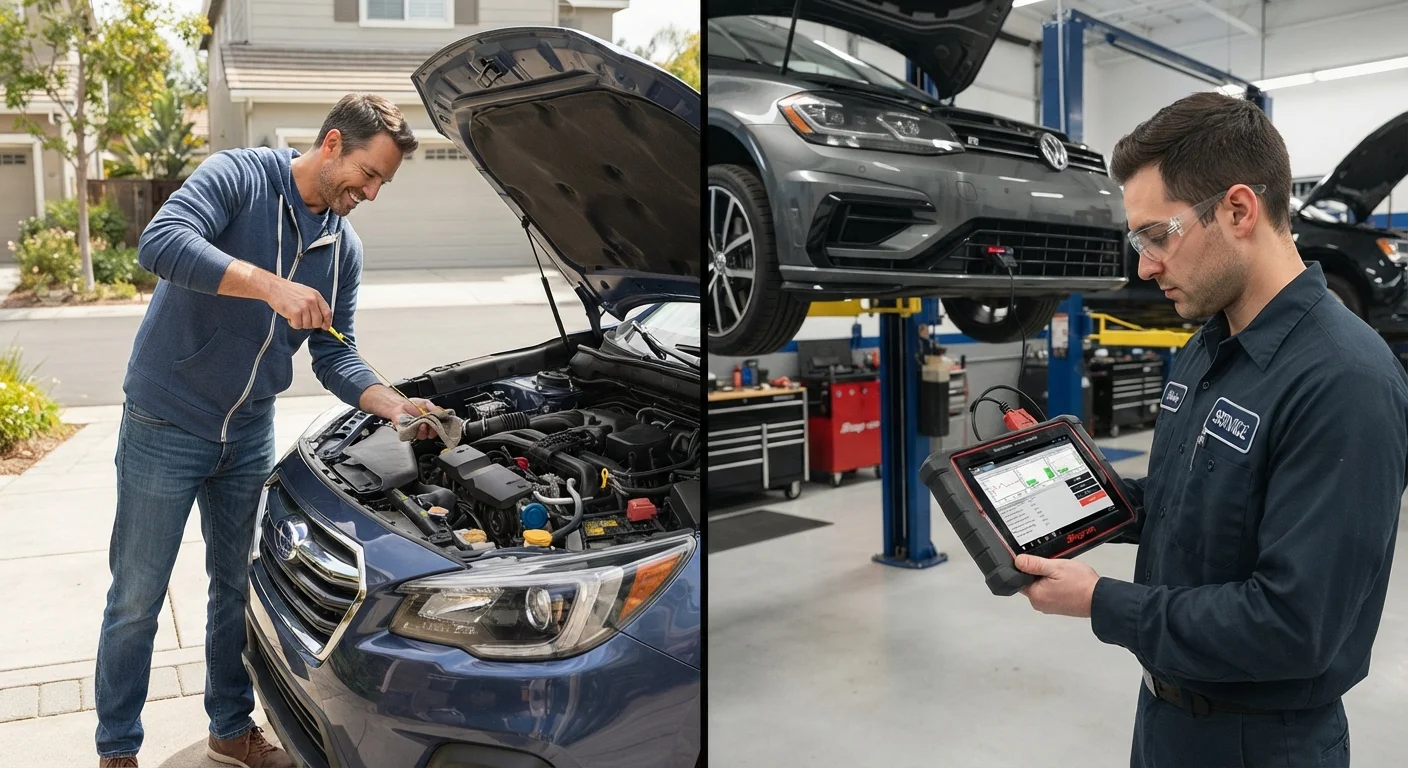
Our Verdict
DIY car maintenance makes good sense for routine, low-risk tasks that any careful adult can learn from a reliable source. However, systems tied directly to vehicle safety — brakes, steering, suspension, fuel, and advanced electronics — are best left to a qualified mechanic. Knowing the line between the two protects both your wallet and everyone sharing the road with you.
| Best for | Recommended |
|---|---|
| Drivers comfortable with basic tools and routine upkeep | DIY maintenance for low-risk tasks |
| Anyone dealing with safety-critical systems or unfamiliar repairs | Professional shop service |
| Drivers wanting to reduce ownership costs without cutting corners on safety | Hybrid approach: DIY for routine checks, shop for complex work |
Why the DIY vs. Shop Question Matters
Car ownership comes with a steady stream of maintenance decisions. Oil changes, tire rotations, worn wiper blades, a dashboard warning light — each one prompts the same question: can I handle this myself, or should I take it in?
The answer isn't simply about confidence. It's about accurately matching a task's complexity and risk level to your actual skill, tools, and working environment. Get that assessment right and you can save meaningful money on routine upkeep. Get it wrong on the wrong job, and you risk putting an unsafe vehicle on the road — or creating a repair bill that dwarfs what a shop would have charged.
Understanding the full picture of car ownership costs, including when professional service is genuinely worth it, is part of being an informed driver.
Tasks Most Drivers Can Safely Handle at Home
Certain maintenance jobs require minimal specialized tools, carry low safety risk if done carefully, and are well-documented in owner's manuals and reputable automotive resources. These are reasonable candidates for DIY:
- Fluid level checks: Engine oil, coolant, brake fluid, power steering fluid, and windshield washer fluid can all be visually inspected without lifting the car. See our guide to fluid checks you can do in your driveway for step-by-step specifics.
- Wiper blade replacement: Most blades clip on and off without tools. Your owner's manual lists the correct size.
- Engine air filter replacement: Typically located in a plastic housing secured by a few clips or screws — a straightforward swap on most vehicles.
- Cabin air filter replacement: Usually behind the glove box, requiring no tools on the majority of cars.
- Battery terminal cleaning: Removing corrosion from battery terminals with a wire brush and baking soda solution is low-risk when the car is off and proper gloves are worn.
- Tire pressure checks and inflation: A reliable pressure gauge and a compressor (or a gas station air pump) are all that's needed.
Start With Your Owner's Manual
Before attempting any maintenance task, check your vehicle's owner's manual for the manufacturer's recommended procedure, fluid specifications, and service intervals. It's the most authoritative source available for your specific car. Many are also available as free PDFs from manufacturer websites if you've misplaced the physical copy.
Keep a seasonal maintenance checklist handy to track which of these tasks are due and when — staying ahead of routine checks is the most cost-effective maintenance strategy available.
Tasks That Belong in a Professional Shop
Other jobs are categorically different. They involve safety-critical systems, require expensive diagnostic equipment, or demand precise torque specifications and professional-grade tools. Mistakes can cause brake failure, steering loss, or fire. These should go to a qualified mechanic:
- Brake pad and rotor replacement: While some experienced DIYers tackle pads, any error in reassembly or bleeding the brake lines can cause brake failure. Shops have the equipment to verify the job correctly.
- Suspension and steering components: Ball joints, tie rods, and struts affect how the car handles and stops. Incorrect installation is a direct road safety hazard.
- Timing belt or timing chain service: Requires precise alignment of internal engine components. An error can destroy the engine.
- Fuel system repairs: Working around gasoline and fuel lines carries real fire risk and often requires specialized fittings.
- Advanced electrical and computer diagnostics: Modern vehicles use complex electronic control modules. Reading and interpreting fault codes beyond simple OBD-II checks (plug-in reader) typically requires professional tools.
- Transmission service and repair: These are among the most complex systems in a vehicle and require specialized knowledge and equipment.
Never Compromise on Safety-Critical Systems
Brakes, steering, and suspension components are not tasks to learn on the fly. A small error — an improperly torqued caliper bolt, a misrouted brake line — can result in brake failure at highway speed. If you have any doubt about a repair involving these systems, stop and take the vehicle to a qualified mechanic. The cost of professional service is always less than the cost of a preventable accident.
How to Make the Call: A Practical Framework
When a maintenance need arises, work through these four questions before deciding:
- Is this system safety-critical? If the task touches brakes, steering, suspension, or fuel, default to professional service unless you have verifiable trade-level experience.
- Do I have the right tools? Some jobs can't be done safely without a torque wrench, jack stands rated for your vehicle's weight, or a specific socket set. Improvising around missing tools is where DIY injuries happen.
- Can I find a reliable, vehicle-specific procedure? Your owner's manual is the first stop. Reputable forums for your specific make and model can supplement, but treat generic online videos with caution — procedures vary significantly by vehicle.
- What's the cost of getting it wrong? A wrongly installed air filter is a nuisance. A wrongly bled brake system is a potential emergency. Weigh the downside honestly.
The routine maintenance tasks that prevent bigger repair bills are largely the same ones that sit safely in the DIY column — not a coincidence.
| DIY at Home | Professional Shop | |
|---|---|---|
| Fluid level checks | Safe and straightforward | Not necessary for routine checks |
| Wiper or filter replacement | Ideal DIY task | Shop can do it, but costs more |
| Brake system work | High risk — not recommended | Recommended; warranty on work |
| Tire pressure & rotation | Pressure check: DIY; rotation needs a lift | Rotation best handled at shop |
| Electrical/computer diagnostics | Basic OBD-II scan only | Full diagnostics and repair |
| Timing belt service | Not recommended for most drivers | Required professional-level work |
| Cost of labor | No labor cost | Labor is typically the largest expense |
| Tools required | Minimal for basic tasks | Specialized equipment available |
The Real Cost Calculation
DIY saves money on labor, which is typically the largest portion of a shop bill. But the honest calculation includes the cost of tools you don't already own, the value of your time, and the potential cost of mistakes. A simple oil change done at home might save $30–$60 in labor. A mishandled brake job could cost thousands to correct — or worse, cause an accident.
The strongest financial case for DIY sits squarely with routine preventive maintenance: fluid checks, filter swaps, tire pressure monitoring. These are the tasks where the skill barrier is low, the risk is minimal, and the savings are consistent over time. For everything more complex, compare a few shop quotes — labor rates vary considerably by region and shop type — and factor in the peace of mind that comes with a professional warranty on the work.
~35%
Share of car repairs attempted as DIY
Industry surveys have found roughly a third of vehicle owners attempt at least some maintenance or repairs at home, most commonly oil changes and filter replacements.
$500–$1,000+
Average cost to correct a botched DIY brake job
Automotive repair professionals note that improperly installed brake components frequently require full disassembly and replacement of additional parts, dramatically increasing the final bill.
This article is for general informational purposes only. Always consult your vehicle's owner's manual and, when in doubt, seek service from a qualified automotive professional. Do not attempt repairs beyond your skill level, particularly on safety-critical systems.
The content on this site is for informational purposes only and is not a substitute for professional advice. Always consult a qualified professional for guidance specific to your situation.