

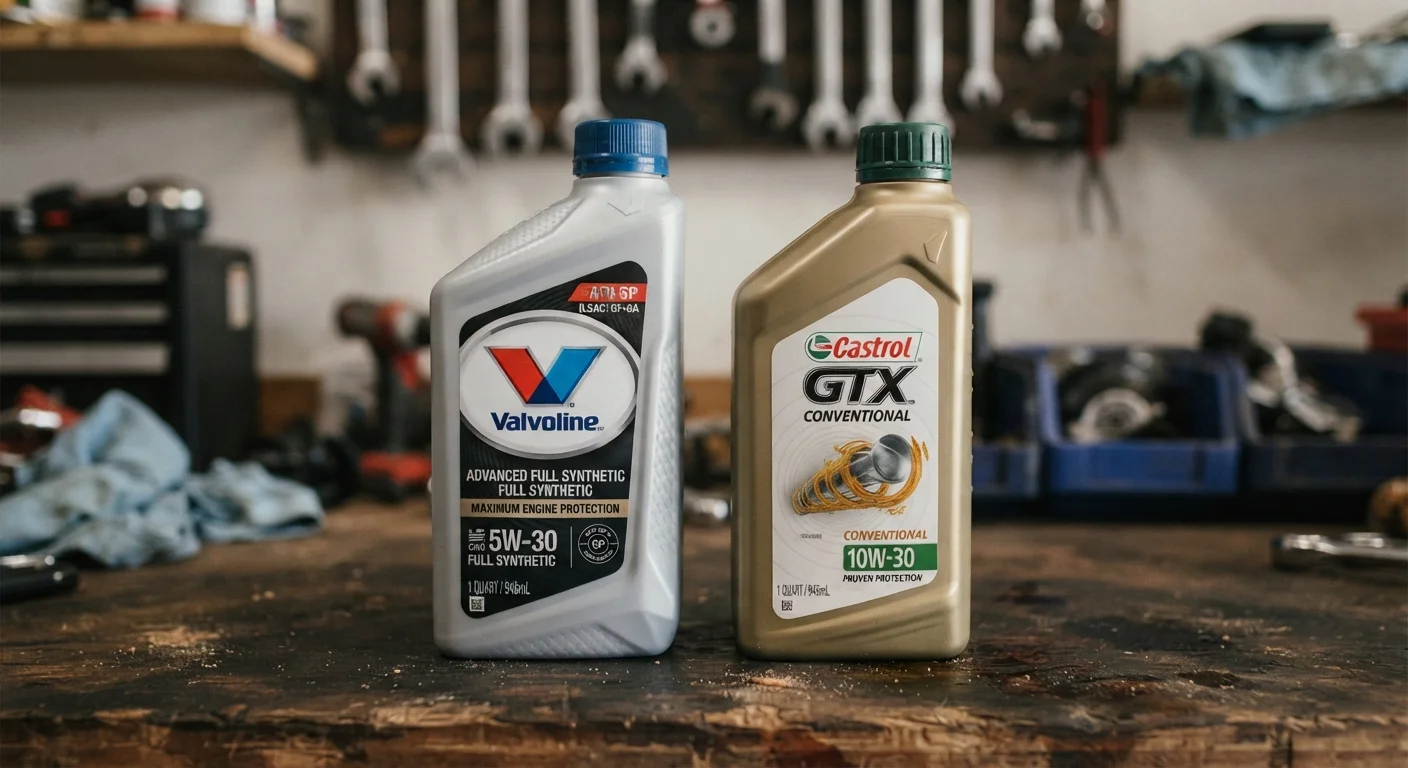
Option A
Synthetic Motor Oil
The engineered, longer-lasting formulation.
Best for: High-performance engines, extreme climates, extended drain intervals, and turbocharged vehicles.
Option B
Conventional Motor Oil
The time-tested, budget-friendly standard.
Best for: Older vehicles with low mileage, simple engines, and drivers following frequent change schedules.
What Makes These Two Oils Different
Motor oil has one core job: lubricate your engine's moving parts to reduce friction, prevent overheating, and carry away contaminants. Both synthetic and conventional oils do this — but they start from very different places.
Conventional motor oil is refined directly from crude petroleum. Refineries remove impurities, but the resulting product still contains naturally occurring molecular irregularities. Those inconsistencies can affect how the oil performs under stress.
Synthetic motor oil is built molecule by molecule in a lab, typically starting from a base of chemically processed petroleum or other compounds. The result is a more uniform molecular structure that resists breakdown at high temperatures, flows more readily in the cold, and maintains its protective properties longer.
A third category worth knowing: synthetic blend oil, which mixes conventional base oil with synthetic components. It offers some performance advantages over straight conventional at a price point between the two. Many drivers use blends as a middle-ground option, particularly in older vehicles.
| Criterion | Synthetic Motor Oil | Conventional Motor Oil |
|---|---|---|
| Origin | Engineered from chemical compounds | Refined from crude petroleum |
| Molecular consistency | Highly uniform | Naturally variable |
| Typical change interval | 7,500–15,000 miles | 3,000–5,000 miles |
| Cost per oil change | Higher upfront | Lower upfront |
| Cold-weather performance | Flows better at low temps | Can thicken in extreme cold |
| Heat resistance | Stronger breakdown resistance | Degrades faster under high heat |
| Turbo engine suitability | Recommended or required | Generally not recommended |
| High-mileage engine caution | May expose existing leaks | Often already in use |
The Real Cost Comparison
Synthetic oil typically costs two to four times more per quart than conventional. For a full oil change, that price difference can add up to $30–$70 more out of pocket depending on your vehicle. That's the number most drivers notice — but it's only part of the picture.
Because synthetic oil lasts significantly longer, you change it less often. A vehicle on conventional oil might need changes every 3,000 to 5,000 miles; on full synthetic, the interval often extends to 7,500–15,000 miles (always check your owner's manual for the number that applies to your car). Over a year, the gap in total spending narrows considerably.
For a deeper look at how routine maintenance fits into your overall vehicle budget, see our guide on fixed vs. variable car ownership costs. It's also worth reading about routine maintenance tasks that prevent bigger repair bills — skipping or delaying oil changes regardless of oil type can lead to costly engine damage.
2–3×
Longer drain interval with synthetic vs. conventional
Many manufacturers specify intervals of 7,500–15,000 miles for full synthetic, compared to 3,000–5,000 miles for conventional oil.
~70%
New US vehicles recommended for synthetic oil
Industry analysts estimate that the majority of new passenger vehicles sold in the US are factory-specified for synthetic or synthetic-blend motor oil.
$30–$70
Typical extra cost per synthetic oil change
The price premium varies by vehicle size and service provider, but the gap often shrinks when fewer annual changes are factored in.
When Your Vehicle — Not Your Preference — Decides
The single most important factor in this decision isn't cost or brand loyalty — it's what your manufacturer specifies. Open your owner's manual to the maintenance section. If it lists a synthetic oil or a viscosity grade (like 0W-20) that only synthetic reliably achieves, use synthetic. Using conventional when synthetic is required can void your warranty and accelerate engine wear.
Turbocharged engines generate intense heat around the turbocharger bearing, which sits directly in the oil flow path. Conventional oil can degrade quickly under those conditions, leaving behind deposits called coking that restrict oil flow. Synthetic handles these temperatures more reliably.
High-mileage vehicles present a specific situation. Older engines may have slightly worn seals that have adapted to conventional oil's composition. Switching to full synthetic — which is thinner and more chemically active — can occasionally expose pre-existing leaks. If you drive an older, high-mileage car, consult a qualified mechanic before changing oil types. Our article on owning an older high-mileage car covers related trade-offs worth knowing.
It's also worth separating fact from fiction: the idea that you must change oil every 3,000 miles regardless of oil type is one of the most persistent automotive myths. For more misconceptions that cost drivers money, see our piece on car maintenance myths that could be costing you money.
Viscosity Grade Matters Too
Beyond synthetic vs. conventional, your oil's viscosity grade — expressed as numbers like 5W-30 or 0W-20 — determines how it flows at different temperatures. Your owner's manual specifies the correct grade for your engine. Using the wrong viscosity, even with a high-quality synthetic, can reduce protection and fuel efficiency. When in doubt, a qualified mechanic can confirm the right oil specification for your vehicle.
The content on this site is for informational purposes only and is not a substitute for professional advice. Always consult a qualified professional for guidance specific to your situation.