

Our Verdict
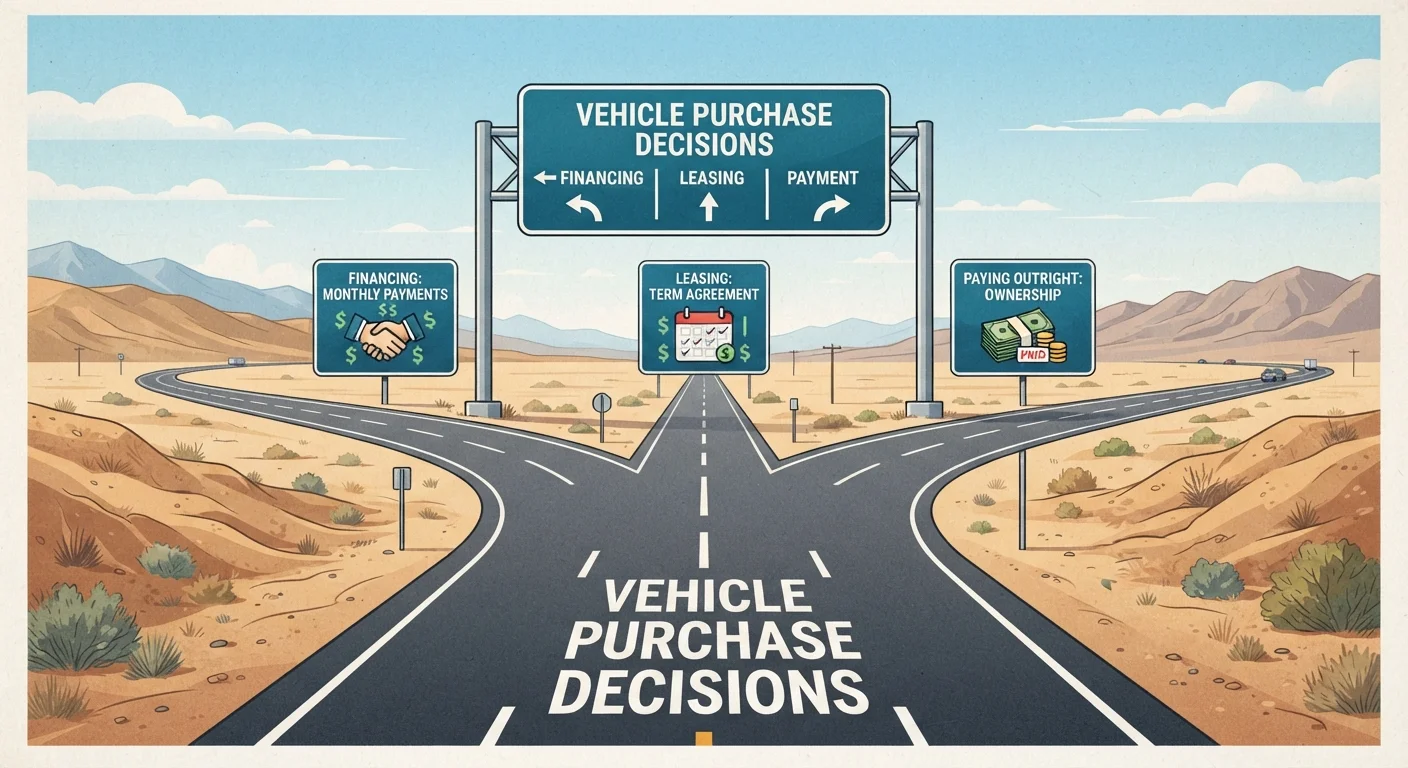
Financing is the most common path and suits buyers who want ownership without deploying all their cash at once. Leasing fits drivers who prioritize lower monthly costs and always want a newer vehicle, provided they stay within mileage limits. Paying cash is the most cost-efficient over time for those with sufficient savings, eliminating all interest. The right choice depends heavily on your cash position, credit, driving habits, and how long you plan to keep the vehicle.
| Best for | Recommended |
|---|---|
| Drivers who want eventual ownership and prefer to spread the cost over time | Financing |
| Those who want lower monthly payments and a new car every few years | Leasing |
| Buyers with sufficient savings who want to minimize total cost and avoid interest | Paying Cash |
| High-mileage drivers who put significant miles on each year | Financing or Paying Cash |
How Financing a Car Actually Works
When you finance a vehicle, a lender — typically a bank, credit union, or the dealership's financing arm — pays the dealer on your behalf. You then repay the lender over a set term, usually 36 to 72 months, with interest. The car's title is in your name, but the lender holds a lien (a legal claim against the vehicle) until the loan is fully repaid.
Your monthly payment is shaped by the loan amount, interest rate (APR), and loan term. A longer term lowers the monthly payment but increases the total interest paid. A higher credit score generally qualifies you for a lower APR, reducing overall cost. See our breakdown of what shapes your monthly car payment for a closer look at how these variables interact.
Once the loan is paid off, you own the vehicle outright and have no further payment obligations — making financing the only credit-based path that ultimately yields full ownership.
| Financing | Leasing | Paying Cash | |
|---|---|---|---|
| Ownership at end | Yes — full ownership | No — return or buy out | Yes — immediate ownership |
| Monthly payment level | Moderate | Usually lowest | None after purchase |
| Interest costs | Yes — paid over loan term | Implicit in lease structure | None |
| Mileage restrictions | None | Yes — typically 10k–15k/yr | None |
| Upfront capital needed | Down payment typical | First month + fees typical | Full purchase price |
| Equity built over time | Yes — gradually | No | Yes — immediately |
| Flexibility to modify/sell | Limited until lien released | Very limited | Full flexibility |
| Credit check required | Yes | Yes | No |
How Leasing a Car Actually Works
A lease is essentially a long-term rental agreement, typically running 24 to 39 months. You pay for the use of the vehicle, not for ownership. The monthly payment is calculated based on the car's expected depreciation during the lease term — not its full value — which is why lease payments are usually lower than loan payments on an equivalent vehicle.
At lease end, you return the car. Most leases offer a purchase option at a predetermined price, but many lessees simply hand the keys back and start a new lease. Key restrictions include:
- Mileage caps: Typically 10,000–15,000 miles per year. Exceeding the limit triggers per-mile fees at lease end, often $0.15–$0.30 per mile.
- Wear-and-tear standards: Damage beyond "normal wear" results in additional charges.
- Early termination penalties: Breaking a lease before its end can be costly.
Leasing transfers depreciation risk to the leasing company, which can be advantageous. However, you build no equity and face perpetual payments if you always lease. Understanding how depreciation works helps clarify why leasing math is structured the way it is.
Know Your Annual Mileage Before You Lease
Before signing a lease, calculate your realistic annual driving distance — not an optimistic estimate. Excess mileage fees accumulate quickly and can significantly raise your total cost at lease end. If you consistently drive more than 15,000 miles per year, leasing may be a more expensive option than it appears on paper. Our guide on costs that catch new car buyers off guard covers this and other surprises.
How Paying Cash Actually Works
Paying cash means covering the full purchase price out of pocket at the time of sale. No lender is involved, no lien is placed on the vehicle, and no interest accrues. You own the car outright from day one.
The primary financial advantage is the elimination of interest costs, which can add thousands of dollars to a financed purchase over the loan term. You also have full flexibility — no mileage restrictions, no lender approval needed for modifications, and no risk of repossession for missed payments.
The main trade-off is opportunity cost: the cash you spend on a car can no longer work for you elsewhere. If that same money could generate meaningful returns in a savings or investment account, paying cash may not be the optimal financial decision for everyone. This is general educational information — consult a qualified financial professional about your specific situation before making large capital allocation decisions.
Cash buyers also sometimes have negotiating leverage, since the transaction is simpler for the dealer. For a broader view of all costs that follow a vehicle purchase, see our overview of the true annual cost of owning a car.
The Real Trade-Offs: What Each Path Costs You
Monthly payment figures are the most visible cost, but they rarely tell the whole story. Financing builds equity gradually, but you pay interest throughout. Leasing keeps monthly costs lower, but you never stop paying as long as you keep leasing. Paying cash is the lowest total cost over the long run — assuming the vehicle is kept for many years — but requires significant upfront capital.
~85%
New cars acquired via financing or leasing
According to Experian's State of the Automotive Finance Market reports, the vast majority of new vehicle acquisitions in the US involve some form of credit rather than outright cash purchase.
$1,000–$3,000+
Typical early lease termination penalty range
Lease contracts commonly impose fees equivalent to remaining payments or a fixed penalty for ending the agreement before the contract term concludes.
Consider also the hidden costs attached to each approach. Financed vehicles must typically carry full comprehensive and collision insurance (required by lenders), as must leased vehicles. Ownership costs like maintenance, registration, and fuel apply equally to all three. What changes between the paths is equity position, flexibility, and how interest factors into total cost over time.
For a complete financial picture that goes beyond the acquisition decision, our article on car ownership from purchase to sale covers everything from financing through eventual resale. And if budgeting is a concern, the budgeting basics hub offers practical frameworks for working a car payment into a monthly spending plan.
This article is for general informational and educational purposes only and does not constitute financial or legal advice. Consult a qualified financial professional before making decisions about large purchases or financing arrangements.
The content on this site is for informational purposes only and is not a substitute for professional advice. Always consult a qualified professional for guidance specific to your situation.