

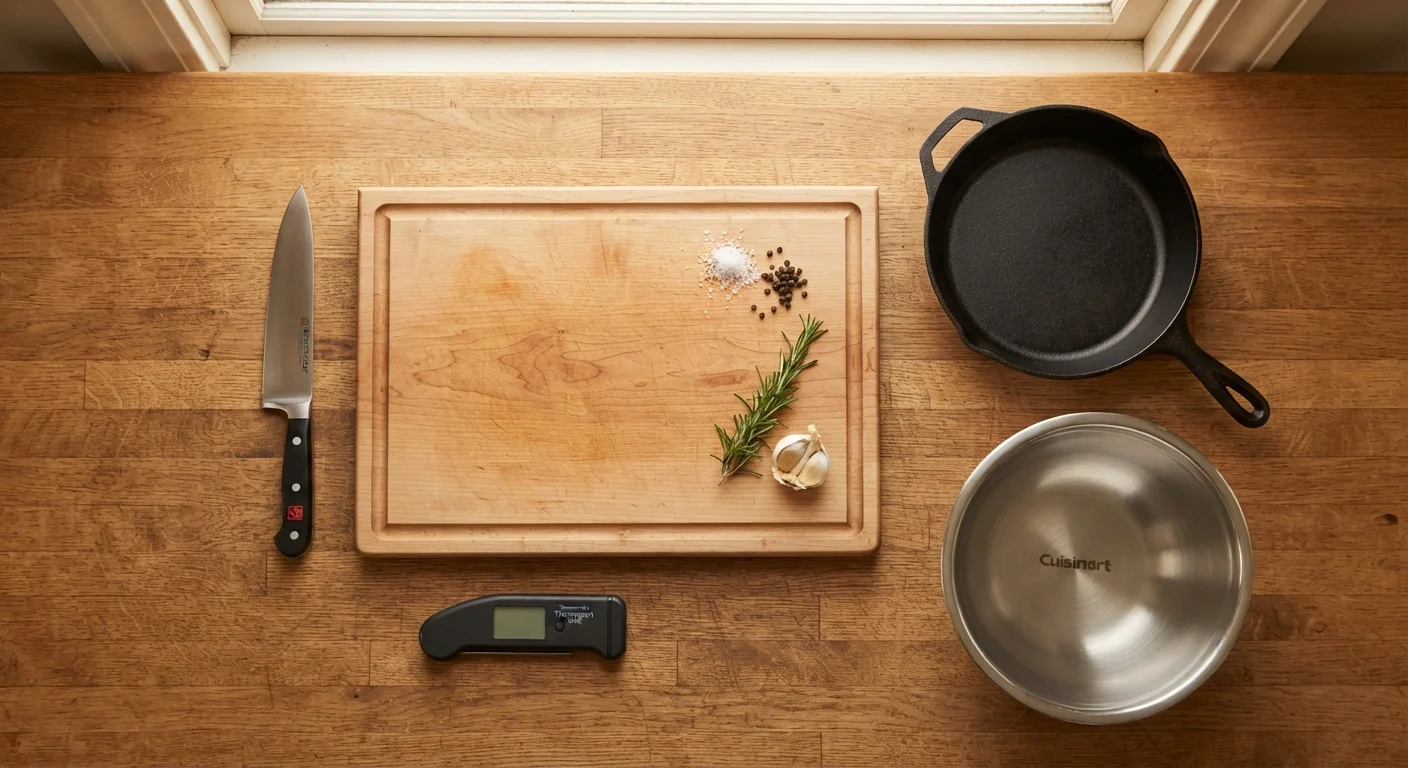
Why Equipment Choice Actually Matters
Kitchen stores and online marketplaces are full of gadgets promising to transform how you cook. The reality is that most home cooks need far fewer tools than they think — but the ones they do use regularly should be capable and comfortable to work with. Underpowered or poorly designed equipment makes basic tasks harder, slows down prep, and can quietly undermine your confidence at the stove.
This list focuses on the tools that appear in kitchen routines day after day. Each one earns its place not by doing something exotic, but by doing something fundamental well. If you're building your kitchen from scratch, these are the categories worth thinking through carefully before spending money on anything else.
An 8-Inch Chef's Knife
A single, well-made chef's knife handles the vast majority of kitchen prep: chopping vegetables, slicing meat, mincing herbs, and breaking down poultry. The 8-inch length is considered the practical sweet spot for most home cooks — long enough for efficient strokes on larger produce, short enough to stay controlled.
When evaluating a chef's knife, handle balance and grip comfort matter as much as blade quality. A knife that feels awkward in your hand is one you'll avoid using. Look for a handle that sits securely without requiring a tight grip. For technique guidance to complement your knife, our knife skills primer covers the fundamentals of grip, cutting motion, and safe prep habits.
One good chef's knife handles more prep tasks than any other single tool in the kitchen.
A 10- or 12-Inch Heavy Skillet
A heavy skillet — whether cast iron or stainless steel — holds and distributes heat far more evenly than a thin pan. This matters for searing proteins, achieving a proper sauté, and any technique that depends on consistent surface temperature. Thin pans create hot spots that scorch food unevenly, often at the moment when even heat would matter most.
Cast iron is highly durable, transitions from stovetop to oven seamlessly, and improves with use when maintained correctly. Stainless steel is lighter, responds to temperature changes faster, and is easier to clean immediately after use. Both are legitimate choices; the key is choosing one with meaningful weight and a flat, stable base.
Pan weight determines heat consistency — thin skillets create hot spots that undermine even simple techniques.
A Digital Instant-Read Thermometer
An instant-read thermometer is one of the highest-impact tools a home cook can own, yet it's consistently underused. Judging meat doneness by touch or color is unreliable and varies significantly between cooks and cuts. An accurate thermometer removes the guesswork and is directly tied to food safety — the USDA publishes specific internal temperature guidelines for different proteins, and hitting those targets is the only reliable way to confirm food is safe to eat.
Look for a thermometer that reads in two to three seconds or less. Probe thickness and a foldable design for storage are practical bonuses. This is also one of the least expensive tools on this list relative to the value it provides.
A thermometer is the most reliable food-safety tool in the kitchen — guessing doneness by color alone isn't sufficient.
A Large Cutting Board
Undersized cutting boards create cramped, inefficient prep work and increase the chance of cross-contamination when raw proteins and produce end up sharing limited space. A board at least 12 by 18 inches gives you room to work without ingredients falling off the edges mid-chop.
Wood and plastic are both widely used. Wood is gentler on knife edges and self-healing to some degree, but requires more deliberate cleaning — it should never be submerged or put through a dishwasher. Plastic boards are dishwasher-safe, which simplifies sanitation after handling raw meat. Keeping two boards — one designated for proteins — is a straightforward habit that reduces cross-contamination risk significantly.
A board large enough to give you real working room changes the pace and safety of all your prep work.
A Medium Dutch Oven or Heavy Pot
A 5- to 6-quart enameled Dutch oven or heavy pot handles an enormous range of tasks: braising, soups, stews, boiling pasta, and even bread baking for those who venture into that territory. The thick walls and tight-fitting lid create an environment that traps moisture and distributes heat gently, which is exactly what slow-cooked dishes need.
Enameled cast iron versions are the most versatile since they work on all stovetop types including induction, go into the oven, and don't require the same seasoning maintenance as bare cast iron. A good heavy pot is one of the longer-lasting kitchen investments — treated reasonably, it should last decades.
A heavy pot with a tight lid handles braising, soups, and stews — slow cooking's most essential piece of equipment.
A Rimmed Baking Sheet
Often overlooked in favor of more specialized tools, a sturdy half-sheet pan (18 by 13 inches) is one of the most used pieces of equipment in a home kitchen. Roasting vegetables, baking sheet-pan dinners, toasting nuts, and finishing proteins in the oven all rely on a pan that stays flat under heat and has sides high enough to contain juices.
Thin, warped baking sheets buckle in a hot oven, creating uneven cooking surfaces. Look for pans with rolled edges and sufficient gauge to stay rigid. Using a wire rack set inside the pan allows hot air to circulate beneath proteins during roasting, improving browning on all sides.
A flat, rigid baking sheet that doesn't warp in the oven is more useful than nearly any specialized kitchen gadget.
Putting It All Together
None of these tools requires a major investment to be effective, but each one rewards a little research before you commit. Focus on fit — how a knife handle feels in your hand, whether a pan's weight feels manageable when full. A tool you enjoy using is one you'll actually reach for.
Start With What You'll Actually Use
Resist the impulse to buy a complete set of anything before cooking regularly. Sets often include sizes and styles you'll reach for rarely. Build your collection incrementally — add tools when a genuine gap in your cooking becomes obvious, not in advance of one.
Pair good tools with good technique and you'll cover most everyday cooking situations. For building out the rest of your kitchen foundation, see our pantry staples guide and our overview of food safety habits every cook should follow.
The content on this site is for informational purposes only and is not a substitute for professional advice. Always consult a qualified professional for guidance specific to your situation.