

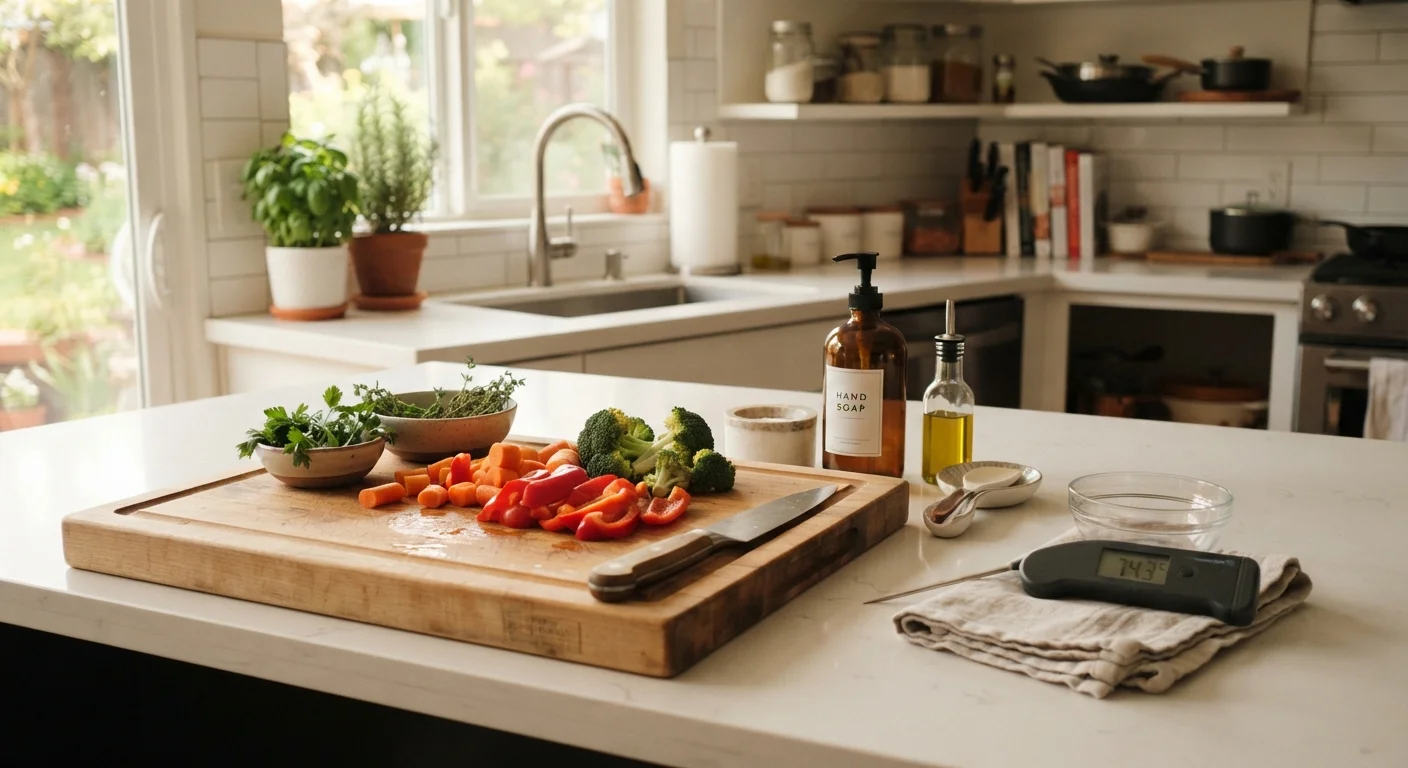
Why Food Safety Deserves Serious Attention
Each year, roughly 48 million Americans experience a foodborne illness, according to the Centers for Disease Control and Prevention (CDC). Most cases aren't caused by restaurant meals — they happen at home, in familiar kitchens, during everyday cooking. The good news is that the habits responsible for the vast majority of these incidents are entirely preventable.
Food safety isn't about fear or perfection. It's about building a short list of non-negotiable routines that become second nature. Whether you're cooking everyday meals or preparing something more involved, the practices below apply every time.
48M
Americans affected by foodborne illness annually
According to the Centers for Disease Control and Prevention (CDC), roughly 48 million Americans experience foodborne illness each year.
128,000
Hospitalizations from foodborne illness each year
The CDC estimates foodborne illnesses result in approximately 128,000 hospitalizations annually in the United States.
Handwashing and Surface Hygiene
Washing hands is the single highest-impact habit in any kitchen. The CDC recommends washing with soap and warm water for at least 20 seconds before handling food, after touching raw meat or poultry, after using the restroom, and after handling garbage or pets. A quick rinse doesn't count — friction and soap together are what remove pathogens effectively.
Counter surfaces and cutting boards need the same attention. Use a clean cutting board for produce and a separate one for raw meat, poultry, or seafood. Cross-contamination — when juices from raw protein come into contact with ready-to-eat foods — is a leading cause of illness at home. Color-coded boards make the separation easy to maintain. Wipe counters with hot, soapy water before and after prep, not just at the end of a cooking session.
A Simple Two-Board System Works
You don't need an elaborate setup to prevent cross-contamination. Two cutting boards — one exclusively for raw meat, poultry, and seafood, and one for everything else — is enough. Color-coding them (many are sold this way) makes the division automatic even when you're moving quickly through a recipe.
Cooking to Safe Internal Temperatures
Visual cues like color and firmness are unreliable indicators of doneness. A burger patty can turn brown before reaching a safe temperature, and chicken can appear done while still harboring harmful bacteria. The only trustworthy method is a food thermometer.
The USDA's recommended minimum internal temperatures are: 145°F for whole cuts of beef, pork, lamb, and seafood (with a three-minute rest); 160°F for ground beef and pork; and 165°F for all poultry, including ground turkey. Insert the thermometer into the thickest part of the food, away from bone. A reliable thermometer is one of the most genuinely useful tools a home cook can keep on hand — see kitchen equipment that earns its place for what to look for.
It's also worth knowing that some common cooking assumptions — like judging doneness by touch or color alone — don't hold up under scrutiny.
Refrigeration, Storage, and the Danger Zone
Bacteria multiply rapidly between 40°F and 140°F — a range the USDA calls the temperature danger zone. Perishable food left in this range for more than two hours (or one hour when ambient temperature exceeds 90°F, such as at outdoor gatherings) enters risky territory. This applies to raw ingredients and cooked leftovers alike.
Store raw meat and poultry on the bottom shelf of the refrigerator so juices can't drip onto other foods. Keep your refrigerator at or below 40°F and your freezer at 0°F. Thaw frozen foods safely: in the refrigerator, under cold running water, or in the microwave if you plan to cook immediately — never on the counter at room temperature.
Leftovers should be portioned into shallow containers before refrigerating so they cool quickly and evenly. Label containers with the date — most cooked leftovers are safe for three to four days. For those building a consistent weekly meal routine, practicing good storage habits prevents both waste and illness.
Always use a food thermometer to verify doneness in meat and poultry.
Color and texture are unreliable indicators — pathogens can survive even when food looks done. A thermometer removes the guesswork and is the standard recommended by the USDA.
Designate separate cutting boards for raw protein and ready-to-eat foods.
Cross-contamination from raw meat juices is a primary source of household foodborne illness. Keeping boards separated by task eliminates this transfer pathway entirely.
Refrigerate perishable food within two hours of cooking or serving.
Bacteria double rapidly at room temperature. The two-hour window is the safety threshold established by the USDA; exceeding it meaningfully increases the risk of illness.
Thaw frozen foods in the refrigerator, not on the counter.
Counter thawing allows the food's outer surface to enter the danger zone while the interior is still frozen, creating ideal conditions for bacterial growth.
Wash hands thoroughly before, during, and after food preparation.
Hands transfer bacteria between surfaces, raw ingredients, and ready-to-eat food at every stage of cooking. Consistent handwashing breaks that chain more reliably than any other single measure.
Quick Wins You Can Start Using Today
Food safety habits don't require a kitchen overhaul. A handful of small, specific actions can close the most common gaps immediately.
Sharpening your broader kitchen knowledge helps these habits stick. Safe prep technique and food safety go hand in hand — both reduce risk and build confidence at the stove.
The content on this site is for informational purposes only and is not a substitute for professional advice. Always consult a qualified professional for guidance specific to your situation.