

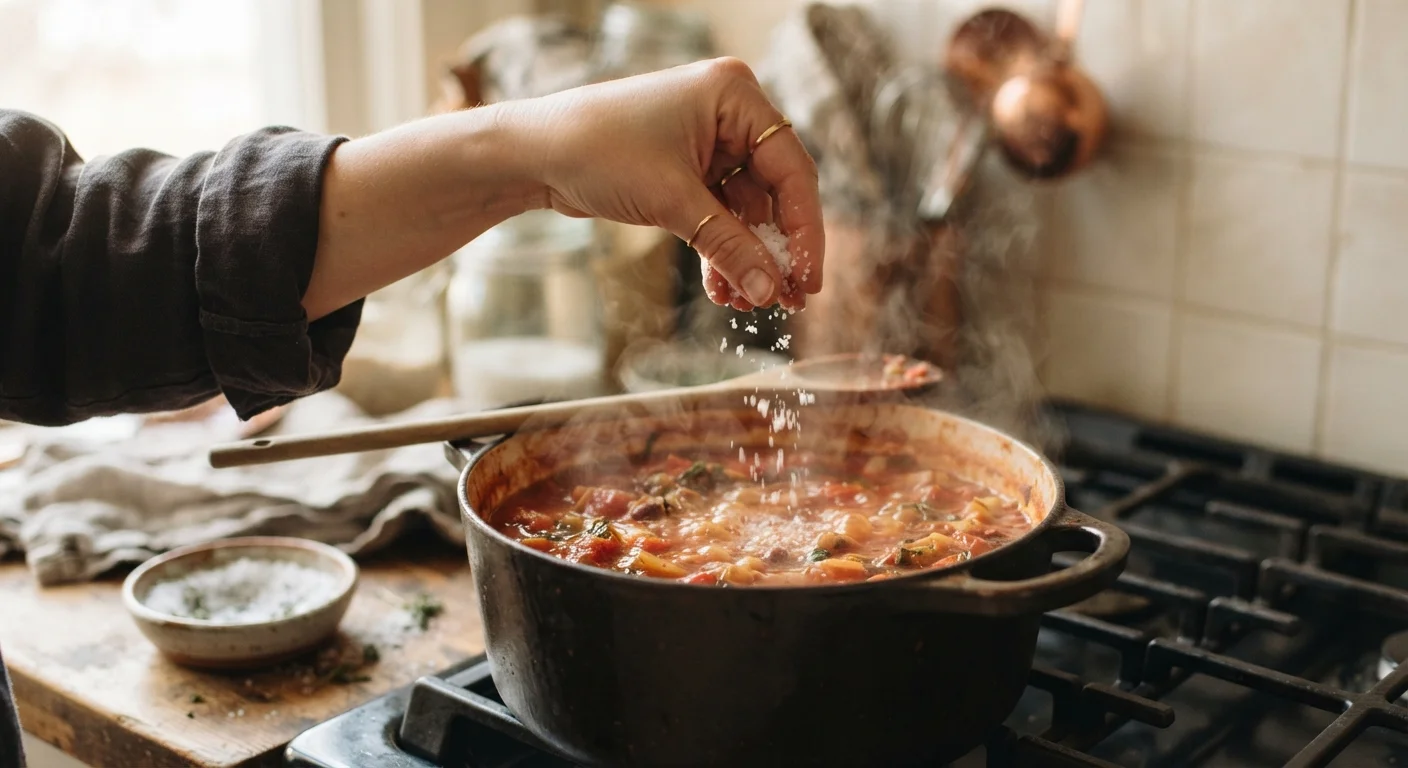
Why This Instruction Confuses So Many Cooks
Nearly every savory recipe ends with some version of the same instruction: season to taste. It sounds simple, but without knowing what to taste for, it's easy to either skip the step entirely or add a reflexive shake of salt and call it done. Neither approach gets you where you want to go.
The phrase is really shorthand for a small but deliberate process: taste the dish critically, identify what it's missing, and adjust in small increments until the flavors click into place. For a deeper look at how recipe language works in general, see our cooking terms glossary.
Understanding the instruction starts with knowing what the main tools are. In almost every dish, flavor balance comes down to three levers: salt, acid, and fat.
The Three Levers of Seasoning
Salt is the most powerful flavor tool in the kitchen. It doesn't just make food taste salty—it suppresses bitterness, amplifies sweetness, and makes other flavors more vivid and forward. A dish that tastes flat or muted almost always needs more salt, even if it doesn't taste under-salted. Our article on how salt works in cooking goes deeper on why timing and salt type both matter.
Acid—from lemon juice, vinegar, citrus zest, or even a splash of wine—is the second lever. Acid lifts and brightens. When a dish tastes heavy, muddy, or one-note even after salting, a small amount of acid often cuts through and brings everything into focus. Think of the squeeze of lime over a bowl of soup or the splash of red wine vinegar that makes a braise pop.
Fat is the third lever. Butter, olive oil, cream, or even a drizzle of good tahini can round harsh edges and carry flavor across the palate. A dish that tastes sharp, astringent, or aggressive—too much acid or heat—often responds well to a small addition of fat.
3
Core seasoning levers in most savory dishes
Salt, acid, and fat cover the vast majority of flavor corrections a home cook will ever need to make.
~20%
Reduction in perceived saltiness when food cools
Culinary educators commonly note that food tastes less salty when cold, which is why dishes should be seasoned at or near serving temperature for accurate results.
These three work together. A dish can need all three in different proportions, and adjusting one sometimes reveals a new need for another.
How to Actually Do It: A Step-by-Step Approach
The mechanics are straightforward once you build the habit:
- Taste before you season. Always start by tasting the dish as-is. You need a baseline to know what's missing.
- Identify the gap. Is it flat and dull? Likely needs salt. Is it dull even after salting? Try a small amount of acid. Does it taste sharp or harsh? Try fat or a pinch of sugar.
- Add in small amounts. A pinch of salt, a few drops of lemon juice, a small knob of butter. Stir, wait a moment, then taste again. Small increments prevent overcorrection.
- Taste again—and again. Seasoning is iterative. One adjustment often reveals the next need.
- Stop when the dish tastes complete. You'll know it when the main ingredients taste forward and vivid rather than hidden or muted.
Always Season at Serving Temperature
Hot food and cold food taste different—a dish seasoned correctly at room temperature may taste under-salted once it's hot, and vice versa. Get in the habit of doing your final taste-and-adjust step when the dish is at the temperature your guests will actually eat it. This single habit eliminates a common source of seasoning errors.
For a broader look at working instinctively with these flavor elements, our guide on building flavor without a recipe walks through the same principles in a freestyle cooking context.
Building Your Palate Over Time
Tasting deliberately is a skill, and it develops with practice. Each time you taste critically—naming what you notice, making an adjustment, and tasting again—you're training your palate to recognize flavor patterns faster. Over time, you'll start catching imbalances earlier in the cooking process, which makes correction easier and the final dish more consistent.
One practical exercise: before seasoning a dish, taste a small spoonful and try to describe it in simple terms. Flat? Bright? Heavy? Sharp? Just naming it helps you choose the right lever. If you're cooking a new dish type, it also helps to taste the components individually before they're combined so you understand what each one contributes.
"Season to taste" isn't a vague hand-wave—it's an invitation to engage actively with what you're cooking. The more you do it, the more natural it becomes.
Frequently Asked Questions
Not at all. While salt is the most common seasoning tool, "season to taste" also includes acid (like lemon juice or vinegar), fat (like butter or olive oil), and sometimes a small amount of sugar. Each corrects a different flavor problem, and good cooks use all of them.
A well-seasoned dish tastes vivid and complete—the flavors of the main ingredients are clear and forward, with no single note overpowering the others. If it tastes dull or muted, it likely needs more salt or acid. If it tastes sharp or one-dimensional, a small amount of fat or sweetness can soften it.
Yes, over-salting is possible. To recover, try adding more of the unseasoned base ingredients, a squeeze of acid, a starchy element like potato or bread, or additional fat to dilute and balance the saltiness. Prevention is easier than correction, which is why small, incremental additions matter.
Taste throughout the entire cooking process—early, middle, and finish. Flavors evolve as food cooks, and catching an imbalance early is far easier to fix than correcting it at the table. Use a clean spoon each time for food safety.
Seasoning enhances and balances what's already present in a dish—it makes the existing flavors brighter or more complete. Flavoring adds new taste elements, like herbs, spices, or aromatics. The two often work together, but they serve different purposes.
The content on this site is for informational purposes only and is not a substitute for professional advice. Always consult a qualified professional for guidance specific to your situation.