

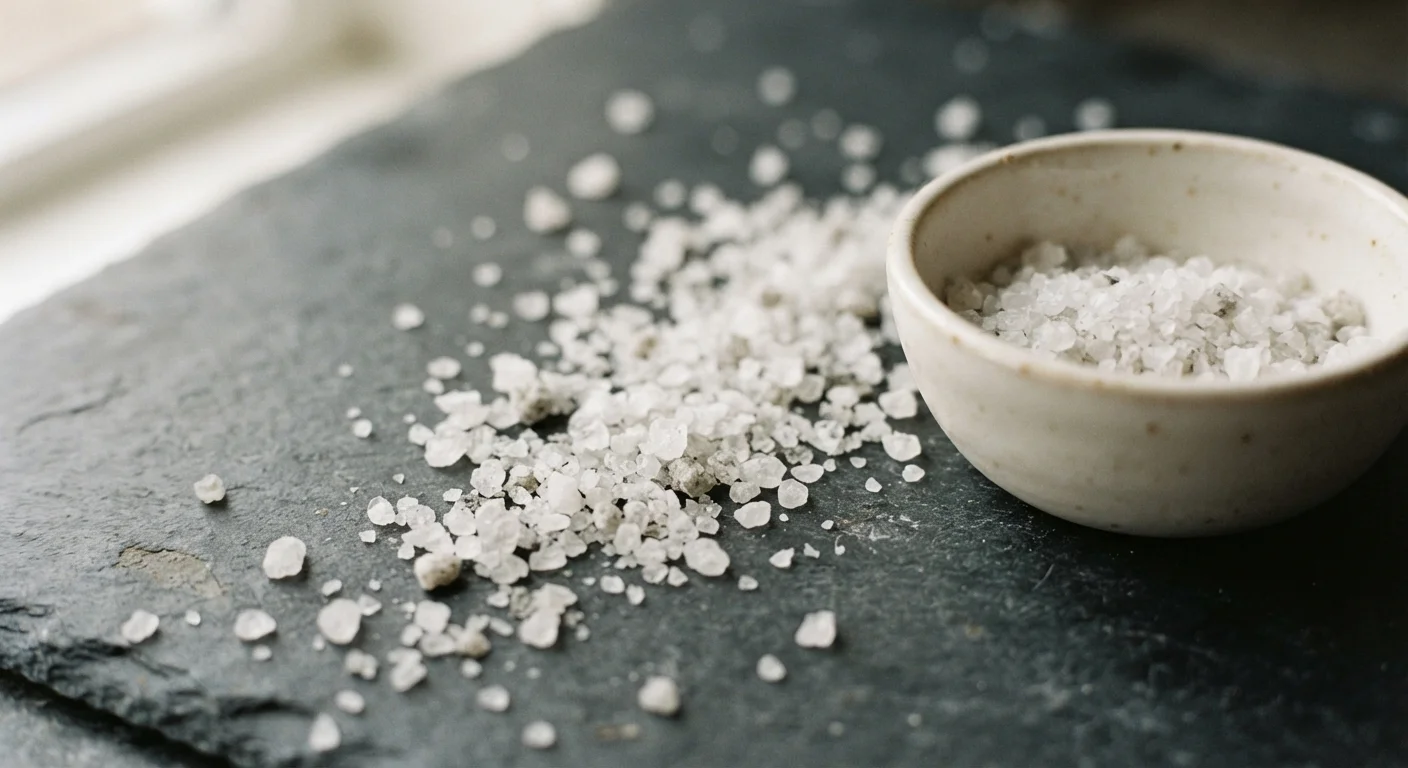
How Salt Changes the Way Food Tastes
Salt's most important job is not making food taste salty — it's making food taste more like itself. At low concentrations, sodium ions suppress bitter taste compounds while amplifying aromas and other flavors. This is why a small pinch of salt in baked goods or coffee rounds out the flavor without adding any detectable saltiness.
Salt also enhances the volatility of aromatic molecules, meaning salted food releases more of its scent as you eat it. Since much of what we perceive as flavor is actually aroma, this effect is significant. Think of the difference between a salted and an unsalted tomato: same tomato, dramatically different experience.
For a deeper look at how flavor-building ingredients work together, see how aromatics, fat, and acid work together — salt fits into that same foundational framework.
“Salt is the most important ingredient in cooking. It's the one that makes everything else taste like what it is.”
— Samin Nosrat, Culinary author and educator, known for 'Salt, Fat, Acid, Heat'
The Physical Effects: Moisture, Texture, and Protein
Salt doesn't just affect taste — it changes the physical structure of food through osmosis and protein chemistry. When salt contacts the surface of a vegetable or piece of meat, it draws water out of the cells and toward the surface. In vegetables like eggplant or zucchini, this can reduce bitterness and improve texture before cooking.
With meat, the story is more nuanced. Initially, salt draws moisture to the surface. But given enough time — typically 45 minutes or more — that moisture is reabsorbed along with the dissolved salt, which begins to denature proteins and help them retain moisture during cooking. This is the principle behind dry-brining: salting meat well in advance produces a juicier result than salting right before cooking.
Salt also affects gluten in bread dough. It strengthens gluten networks and slows fermentation, giving bakers more control over texture and rise. Without salt, bread dough often becomes slack and sticky.
~70%
Taste perception attributed to aroma
Sensory science research consistently shows that the majority of what humans experience as 'flavor' is driven by olfaction, which explains why salt's role in releasing aromatic compounds has such a large impact.
45+ min
Minimum dry-brine time for moisture reabsorption
Food science writers including Samin Nosrat and J. Kenji López-Alt have documented that salting meat at least 45 minutes — or ideally overnight — allows brine to reabsorb into the muscle rather than sit on the surface.
Why Timing and Type Both Matter
When you add salt is nearly as important as how much you add. Seasoning in layers — at each stage of cooking rather than all at once at the end — gives salt time to penetrate and work. Onions salted as they hit the pan release moisture faster and caramelize more evenly. A braise seasoned early develops more integrated flavor than one corrected at the end.
Salt type also affects outcomes, primarily because of crystal size and density. Coarse kosher salt has large, irregular flakes that are easier to pinch and distribute evenly by hand. Fine table salt dissolves quickly and is better suited to baking, where precise measurement matters. Flaky finishing salts like fleur de sel are used at the end of cooking for texture and visual appeal — their delicate structure would dissolve and disappear under heat.
This is a common source of confusion when following recipes — a teaspoon of one salt is not a teaspoon of another. Some home cooks discover this the hard way with an over-salted dish. Common cooking myths worth letting go touches on similar cases where small misunderstandings have outsized consequences in the kitchen.
Use Your Fingers, Not a Spoon
Pinching and distributing salt by hand gives you far more control than shaking from a container. You can feel how much you're applying and spread it more evenly across a surface. Most professional cooks develop their sense of how much salt to use through this tactile habit rather than measuring every time.
Practical Applications Every Home Cook Should Know
A few reliable habits can immediately improve your cooking. Salt pasta water generously — it's the only chance you have to season pasta itself, not just the sauce on top. See why pasta water is the secret ingredient for more on getting the most from this step.
Taste as you cook, and season progressively. If a dish tastes flat, ask whether it needs more salt or whether it needs acid — sometimes lemon juice or vinegar does what an extra pinch of salt cannot. For a structured approach to this, what 'season to taste' actually means walks through the full balancing process.
Finally, keep your sodium context in mind. Most dietary sodium in the American diet comes from processed and restaurant foods, not the salt you add at home — something sodium sources in the American diet explores in detail. Thoughtful salting at home is not a health risk for most people; it's a cooking skill.
Frequently Asked Questions
Bland food is often the result of salting too late or too lightly at each stage of cooking. Salt works best when added gradually throughout the cooking process, not just at the table. Also check that your acid balance is right — a squeeze of lemon can make salt more effective.
You can substitute, but not cup-for-cup. Table salt has smaller, denser grains, so it packs more sodium per teaspoon than coarse kosher salt. As a general guideline, use about half the volume of table salt if a recipe specifies kosher salt — but always taste as you go.
It depends on your goal. Salting draws out moisture through osmosis, which softens texture. For cucumbers in a salad, this is often desirable — it removes excess water and concentrates flavor. For roasted vegetables, patting them dry after salting helps achieve browning rather than steaming.
A widely used benchmark is roughly one to two tablespoons of kosher salt per gallon of water — enough that the water tastes pleasantly seasoned, sometimes described as 'like the sea.' This seasons the pasta from the inside out and cannot be replicated by salting after draining.
Nutritionally, sea salt and table salt contain essentially the same amount of sodium by weight. Sea salt may contain trace minerals, but the amounts are too small to have a meaningful health impact. The main practical differences are texture, crystal size, and how they dissolve.
The content on this site is for informational purposes only and is not a substitute for professional advice. Always consult a qualified professional for guidance specific to your situation.