

Our Verdict
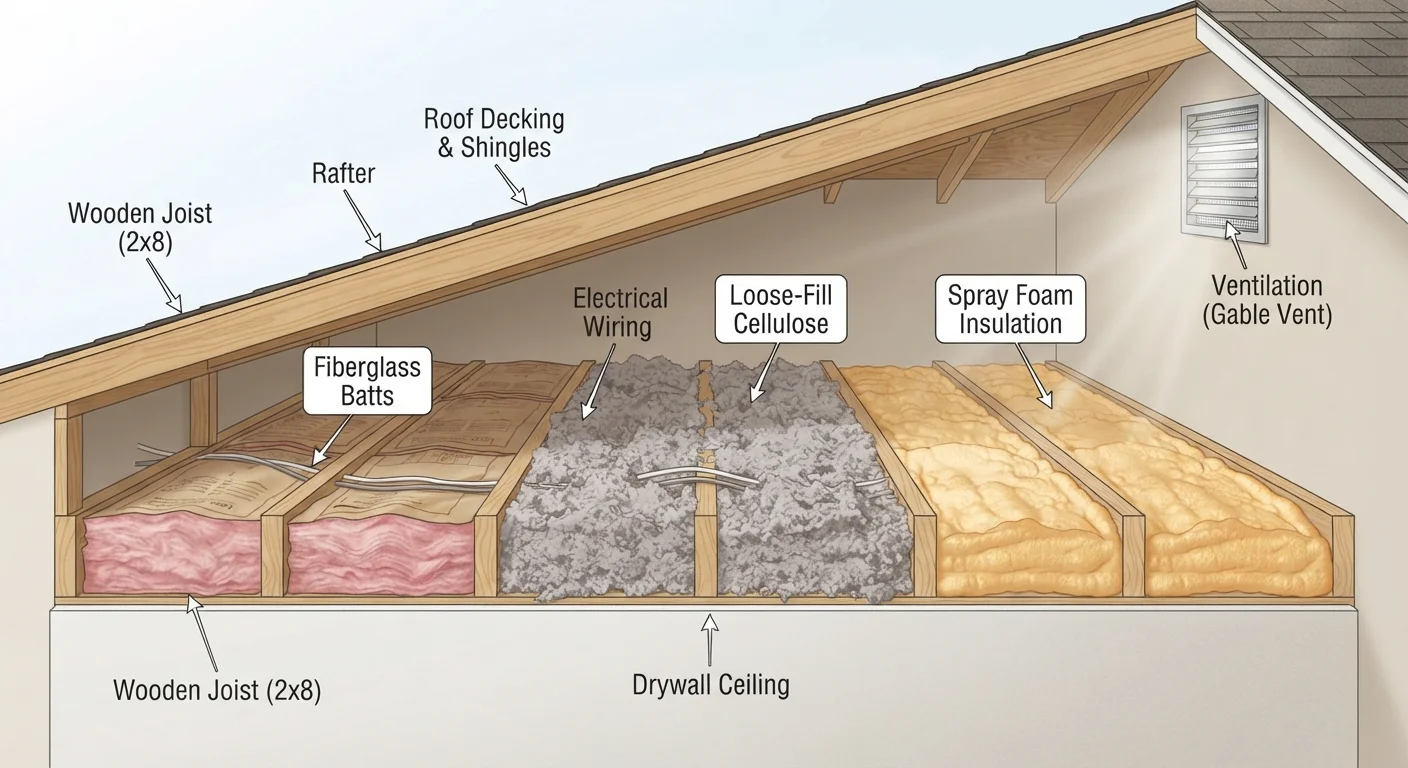
Each insulation type fills a different role. Batts suit DIY-friendly, straightforward attics; blown-in is the go-to for adding coverage to existing insulation or navigating tight spaces; and spray foam is the premium choice when air sealing and maximum thermal resistance are both priorities. The right pick depends on your attic's condition, your budget, and how much of the work you can do yourself.
| Best for | Recommended |
|---|---|
| DIYers with open, evenly spaced joists and a clean attic | Fiberglass Batts |
| Homeowners adding insulation over existing material or dealing with irregular spaces | Blown-In (Cellulose or Fiberglass) |
| Those prioritizing maximum air sealing and R-value in a single application | Spray Foam |
| Budget-conscious projects where professional installation is acceptable | Blown-In (Cellulose or Fiberglass) |
Why Attic Insulation Type Matters
Choosing attic insulation isn't just about picking a product off a shelf — it's about matching the material to your attic's actual conditions. Factors like joist spacing, existing insulation, the presence of air leaks, and whether you're doing the work yourself all point toward different solutions.
Before comparing materials, it's worth noting that insulation and ventilation work as a system. Adding insulation without addressing airflow can trap moisture and damage your home's structure. See our guide on attic insulation and ventilation to understand how these two systems depend on each other before you begin.
Also, no insulation type substitutes for air sealing. Gaps around recessed lights, plumbing penetrations, and attic hatches should be sealed first. Our article on caulking, weatherstripping, and sealing covers where each method belongs.
| Fiberglass Batts | Blown-In Cellulose | Blown-In Fiberglass | Closed-Cell Spray Foam | |
|---|---|---|---|---|
| Typical R-value per inch | R-3.0 to R-3.8 | R-3.2 to R-3.8 | R-2.2 to R-2.9 | R-6.0 to R-7.0 |
| DIY-friendly | Yes, with basic tools | Possible with rented equipment | Possible with rented equipment | No — professional required |
| Air sealing capability | None on its own | Minimal | Minimal | Excellent — seals as it insulates |
| Relative material cost | Low to moderate | Low | Low to moderate | High |
| Handles irregular spaces | Poor — voids common | Excellent | Excellent | Excellent |
| Moisture resistance | Moderate — can absorb moisture | Good when dry; avoid if damp | Good | Excellent — vapor barrier |
| Environmental profile | Moderate recycled content | High recycled content | Moderate recycled content | Petrochemical-based |
Fiberglass Batts: The DIY Classic
Fiberglass batts are pre-cut panels of spun glass fibers, typically sold in widths designed to fit standard 16-inch or 24-inch joist spacing. They're the most recognizable insulation type and the most accessible for homeowners tackling the job themselves.
Strengths
- Widely available and straightforward to install between open joists
- No special equipment required beyond gloves, a mask, and a utility knife
- Available in a range of R-values (R-13 to R-38 for attic use)
Limitations
- Performs poorly if compressed or if joists are irregularly spaced
- Does not air-seal on its own — gaps around batts allow warm air to bypass insulation
- Difficult to retrofit over existing insulation without creating moisture traps
Always Wear Proper Protection with Batts
Fiberglass fibers are a skin and respiratory irritant. Wear long sleeves, gloves, safety glasses, and an N95 or better respirator when handling batts. Work in a well-ventilated attic and take breaks in fresh air regularly. Disposable coveralls make cleanup much easier.
Blown-In Insulation: Flexible and Effective
Blown-in insulation — available in cellulose (recycled paper) or loose-fill fiberglass — is installed using a blowing machine that distributes material evenly across the attic floor. Many home improvement centers loan the equipment when you purchase enough bags.
Strengths
- Fills irregular spaces, around obstructions, and over existing insulation without voids
- Cellulose has strong environmental credentials (high recycled content) and good fire resistance
- Cost-effective way to increase R-value in an already-insulated attic
- Professional installation is fast — often completed in a single day
Limitations
- Settles over time, which can reduce effective R-value if not accounted for during installation
- Not a DIY-friendly project for most homeowners without renting blowing equipment and a helper
- Like batts, does not inherently air-seal — separate caulking or foam is still needed at penetrations
Spray Foam: Maximum Performance, Higher Cost
Spray polyurethane foam (SPF) comes in two varieties: open-cell (lower density, lower R-value, more affordable) and closed-cell (dense, high R-value, vapor-resistant). In attics, closed-cell foam is typically applied to the underside of the roof deck when creating a conditioned attic, while open-cell is sometimes used for the same purpose at lower cost.
Strengths
- Closed-cell foam achieves R-6 to R-7 per inch — the highest of the three types
- Simultaneously insulates and air-seals in a single application
- Resistant to moisture and does not settle
Limitations
- Significantly more expensive than batts or blown-in — typically requires professional installation
- Improper DIY application can leave uncured foam that off-gasses; professional installation is strongly recommended
- Changes attic ventilation dynamics; consult a professional before choosing this approach
Spray Foam Requires Professional Installation
Off-ratio or improperly mixed spray foam can remain chemically active and release harmful vapors for extended periods. Consumer-grade spray foam kits are not suitable for large-area attic applications. Always hire a certified spray foam contractor, ensure adequate ventilation during and after application, and verify the product has been fully cured before reoccupying the space.
Making the Right Choice for Your Attic
Start by assessing your attic honestly. Is the floor open with consistent joist spacing and no existing insulation? Batts may be all you need. Is there already some insulation but coverage is thin or uneven? Blown-in is typically the most cost-effective upgrade. Are you renovating a finished attic, converting space, or dealing with serious air infiltration? Spray foam may justify the investment.
Climate zone also matters. The U.S. Department of Energy recommends total attic insulation levels ranging from approximately R-30 in warmer southern climates to R-60 in colder northern regions. Any insulation type can be layered to reach the target R-value, though combining materials (such as batts plus blown-in) requires attention to moisture management.
Whatever type you choose, have the attic inspected for existing damage, pest activity, or moisture issues before installation. Adding insulation over existing problems only conceals them — and that can lead to far costlier repairs down the road.
The content on this site is for informational purposes only and is not a substitute for professional advice. Always consult a qualified professional for guidance specific to your situation.