

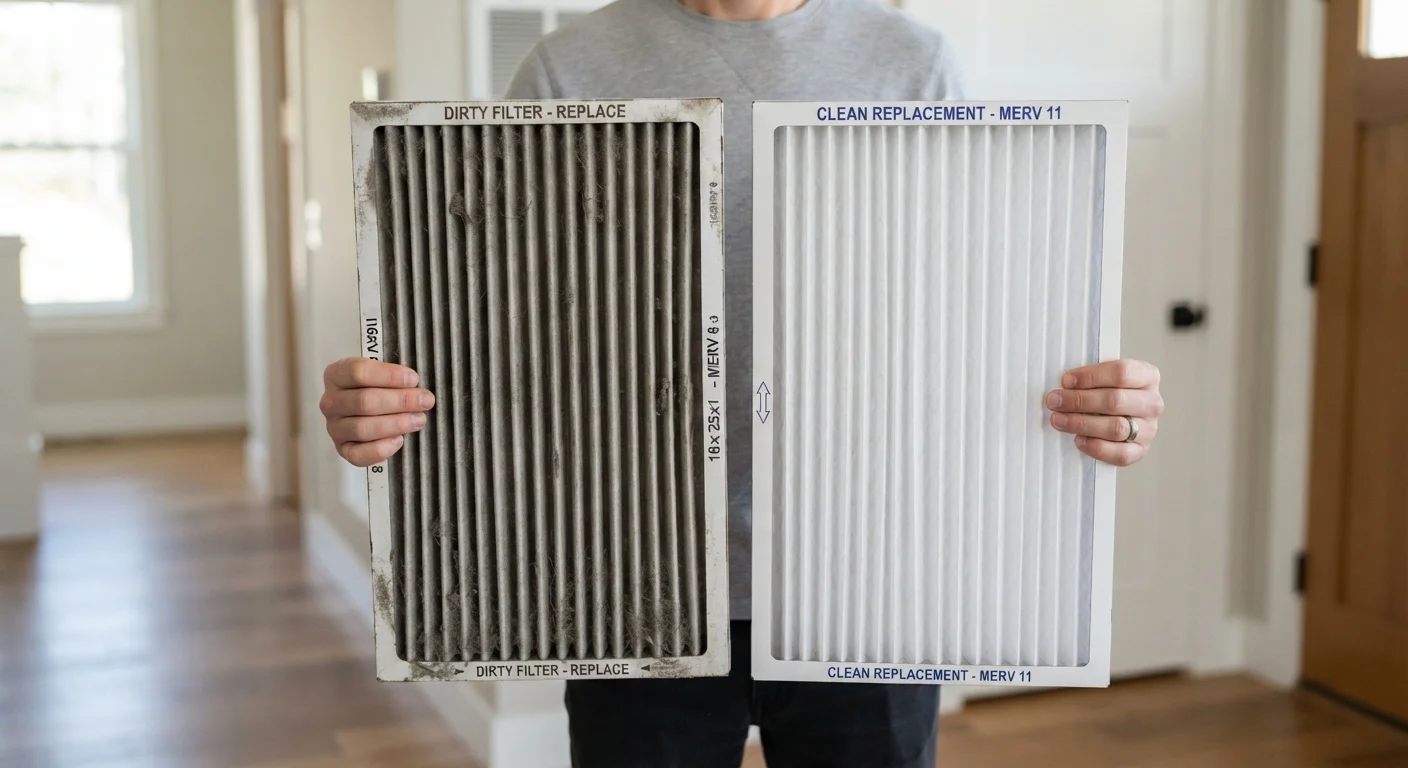
The Job Your Filter Does Every Day
Your HVAC system circulates the air in your home multiple times per hour — and every time it does, that air passes through the filter. The filter's job is to catch the particles that would otherwise coat your ductwork, clog internal components, and recirculate through your living space.
Without a functioning filter, dust accumulates on the evaporator coil, reducing its ability to transfer heat. The blower motor works harder to pull air through debris-choked passages. In cooling mode, restricted airflow can cause the coil to ice over entirely, shutting the system down. None of this happens dramatically — it builds gradually, which is exactly why a filter is so easy to ignore.
Just as your car's air filter quietly affects performance, your HVAC filter does its most important work invisibly, until the system fails.
5–15%
Potential energy savings from a clean filter
The U.S. Department of Energy estimates that replacing a clogged HVAC filter can lower energy consumption by 5–15%.
$10–$30
Typical cost of a quality replacement filter
A standard pleated filter costs a fraction of even a basic HVAC service call, making it one of the highest-value maintenance tasks in the home.
1 in 5
HVAC failures linked to poor maintenance
Industry estimates suggest that a significant share of HVAC breakdowns are attributable to restricted airflow from dirty filters and coils.
Understanding MERV Ratings
Every filter carries a MERV rating — a standardized measure of how effectively it captures particles of different sizes. Here's a practical breakdown:
- MERV 1–4: Basic fiberglass panels. Protects equipment from large debris, does little for indoor air quality.
- MERV 8–11: Pleated filters that capture dust mites, mold spores, pet dander, and most pollen. Suitable for the majority of homes.
- MERV 13–16: High-efficiency filters that capture bacteria and fine smoke particles. Typically used in medical or commercial settings, and can restrict airflow in standard residential systems.
The key insight: a MERV 13 filter installed in a system rated for MERV 8 can cause the same airflow restriction as a clogged filter. When in doubt, consult your equipment documentation or a licensed HVAC technician before upgrading.
Write the Date on Every New Filter
When you install a fresh filter, use a marker to write the installation date directly on the filter frame. Next time you open the unit, you'll know exactly how long it's been in service — no guesswork, no missed changes.
How Often to Change It — and What Changes That
General guidelines suggest replacing a standard 1-inch filter every 30–90 days. But several household factors pull that timeline shorter:
- Pets: Fur and dander load a filter quickly — monthly changes are common in multi-pet homes.
- Allergies or asthma: More frequent changes maintain better indoor air quality for sensitive household members.
- High occupancy: More people mean more skin cells, tracked-in debris, and cooking particles in the air.
- Construction or renovation nearby: Drywall dust and construction particulates can clog a filter in days.
- Thicker filters: 4–5 inch media filters have much larger surface area and can last 6–12 months — always follow manufacturer guidance.
A simple habit: check the filter when you pay your utility bill each month. Hold it up to the light — if you can't see light through it, it's time for a replacement. This kind of routine home maintenance check takes under two minutes and can prevent hundreds of dollars in repairs.
What Happens When You Let It Slide
Deferred filter maintenance doesn't just affect air quality — it cascades through the entire system. A restricted filter forces the blower motor to strain, shortening its lifespan. The evaporator coil ices over, potentially causing refrigerant line damage. In heating mode, a clogged filter can cause the heat exchanger to overheat and crack — a safety hazard that requires immediate professional attention.
Energy consumption rises too. Studies by the U.S. Department of Energy have noted that dirty filters are a significant contributor to reduced HVAC efficiency, driving up utility costs in ways that dwarf the cost of a replacement filter. The pattern closely mirrors what happens across all deferred home maintenance: small, inexpensive tasks ignored become large, expensive repairs.
Keeping up with filters is among the simplest ways to protect a major home system — and it requires no tools, no professional help, and minimal cost.
Frequently Asked Questions
Most standard 1-inch filters should be replaced every 30–90 days. Homes with pets, smokers, or allergy sufferers should change filters closer to every 30 days. Thicker filters (4–5 inches) may last up to 6–12 months — check the manufacturer's guidance.
MERV 8–11 is the practical sweet spot for most homes — efficient enough to capture common allergens without over-restricting airflow. MERV 13+ offers hospital-grade filtration but may strain systems not designed for higher resistance. Check your HVAC manual or consult a technician before upgrading.
Yes. A clogged filter starves the system of airflow, causing the blower motor to work harder and the evaporator coil to freeze in cooling mode. Over time this can lead to compressor failure — one of the most expensive HVAC repairs possible.
In most homes, the filter sits in the return air grille on a wall or ceiling, or inside the air handler unit itself. Check both locations — some systems have more than one filter. Your HVAC owner's manual will show you the exact spot.
Not necessarily. A very high-MERV filter can restrict airflow in systems designed for lower-resistance filters, causing the same problems as a clogged filter. Match the filter to what your system is rated to handle, not just to the highest number available.
The content on this site is for informational purposes only and is not a substitute for professional advice. Always consult a qualified professional for guidance specific to your situation.