

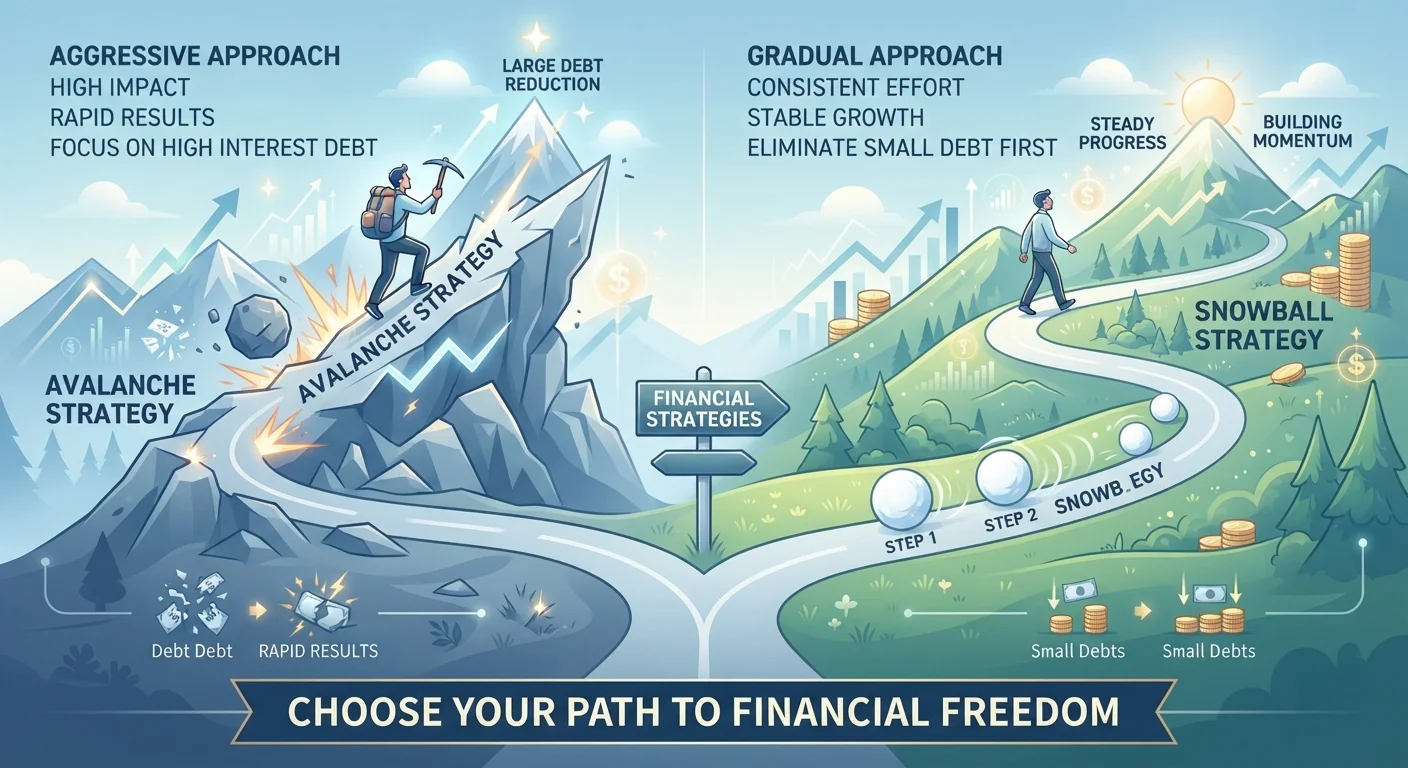
Option A
Debt Avalanche
The mathematically optimal approach for minimizing total interest paid.
Best for: People who are motivated by long-term savings and can stay disciplined even when early progress feels slow.
Option B
Debt Snowball
The psychologically rewarding method built around quick wins.
Best for: People who need visible momentum to stay motivated and are willing to pay a bit more interest for the encouragement of eliminating accounts.
How Each Strategy Actually Works
Both methods share the same core mechanic: you pay the minimum required on every debt each month, then funnel any extra money you can afford toward one specific target. Where they differ is which debt gets that focused extra payment.
Debt Avalanche: List your debts from highest interest rate to lowest. Direct all extra money to the debt at the top of that list. Once it's paid off, roll its payment into the next-highest-rate debt, and so on. Because high-interest debt accumulates charges fastest, eliminating it first shrinks the total amount you'll repay over the life of your debts.
Debt Snowball: List your debts from smallest balance to largest — ignoring interest rates entirely. Direct extra money to the smallest balance first. When that debt is gone, add what you were paying on it to the next smallest, creating a growing "snowball" of payments. The appeal is speed: smaller balances disappear faster, giving you early victories that can sustain motivation.
To understand how these fit into a broader financial picture, see our complete overview of savings and debt management.
| Criterion | Debt Avalanche | Debt Snowball |
|---|---|---|
| Payoff order | Highest interest rate first | Smallest balance first |
| Total interest paid | Lower (mathematically optimal) | Typically higher |
| Time to first payoff | Slower if high-rate debt is large | Faster — smallest debt clears first |
| Psychological motivation | Relies on long-term discipline | Built-in quick wins |
| Best debt profile | One or more high-rate debts | Multiple small balances |
| Complexity | Requires tracking APRs | Simple to set up and follow |
The Real Cost Difference — and When It Matters
The avalanche will almost always cost you less in total interest than the snowball — that's simply arithmetic. But how much less depends on your specific debt mix. If your balances are similar in size, the difference in total interest may be modest. If you have one debt charging 24% APR alongside others at 7–10%, the gap can be substantial.
~$1,000+
Potential interest savings with avalanche vs. snowball
The exact savings vary widely by debt mix; households with high-rate credit card debt tend to see the largest difference between methods.
~77%
Americans carrying some form of debt
According to Federal Reserve data, the vast majority of U.S. households carry at least one form of consumer or mortgage debt.
Here's the honest tradeoff: if the snowball's momentum keeps you on plan for three years while you might have abandoned the avalanche after six months, the snowball wins in practice — even though it costs more on paper. Behavioral research consistently finds that people tend to underestimate how much motivation and habit formation matter in debt payoff. A strategy you follow through beats a strategy you abandon.
It's also worth noting that not all debt is equally worth rushing to eliminate. Our article on good debt, bad debt, and the gray area in between explains why prioritizing debt payoff sometimes depends on the type and rate of the debt itself.
Choosing the One That Fits You
There's no single correct answer here — but there are honest questions worth asking yourself before you choose.
- Have you tried paying down debt before and stalled? If yes, the snowball's early wins may be worth the extra interest cost.
- Do you find spreadsheets and financial projections motivating? If seeing the math work in your favor energizes you, the avalanche will feel rewarding on its own.
- Is one debt's interest rate dramatically higher than the others? If so, the avalanche's advantage grows larger and is harder to ignore.
- Do you have many small accounts? The snowball can simplify your financial life faster by closing accounts quickly.
Some people use a hybrid: knock out one small balance as a confidence builder, then switch to avalanche order for the rest. That's a reasonable approach if you're starting fresh and want both momentum and math on your side.
Whatever you choose, consider how debt payoff fits alongside your savings goals. You don't have to pick one or the other — our guide on paying off debt while saving at the same time offers a practical framework for doing both. And if your debts are scattered across multiple accounts, it may be worth reviewing the pros and cons of debt consolidation before locking in a strategy.
This article is for general informational purposes only and does not constitute personalized financial or legal advice. Consider consulting a licensed financial professional about your specific situation.
The content on this site is for informational purposes only and is not a substitute for professional advice. Always consult a qualified professional for guidance specific to your situation.