

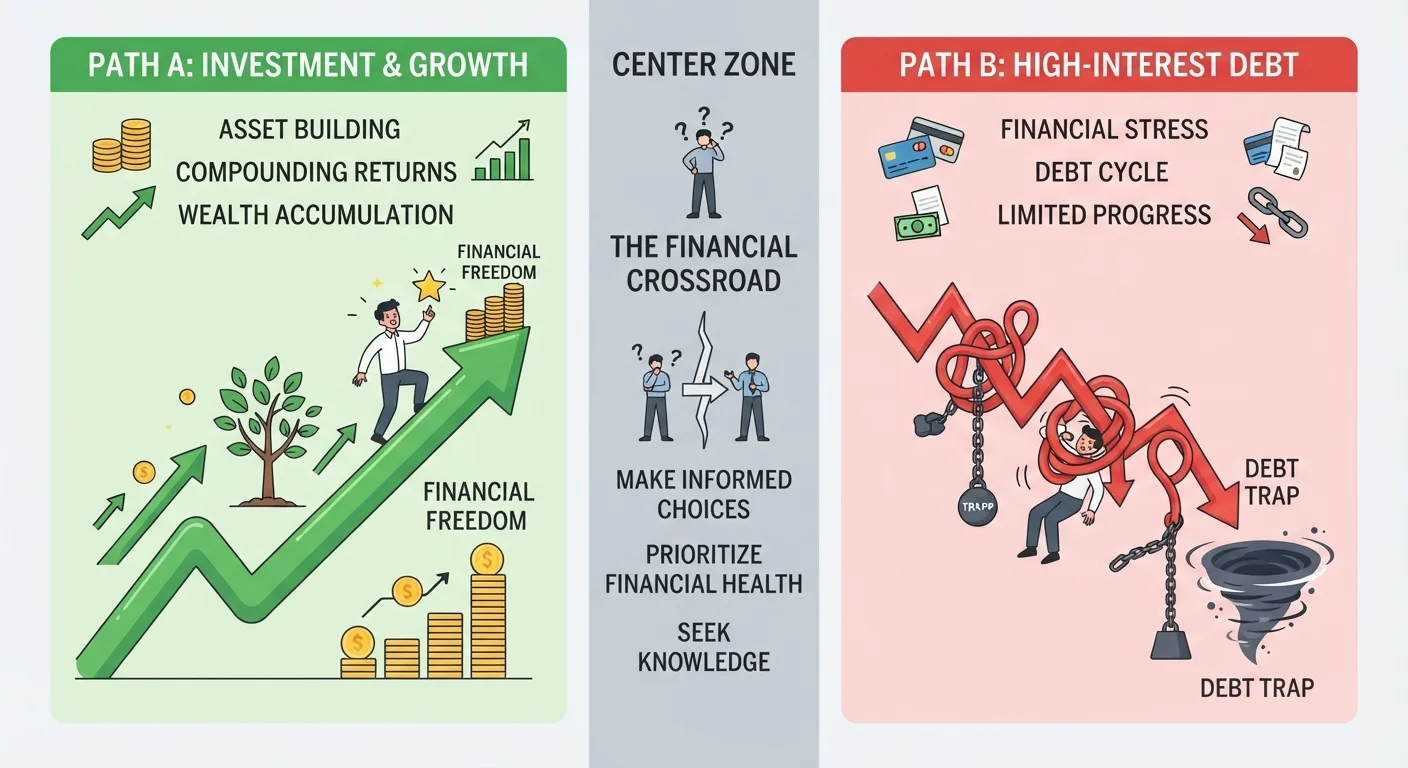
Why the Good vs. Bad Framework Exists
The idea of categorizing debt as "good" or "bad" came out of personal finance education as a shorthand for a more complex idea: not all borrowing hurts you equally. At its core, the framework asks one question — does this debt work for you or against you?
Good debt is typically borrowing tied to something that holds or increases in value, or that expands your ability to earn. A mortgage helps you build equity in an asset. A student loan, in many cases, finances credentials that increase lifetime earnings. A small business loan can fund a venture that generates income. These aren't sure things, but the underlying logic is sound: you borrow now to gain more later.
Bad debt, by contrast, usually finances things that lose value fast or provide no lasting return. High-interest credit card balances carried month to month are the classic example. A payday loan used to cover routine expenses is another. The cost of borrowing outpaces any benefit received.
Understanding this spectrum is a starting point — not a rule book. For a broader picture of how debt fits into your overall financial life, see the complete guide to savings and debt management.
$1.14T
Total U.S. credit card debt outstanding
According to the Federal Reserve Bank of New York's household debt report, U.S. credit card balances reached approximately $1.14 trillion in 2024.
~20%
Average credit card interest rate
The Federal Reserve tracks average credit card interest rates, which have exceeded 20% for accounts assessed interest in recent reporting periods.
$1.77T
Total federal student loan debt in the U.S.
The U.S. Department of Education reports total federal student loan debt in the trillions, with millions of borrowers carrying balances across undergraduate and graduate programs.
The Gray Area: When Debt Defies Easy Labels
Plenty of debt doesn't fit neatly into either box — and that's where most Americans actually live. Auto loans are a good example. A car is a depreciating asset (it loses value over time), which sounds bad. But if a reliable vehicle is what gets you to a job that pays well, the loan enabled real economic value. The same logic applies to medical debt: no one wants it, but avoiding necessary care to sidestep debt can cost far more in the long run.
Student loans sit in gray territory more often than the "always good" label suggests. A degree in a high-demand field from a reasonably priced school is different from six-figure debt for a credential with limited earning power. The debt might be identical in structure, but the outcomes differ dramatically.
Home equity loans and lines of credit add another layer. They use your home as collateral, which amplifies risk — but they're sometimes used for home improvements that genuinely increase property value. The debt itself isn't inherently good or bad; how it's used determines where it falls.
Ask This Before Taking on Any Debt
Before borrowing, ask: What is this debt financing, and will its value exceed what I'll pay in interest over time? If you can't answer that clearly, it's worth pausing. Understanding the true cost of borrowing — including the total interest paid, not just the monthly payment — helps you see debt for what it actually is.
It's also worth noting that debt misconceptions can keep people from making sound decisions. The common myths about debt article tackles some of the most costly misunderstandings head-on.
What Actually Makes Debt Manageable
The category matters less than how you handle it. A few factors that consistently separate manageable debt from debt that spirals:
- Interest rate: Lower rates mean less of your money goes toward the cost of borrowing. Federal student loans and mortgages typically carry lower rates than credit cards or personal loans from certain lenders.
- Your debt-to-income ratio: This compares your monthly debt payments to your gross monthly income. The higher the ratio, the harder it becomes to absorb new expenses or qualify for future credit. See what your debt-to-income ratio actually tells you for a plain-language breakdown.
- Purpose and plan: Debt without a clear repayment plan tends to grow. Debt tied to a specific goal — with a defined payoff timeline — is easier to manage.
If you're carrying multiple debts and feeling overwhelmed, understanding your options is essential. The debt avalanche vs. debt snowball guide walks through two practical payoff methods. And if you're trying to save while managing debt at the same time, paying off debt while saving simultaneously offers a workable framework.
This article is for general informational purposes only and does not constitute personalized financial advice. Please consult a qualified financial professional before making decisions about your specific debt situation.
Frequently Asked Questions
A mortgage is commonly cited as good debt because real estate can appreciate in value and owning a home builds equity over time. But it isn't automatically good — borrowing more than you can comfortably repay, or buying in a declining market, can make mortgage debt a burden. The terms and your financial situation matter as much as the category.
In genuine emergencies where no other options exist, credit card debt may be unavoidable. But carrying a balance long-term is costly — credit cards typically charge some of the highest interest rates available. Paying off balances monthly avoids interest charges entirely and is almost always the better approach.
Student loans can cross into bad debt territory if the degree doesn't lead to meaningful income growth, or if the loan amount far exceeds what the career field typically pays. Borrowing strategically — only what you need, for fields with strong job prospects — reduces this risk considerably.
Your debt-to-income (DTI) ratio compares your monthly debt payments to your gross monthly income. Taking on more debt raises your DTI, which can affect your ability to qualify for loans or favorable interest rates. Lenders and financial professionals use DTI as a key indicator of financial health.
Not necessarily. Responsibly managed debt — making on-time payments and keeping balances well below your credit limits — can actually support a healthy credit score. It's mismanaged debt, like missed payments or maxed-out cards, that tends to cause damage.
The content on this site is for informational purposes only and is not a substitute for professional advice. Always consult a qualified professional for guidance specific to your situation.