

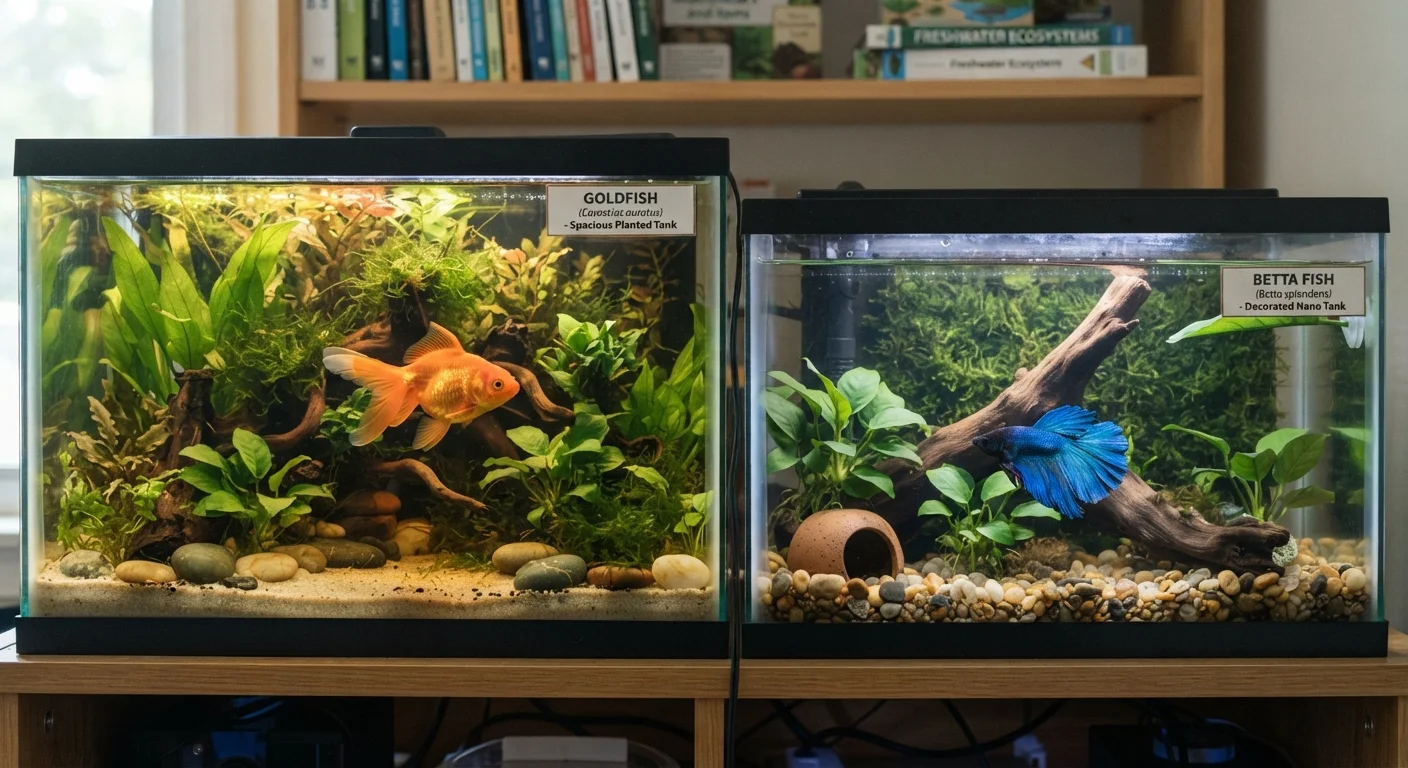
Option A
Goldfish
The classic, social, cold-water companion.
Best for: Owners who can invest in a larger tank and enjoy watching a group of active, hardy fish.
Option B
Betta Fish
The vibrant, low-volume, warm-water solo dweller.
Best for: Owners with limited space who want a visually striking fish with a distinct personality.
Tank Size and Water Conditions
One of the biggest misconceptions in fishkeeping is that both goldfish and bettas can survive in a small bowl. In practice, the minimum tank recommendations for each are very different — and both are larger than the classic bowl.
Goldfish are heavy waste producers. A single fancy goldfish generally needs at least 20 gallons, with an additional 10 gallons per additional fish. Without strong biological filtration and regular water changes, ammonia levels spike quickly, which is one of the most common reasons fish die prematurely. See our guide to why fish keep dying for a deeper look at water chemistry problems.
Bettas need far less space — a 5-gallon tank is the accepted minimum for a single fish — but they are tropical animals. Water temperature must stay between 76–82°F, which means a reliable aquarium heater is essential year-round. Bettas also prefer calm water with minimal current, since their long fins make swimming in strong flow tiring and stressful.
| Criterion | Goldfish | Betta Fish |
|---|---|---|
| Minimum tank size | 20 gallons (single fish) | 5 gallons (single fish) |
| Water temperature | 65–72°F (no heater needed) | 76–82°F (heater required) |
| Filtration needs | High — heavy waste producers | Moderate — low flow preferred |
| Social compatibility | Peaceful; groups welcome | Males must be kept alone |
| Diet | Omnivore; goldfish-specific pellets | Carnivore; high-protein pellets |
| Typical lifespan | 10–15+ years | 3–5 years |
| Beginner-friendliness | Moderate (large tank demands) | Moderate (temperature-sensitive) |
Temperament, Compatibility, and Social Needs
Goldfish are peaceful schooling fish that generally coexist well with other goldfish of similar size. They do not establish territories and rarely show aggression. However, they should not be housed with tropical species, since their temperature requirements conflict.
Bettas, particularly males, are highly territorial. Two male bettas housed together will almost always fight, sometimes fatally. A single male betta can share a tank with certain calm, short-finned species — such as small corydoras catfish or snails — but this requires careful planning. Female bettas can sometimes be kept in groups called sororities, though this setup demands close monitoring and ample hiding spots.
Bettas and Tankmates: Proceed Carefully
Not all fish listed as 'betta-compatible' online will work in every setup. Tank size, individual betta temperament, and the specific species involved all affect outcomes. When introducing any tankmate to a betta, monitor closely for the first several days and have a backup plan if aggression develops. When in doubt, a single betta in a well-planted tank is a stable, rewarding setup on its own.
If you are new to fishkeeping entirely, our freshwater aquarium setup guide walks through cycling, stocking, and filtration basics that apply to both species.
Diet, Lifespan, and Overall Care Commitment
Both fish are omnivores, but their dietary preferences differ. Goldfish do best on sinking pellets or flakes formulated specifically for goldfish, supplemented with blanched vegetables like zucchini or peas. They have no stomach and process food continuously, so overfeeding is a common and harmful mistake.
Bettas are primarily carnivorous and thrive on high-protein diets — betta-specific pellets, frozen or freeze-dried bloodworms, and daphnia are appropriate options. Generic tropical flakes are not nutritionally complete for bettas and should be avoided as a primary food source.
20+ years
Maximum documented goldfish lifespan
Some common goldfish varieties have been documented living over 20 years in well-maintained pond or aquarium environments.
5 gallons
Minimum tank size for a single betta
Aquarium husbandry organizations and veterinary sources generally recommend at least 5 gallons to maintain stable water parameters for one betta.
10x
Waste output difference vs. small tropical fish
Goldfish are widely noted by aquarists and fishkeeping educators to produce significantly more ammonia-rich waste than similarly sized tropical fish, requiring proportionally stronger filtration.
In terms of lifespan, goldfish live significantly longer under proper conditions — commonly 10 to 15 years, with some varieties documented living beyond 20 years. Bettas typically live 3 to 5 years, though some reach 6 or 7 with excellent care. Both lifespans assume appropriate water quality, diet, and tank conditions. If you ever need health guidance specific to either species, finding a vet experienced with aquatic animals is worth the effort — our exotic pet vet guide explains what to look for.
This article is for general informational purposes only and is not a substitute for advice from a qualified aquatic veterinarian or fishkeeping professional.
The content on this site is for informational purposes only and is not a substitute for professional advice. Always consult a qualified professional for guidance specific to your situation.