

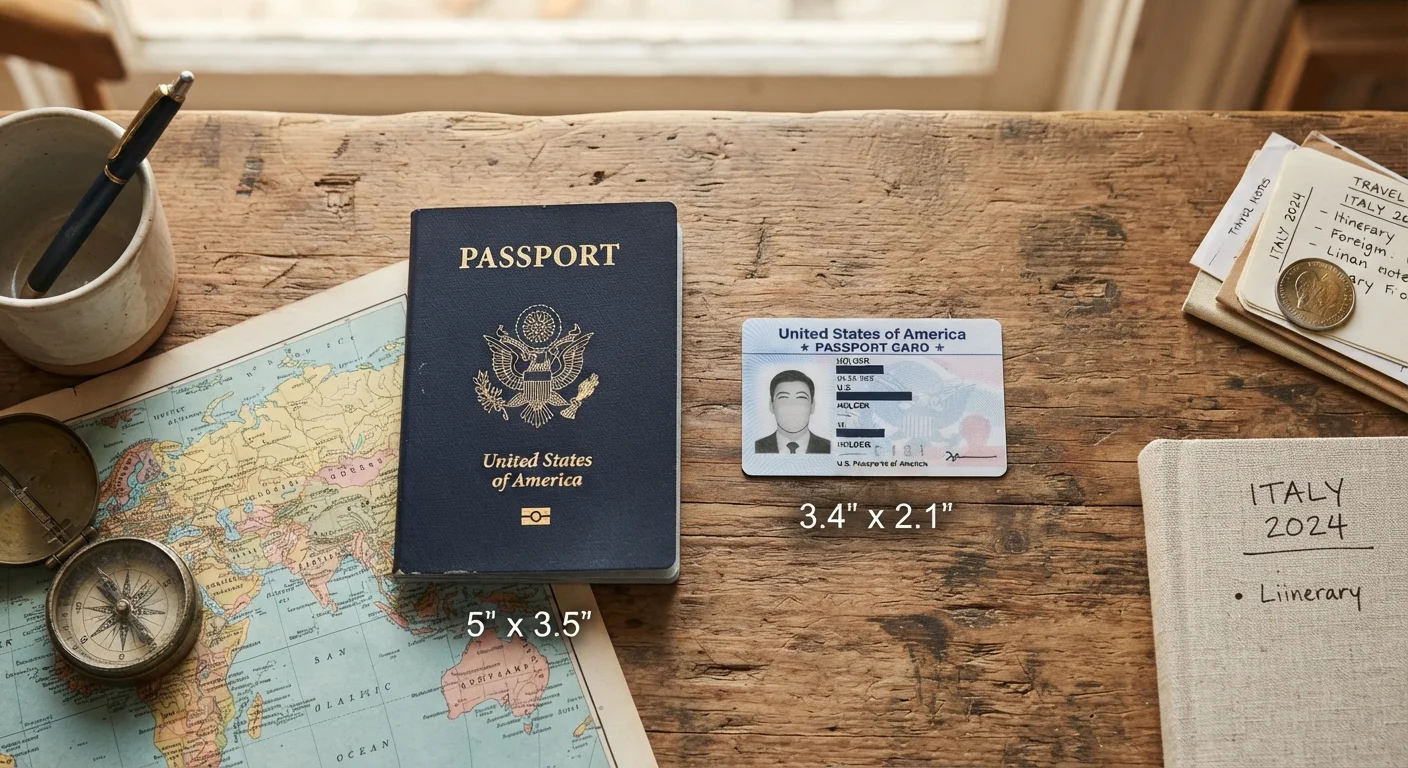
Option A
U.S. Passport Book
The all-access travel document for virtually everywhere.
Best for: Travelers flying internationally, cruising to foreign ports, or visiting destinations outside North America.
Option B
U.S. Passport Card
The wallet-sized alternative for land and sea border crossings nearby.
Best for: Frequent land border crossers and cruise passengers traveling to Mexico, Canada, Bermuda, and the Caribbean.
What Each Document Actually Is
Both the U.S. passport book and the U.S. passport card are issued by the Department of State and prove your U.S. citizenship and identity. That's where a lot of the similarity ends.
The passport book is the familiar navy booklet with pages for stamps and visas. It's accepted at every type of U.S. port of entry — airports, land crossings, and seaports — and is valid for international travel to virtually every country on earth.
The passport card is roughly the size of a driver's license and fits neatly in your wallet. It's accepted at land border crossings and sea ports of entry when traveling between the U.S. and Canada, Mexico, Bermuda, or the Caribbean. It is not valid for international air travel — a detail that catches many travelers off guard.
For a deeper look at how passports interact with visa rules and entry requirements, see our traveler's quick reference on passports, visas, and entry requirements.
| Criterion | Passport Book | Passport Card |
|---|---|---|
| Size | Standard booklet | Wallet/credit-card size |
| International air travel | ✓ Accepted | ✗ Not accepted |
| Land border crossings (Canada/Mexico) | ✓ Accepted | ✓ Accepted |
| Sea ports of entry | ✓ Accepted | ✓ Accepted |
| Closed-loop cruises | ✓ Accepted | ✓ Accepted (qualifying destinations) |
| Travel beyond North America/Caribbean | ✓ Accepted worldwide | ✗ Not valid |
| Validity (adults) | 10 years | 10 years |
| Application fee | Higher (see State Dept.) | Lower (see State Dept.) |
| REAL ID–compliant federal ID | ✓ Yes | ✓ Yes |
Cost, Validity, and the Application Process
Both documents have the same validity period — 10 years for adults, 5 years for applicants under 16 — and both go through the same State Department application process. You can apply for both simultaneously using the same forms and supporting documents, which many travelers choose to do to maximize value from a single trip to an acceptance facility.
The key financial difference: the passport card carries a lower application fee than the book (fees are set by the State Department and updated periodically, so check travel.state.gov for current amounts). However, if you apply for both at the same time, you pay a reduced fee for the card add-on rather than two separate full fees.
145M+
Valid U.S. passports in circulation
The U.S. Department of State reports more than 145 million valid U.S. passports outstanding, reflecting the high volume of American international travelers.
~$65
Typical passport card fee (adult, new)
As of recent State Department fee schedules, the adult passport card application fee is significantly lower than the book; verify the current amount at travel.state.gov before applying.
6–8 weeks
Routine processing time (approximate)
The State Department's routine processing window has historically ranged from several weeks to a few months; expedited options exist for travelers with imminent departures.
Renewal timelines and processing times are the same for both documents. Expedited processing is available for an additional fee. Because processing times can vary significantly by season, the State Department recommends applying well in advance of any planned travel — typically at least a few months ahead.
Where Each One Works — and Where It Won't
The most important thing to understand before choosing is accepted travel zones. The passport book has virtually no restrictions — it works for air, land, and sea travel anywhere in the world. The passport card is geographically limited:
- Accepted: Land border crossings between the U.S. and Canada or Mexico; sea ports of entry; closed-loop cruises visiting Canada, Mexico, Bermuda, or the Caribbean.
- Not accepted: International airports for flights to or from foreign countries; travel to destinations outside Canada, Mexico, Bermuda, and the Caribbean.
A common scenario where the card falls short: you take a cruise from Miami to the Caribbean with only your passport card, and the ship makes an unscheduled stop that requires air travel home. In that situation, the card won't get you on an international flight. The passport book would.
Smart trip planning also means thinking ahead about what else you'll need before departure. Our guide on packing strategies for different trip types covers how to avoid common oversights, and it's worth reading alongside your document checklist. You may also want to consider what travel insurance can cover — especially on international trips where unexpected itinerary changes can happen.
Always verify official entry requirements directly with the destination country's government and the U.S. Department of State before traveling. Requirements can change, and this article is not a substitute for official guidance.
The content on this site is for informational purposes only and is not a substitute for professional advice. Always consult a qualified professional for guidance specific to your situation.