

Start here
Why Vulnerable Road Users Face Greater Risk
Next
Sharing the Road with Motorcyclists
Then
Sharing the Road with Cyclists
Continue
Sharing the Road with Pedestrians
Finish with
Legal Obligations Every Driver Should Know
Why Vulnerable Road Users Face Greater Risk
Traffic engineers and safety researchers use the term vulnerable road users (VRUs) to describe anyone on the road who lacks the structural protection of an enclosed vehicle — primarily pedestrians, cyclists, and motorcyclists. When a collision occurs between a car and a VRU, the physics are starkly one-sided: the car's mass and rigid frame absorb little of the impact, while the unprotected person absorbs most of it.
According to federal traffic safety data, pedestrians and cyclists together account for a disproportionately high share of road fatalities relative to their share of total trips. Motorcyclists face per-mile fatality rates significantly higher than car occupants. These figures are not inevitable — the majority of these crashes involve contributing factors that attentive drivers can influence, including following too closely, failing to check blind spots, or misjudging a VRU's speed and position.
Understanding the perspective of each road user type is the foundation of safer driving. See our guide to defensive driving for the broader mindset that makes sharing the road safer for everyone.
Vulnerable road users (VRUs)
People traveling on or near roads without the structural protection of an enclosed vehicle, including pedestrians, cyclists, and motorcyclists.
Blind spot
An area around your vehicle that cannot be seen in your mirrors — typically the rear corners. A physical head-check is required to detect vehicles or cyclists there.
Following distance
The gap maintained between your vehicle and the one ahead. Measured in seconds, a safe following distance gives you time to react and brake before a collision.
Unmarked crosswalk
An implied pedestrian crossing at any standard intersection, even without painted lines on the road. Drivers are still legally required to yield to pedestrians in these areas.
Door zone
The area alongside a parked car where an opening door would swing into the road. Cyclists are at risk of being struck if they ride too close to parked vehicles.
Lane-splitting
A motorcyclist riding between lanes of slow or stopped traffic. It is legal in only a small number of U.S. states.
Sharing the Road with Motorcyclists
Motorcycles have the same legal right to a full lane as any other vehicle — a driver should never attempt to share a lane with a motorcycle or force a rider toward the edge of the road. Because motorcycles are narrow, they can appear to be farther away than they are, which makes gap estimation during turns a common failure point. Before turning left across oncoming traffic, take an extra moment to scan for approaching motorcycles specifically.
Blind spots are a serious concern. A motorcycle can disappear entirely into your vehicle's rear quarter blind spot. Develop the habit of doing a physical head-check — actually turning your head — before every lane change, not just relying on mirrors. Maintain a following distance of at least three to four seconds behind a motorcycle; riders may need to brake hard or swerve suddenly to avoid road hazards like gravel or potholes that a car would simply roll over.
Use the Dutch Reach When Exiting Your Car
The Dutch Reach is a simple habit: use your far hand (right hand if exiting from the driver's door) to open your car door. The motion naturally rotates your body so you see approaching cyclists before the door fully opens. It takes only a second and can prevent serious injuries.
Be aware that road conditions affect motorcycles differently than cars. A small patch of sand or a rain-slicked painted line can cause a rider to lose traction. When following a motorcycle, give extra buffer room and avoid tailgating.
Sharing the Road with Cyclists
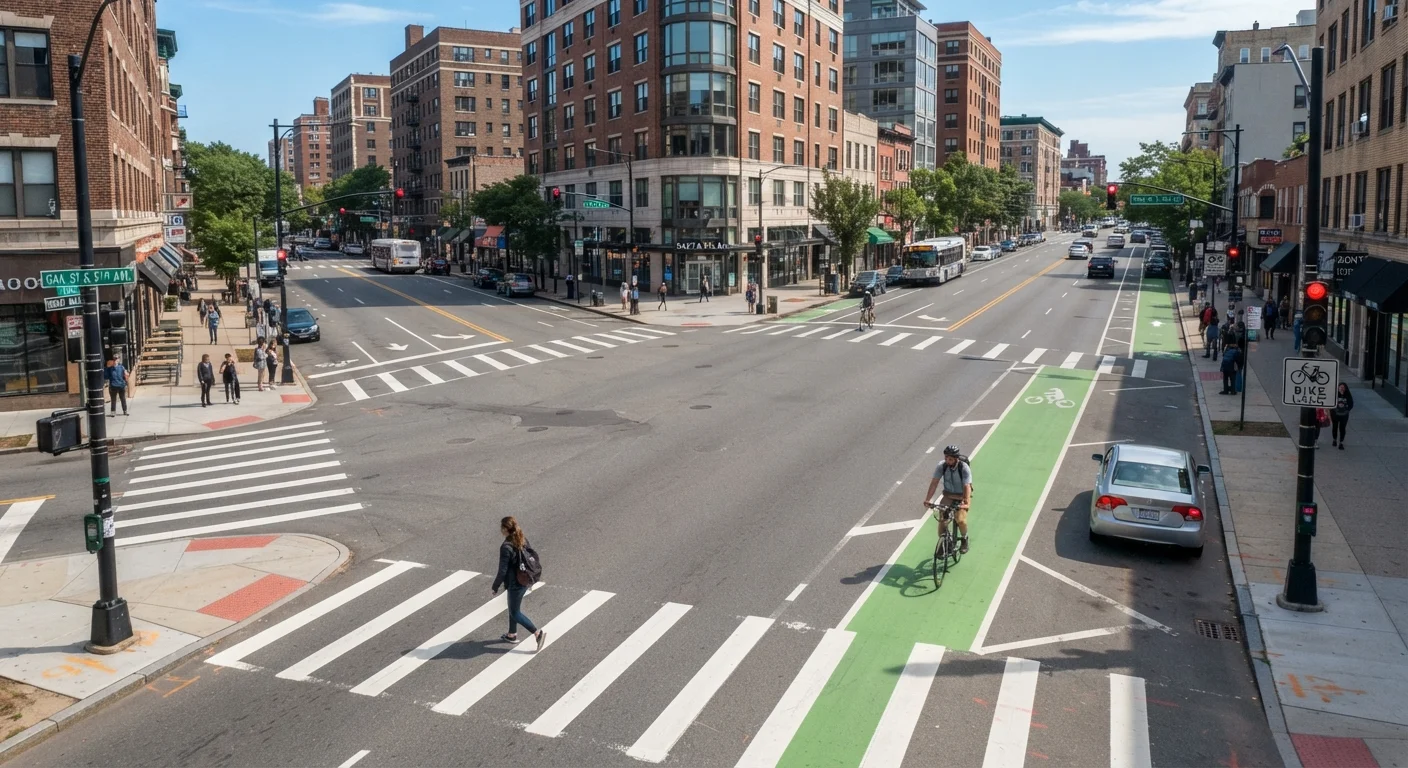
Cyclists occupy a legal middle ground — they have the right to ride in the road, are often required to use bike lanes when available, and must generally follow the same traffic laws as motor vehicles. From a driver's perspective, the most critical skill is the door zone check: before opening your car door when parked along a street, check your mirror and do a shoulder check for approaching cyclists. A cyclist struck by a suddenly opened door (called a "dooring" crash) can be thrown into traffic.
When passing a cyclist on an open road, signal, move fully into the adjacent lane if possible, and pass at a consistent speed — abrupt movements can startle riders. After passing, do not cut back in sharply. At intersections, watch for cyclists filtering to the front at red lights, which is legal in many jurisdictions. Never make a right turn across a cyclist's path without first checking your right mirror and blind spot. For more on intersection behavior, see our article on right-of-way rules.
Sharing the Road with Pedestrians
Pedestrians are the most physically exposed of all road users, and the law reflects that. In the U.S., drivers are generally required to yield to pedestrians at both marked crosswalks and unmarked crosswalks (the implied crosswalk at any intersection where two roadways meet). Coming to a complete stop — not a rolling slow — is expected when a pedestrian is in or entering the crosswalk.
School zones, residential streets, and parking lot driveways are high-risk environments. Children in particular move unpredictably and may dart between parked vehicles. Treat every parked car as a potential concealment for a pedestrian about to step out. At night or in poor visibility, slow down proactively in pedestrian-heavy areas; headlights illuminate the road ahead but peripheral detection is reduced significantly.
Distraction Eliminates Your Safety Margin
Even a brief distraction while driving in an area with pedestrians or cyclists can eliminate your ability to stop in time. Put your phone away, pre-set navigation before moving, and treat any non-driving task as a hazard. No notification is worth the consequences of a pedestrian strike.
Distracted driving — checking a phone, adjusting a navigation screen, or eating — eliminates the reaction time needed to stop for a pedestrian. At 30 mph, a car travels roughly 44 feet per second. A one-second distraction means 44 feet of road covered without awareness.
Legal Obligations Every Driver Should Know
Traffic laws protecting VRUs vary by state, but several obligations are consistent across most of the U.S. First, drivers must yield to pedestrians in crosswalks — failure to do so is a moving violation in every state. Second, most states have enacted three-foot or greater passing laws for cyclists. Third, stopping for a school bus with its red lights flashing and stop arm extended is federal-level guidance adopted universally, protecting children who are crossing.
Speed limits in school zones and near parks are often reduced and actively enforced. Violating these limits is not just a ticket risk — it substantially reduces your ability to stop in time for a small child. Understanding how right-of-way rules work in mixed-traffic scenarios is covered in more depth in The Complete Road Safety Handbook for American Drivers.
Ultimately, the legal minimum is a floor, not a ceiling. The practical goal is to drive in a way that gives every road user around you enough time and space to react — and that requires attention, margin, and the willingness to slow down when conditions call for it.
Frequently Asked Questions
Most U.S. states require drivers to leave at least three feet of clearance when passing a cyclist. Some states mandate four feet. If the lane is too narrow to pass safely, wait until you can move fully into an adjacent lane before overtaking.
Yes, in virtually every U.S. state you must yield to pedestrians who are in a marked or unmarked crosswalk at an intersection. Even when a pedestrian steps into the road unlawfully, your duty to avoid a collision remains. Always approach intersections at a speed that allows you to stop.
Lane-splitting — riding between lanes of slow or stopped traffic — is legal in California and has been considered or partially permitted in a small number of other states. In most U.S. states it remains illegal. Regardless of its legality, drivers should avoid sudden lane changes that could endanger a rider.
Motorcycles are narrower and shorter than cars, making them much easier to miss in a vehicle's blind spots and mirrors. Always do a physical head-check over your shoulder before changing lanes, especially on multi-lane roads and highways.
In most states, cyclists are required to use a bike lane when one is present and safe to use. However, they may legally move out of it to avoid hazards like drain grates, debris, or parked-car door zones. Drivers should anticipate this and not crowd cyclists back toward the curb.
Slow down and be prepared to stop. Even if a pedestrian is crossing unlawfully, a collision can result in serious injury or death — and a driver may still face legal consequences if they could have avoided the impact. Defensive driving means anticipating unpredictable behavior.
The content on this site is for informational purposes only and is not a substitute for professional advice. Always consult a qualified professional for guidance specific to your situation.