

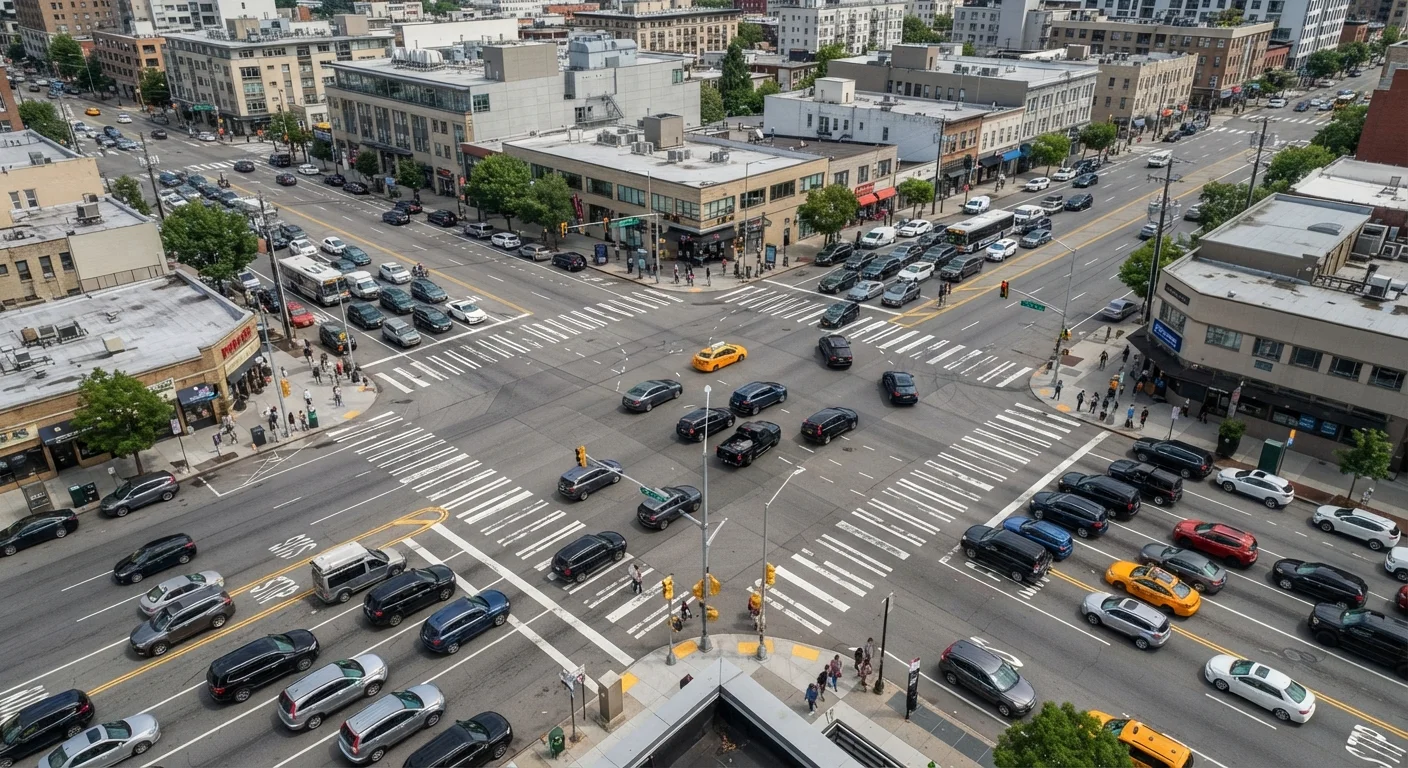
Why Right-of-Way Rules Trip Up Even Experienced Drivers
Right-of-way rules sit at the heart of nearly every traffic conflict, near-miss, and intersection collision in the United States. According to the Federal Highway Administration, intersections are the site of roughly 40% of all reported crashes — and driver error, including right-of-way violations, is a leading contributing factor.
The challenge is that these rules aren't always intuitive. Many drivers learn them once for a license exam and never revisit them. Others pick up habits — some correct, some dangerously wrong — from watching those around them. For a full framework of road safety principles, see our Complete Road Safety Handbook for American Drivers.
Below, we break down the most common right-of-way and merging mistakes drivers make — and what to do instead.
Forcing a merge instead of using the zipper method.
Why it happens: Many drivers feel pressure to merge far in advance, then become frustrated when others use the full merge lane — which is actually the correct behavior. This leads to aggressive merging and unnecessary braking.
Misunderstanding four-way stop order, especially when two cars arrive simultaneously.
Why it happens: Most drivers remember the basic rule — first to arrive, first to go — but freeze or guess incorrectly when two vehicles arrive at the same time, which happens frequently.
Rolling through or ignoring yield signs on highway on-ramps.
Why it happens: Drivers often misread yield signs as merely suggesting caution rather than requiring them to give way to all oncoming traffic before entering. The urgency to match highway speed can override the legal obligation.
Failing to yield to pedestrians at crosswalks — including unmarked ones.
Why it happens: Drivers often look only for painted crosswalk lines and overlook that every intersection corner legally constitutes a crosswalk in most U.S. states, even without markings.
Turning left across oncoming traffic without an adequate gap.
Why it happens: Left turns are cognitively demanding. Drivers under time pressure frequently underestimate the speed or distance of oncoming vehicles, especially in low-light conditions or at unfamiliar intersections.
Pulling into a roundabout without yielding to circulating traffic.
Why it happens: Roundabouts remain less common in the U.S. than in Europe, so many American drivers haven't internalized the yield-to-circulating-traffic rule, defaulting instead to the four-way stop logic they know.
High-Risk Situations: Pedestrians, Roundabouts, and Vulnerable Road Users
Some right-of-way errors are especially dangerous because they involve road users with far less protection than drivers inside a vehicle. Pedestrians legally crossing in a marked — or even unmarked — crosswalk have the right-of-way in all 50 states, yet failure-to-yield incidents involving pedestrians remain stubbornly common.
Never Assume a Pedestrian Sees You
Even when you have a green light, a turning driver must yield to pedestrians in the crosswalk. Do not assume a pedestrian will stop for your vehicle. Making eye contact before proceeding through a crosswalk significantly reduces the risk of a collision.
Roundabouts represent another consistent trouble spot. Drivers entering a roundabout must yield to traffic already circulating inside — not the other way around. A common error is treating the roundabout like a four-way stop, coming to a complete halt when the intersection is clear or, conversely, entering without yielding at all.
Sharing the road with motorcycles and cyclists adds an additional layer of right-of-way complexity. Because these users are less visible, drivers often fail to register their presence when making turns or lane changes. Our guide on sharing the road with motorcycles, cyclists, and pedestrians covers the legal and practical obligations drivers carry in mixed traffic.
Right-of-Way Cannot Be Forced
A critical legal and safety principle: right-of-way is something that must be yielded by the driver who has it — it cannot be claimed, assumed, or taken. Even if another driver is legally required to yield to you, proceeding into a conflict without confirming they are stopping puts you and others at risk. Always verify before you move.
Building Habits That Prevent Right-of-Way Errors
Understanding the rules is one thing — executing them consistently under pressure is another. Right-of-way errors often spike in unfamiliar environments, during high-traffic periods, or when a driver is rushed or distracted. New drivers are particularly vulnerable to these errors because they haven't yet built the automatic pattern recognition that experience provides.
A few practices significantly reduce right-of-way mistakes:
- Slow down before every intersection — speed compresses decision time and eliminates the buffer needed to yield safely.
- Make eye contact with other drivers and pedestrians before proceeding; don't assume others know or will follow the rules.
- Resist the urge to assert dominance — yielding when uncertain is almost always the safer choice and rarely costs more than a few seconds.
- Review your state's driver handbook periodically; rules vary by state on specific scenarios like uncontrolled intersections and emergency vehicles.
Right-of-way conflicts can also escalate into aggressive driving when one driver feels the other acted unfairly. Understanding how these moments can spiral is explored further in our guide on road rage and aggressive driving.
~40%
Of all U.S. crashes occur at intersections
According to the Federal Highway Administration, intersection-related crashes account for approximately 40% of all reported traffic collisions in the United States.
2x
Higher pedestrian fatality risk at night
The National Highway Traffic Safety Administration (NHTSA) reports that pedestrian fatalities are disproportionately concentrated in low-light and nighttime conditions, often involving failure-to-yield situations.
Getting right-of-way right isn't just about following the law — it's the difference between a smooth commute and a preventable collision.
The content on this site is for informational purposes only and is not a substitute for professional advice. Always consult a qualified professional for guidance specific to your situation.