

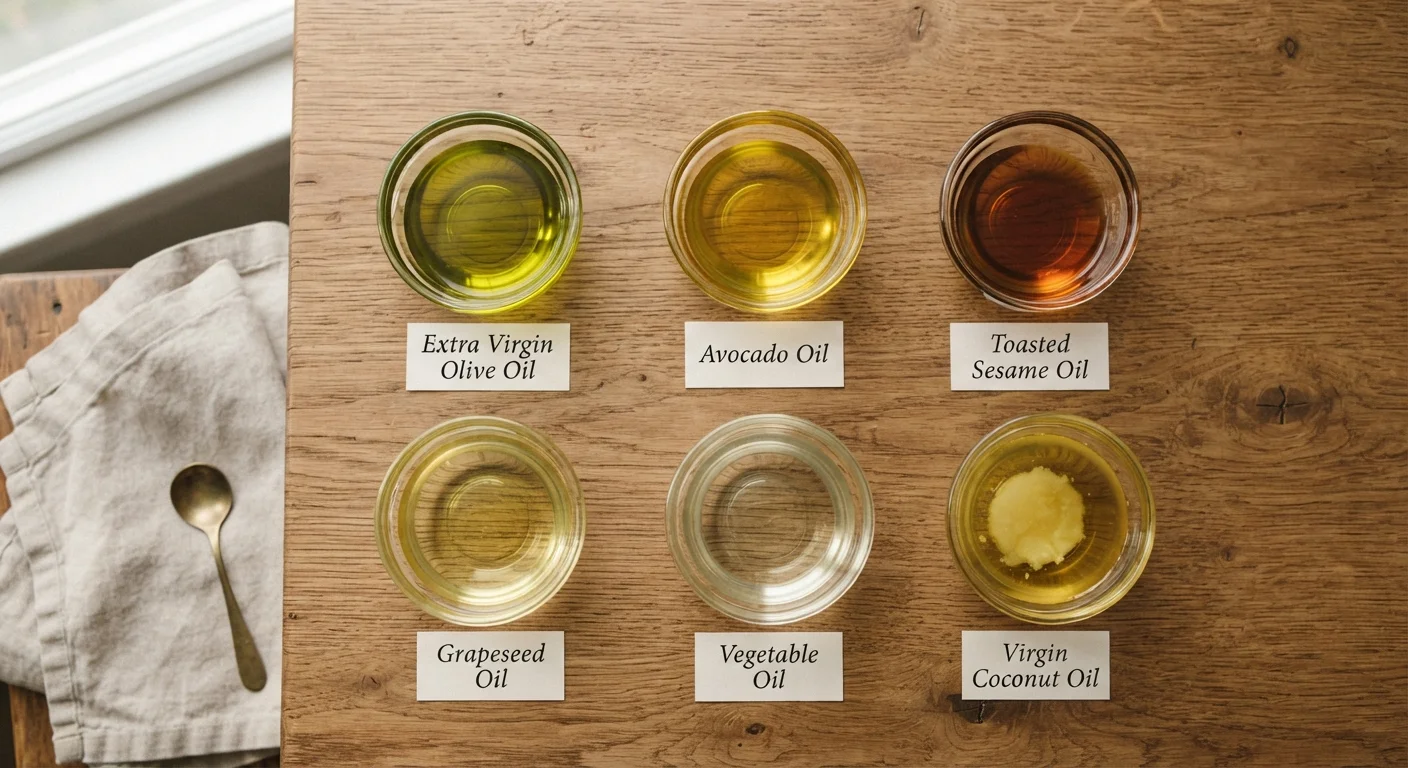
What Is a Smoke Point?
Every cooking oil has a temperature ceiling. Heat it past that point and it doesn't just get hotter — it starts to break down. That breakdown is visible as a thin, bluish smoke rising from the pan. This threshold is called the smoke point, and it matters for two reasons: flavor and safety.
When oil smokes, it undergoes oxidation and releases free fatty acids along with compounds called aldehydes and acrolein. These can give your food a bitter, acrid taste and, with repeated exposure to heavily degraded oil, raise concerns about air quality in your kitchen. For occasional home cooking, a brief overshoot isn't a crisis — but consistently cooking at the wrong temperature for your oil will affect how food tastes.
Smoke Point
The temperature at which an oil begins to visibly smoke and break down chemically. Cooking above this point can produce off-flavors and harmful compounds.
Refined Oil
Oil that has been processed to remove impurities, pigments, and flavor compounds. Refining generally raises the smoke point and extends shelf life.
Unrefined Oil
Oil extracted with minimal processing, preserving natural flavor, color, and nutrients — but also resulting in a lower smoke point.
Free Fatty Acids
Compounds released as oil degrades with heat. Higher concentrations of free fatty acids lower an oil's smoke point and indicate breakdown.
Oxidation
A chemical reaction between oil and oxygen, accelerated by heat, that produces rancid flavors and potentially harmful compounds.
Beyond smoke, there's also the flash point — a much higher temperature at which oil can ignite. That's a separate safety issue, but it underscores why matching your oil to your cooking method is a practical habit worth building.
How Refinement Changes the Numbers
The biggest factor determining an oil's smoke point isn't what plant it came from — it's how much processing it went through. Refined oils have had impurities, water, and flavor compounds removed, which raises their tolerance for heat. Unrefined or cold-pressed oils keep more of their natural character but burn at lower temperatures.
Consider olive oil: extra-virgin olive oil (unrefined) smokes at roughly 375°F, while light or refined olive oil can reach 465°F or higher. The extra-virgin version carries more flavor and polyphenols — it's excellent for finishing dishes, low-heat sautéing, and vinaigrettes. Refined olive oil is better suited for cooking at higher heat where a neutral profile is acceptable.
Smoke Point Ranges Vary by Source
You'll find slightly different smoke point numbers depending on which culinary reference you consult. That's normal — factors like oil freshness, level of refinement, and even how the measurement was taken all affect the result. Treat published smoke points as useful guidelines rather than precise cutoffs, and watch your pan for visual cues like shimmering, wisps of smoke, or color change.
The same logic applies to coconut oil, avocado oil, and even sesame oil. Refined versions consistently outperform their unrefined counterparts in heat tolerance. When a recipe calls for high heat — like a sear or stir-fry — reach for a refined oil with a smoke point well above your target cooking temperature.
A Practical Reference by Cooking Method
Matching oil to method is simpler once you know the temperature ranges involved. Here's a breakdown:
| Smoke point of extra-virgin olive oil | Approximately 375°F (190°C) (Institute of Shortening and Edible Oils) |
| Smoke point of refined avocado oil | Approximately 520°F (271°C) (General culinary reference) |
| Smoke point of butter | Approximately 300–350°F (149–177°C) (General culinary reference) |
| Smoke point of refined coconut oil | Approximately 450°F (232°C) (General culinary reference) |
| Typical sauté pan temperature | 325–400°F (163–204°C) (General culinary reference) |
| Deep-frying temperature range | 350–375°F (177–190°C) (General culinary reference) |
- Low-heat cooking (under 300°F): Butter, unrefined nut oils, or extra-virgin olive oil work well for gentle sweating of vegetables or warming sauces. See our article on reading heat levels on the stovetop for how to judge temperature without a thermometer.
- Medium-heat sautéing (300–375°F): Extra-virgin olive oil, unrefined coconut oil, and most vegetable oils are reliable here.
- High-heat searing and stir-frying (375–500°F): Refined avocado oil, refined coconut oil, refined peanut oil, and ghee (clarified butter) hold up well. Ghee removes the milk solids that cause regular butter to burn, raising its smoke point considerably.
- Deep frying (350–375°F sustained): Refined peanut oil and refined canola oil are common choices due to their neutral flavor and heat stability.
Storage also matters. Oils stored in warm, light-exposed places oxidize faster, which lowers their effective smoke point over time. Keep oils in a cool, dark cabinet and use them before they go rancid — a stale smell is a reliable signal.
Common Misconceptions About Cooking Oil
One widespread idea is that olive oil should never be used for cooking — only for finishing. This overstates the limitation. Extra-virgin olive oil is genuinely well-suited to medium-heat cooking, which covers the majority of everyday stovetop tasks. The concern arises when it's pushed into high-heat territory unnecessarily. For a broader look at kitchen lore that doesn't always hold up, see our piece on common cooking myths worth reconsidering.
Another misconception: a higher smoke point always means a better oil. Smoke point is one consideration, not the only one. Nutritional profile, flavor, and intended use all factor in. A high-smoke-point refined oil is ideal for frying; it isn't necessarily the right choice for a salad dressing where flavor and nutrient density matter more.
Finally, smoke points published online vary, sometimes meaningfully. Freshness, how the oil was pressed, and even the testing method affect the result. Rather than memorizing exact numbers, think in ranges and watch your pan. Shimmering without smoke means you're in a good zone. Persistent smoke means pull back the heat or switch oils.
This article provides general educational information about cooking oils and is not intended as nutritional or medical advice. For specific dietary needs, consult a qualified nutrition professional.
The content on this site is for informational purposes only and is not a substitute for professional advice. Always consult a qualified professional for guidance specific to your situation.