

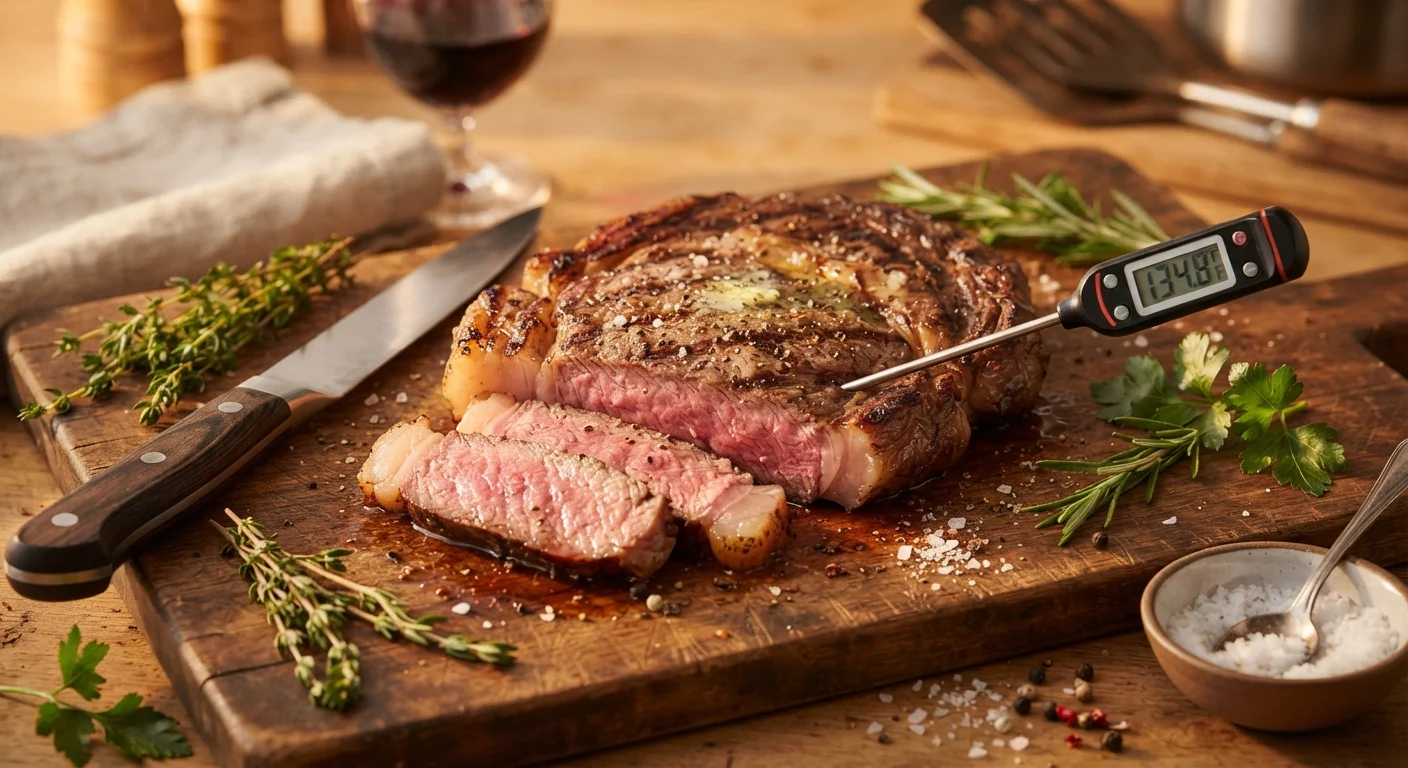
What Happens Inside Meat During Cooking
To understand why resting works, it helps to know what cooking actually does to meat at a structural level. Meat is made up of muscle fibers — long, tightly bundled proteins held together by connective tissue. When heat is applied, those proteins begin to denature, meaning they change shape and tighten up.
As the fibers contract under heat, they squeeze inward, pushing moisture — the flavorful liquid inside the muscle — toward the center of the cut. Think of it like wringing out a wet cloth: the pressure forces the water to migrate. By the time a steak comes off a hot grill, the innermost portion is carrying a concentrated pool of juice under significant pressure.
If you cut the meat at this point, that pressure releases immediately. The juice flows freely out of the fibers and puddles on your cutting board instead of staying in your food. This is not just theory — it's visible every time someone slices into a steak straight from the pan.
“The resting period is not a suggestion — it's a continuation of the cooking process. What happens off the heat is just as important as what happens on it.”
— Harold McGee, Author of 'On Food and Cooking,' widely cited authority on food science
The Resting Process: What's Actually Happening
As meat rests off the heat, two things happen simultaneously. First, the muscle fibers gradually relax as internal temperature equalizes. The proteins, no longer under intense heat stress, loosen their grip and become capable of holding moisture again. Second, the internal temperature gradient evens out — the very hot exterior and the cooler center move toward a more uniform temperature throughout the cut.
This redistribution is what makes the difference. When you slice rested meat, the fibers have had time to reabsorb much of that migrated liquid. The result is a juicier, more evenly textured piece of meat from edge to center. Some estimates from culinary tests suggest that properly rested meat can retain significantly more juice — in some cases nearly double — compared to meat sliced immediately off the heat.
It's worth noting that resting does not stop carryover cooking. The internal temperature of meat continues to rise for a few minutes after it leaves the heat source, a well-documented effect explained in depth in our piece on low and slow cooking methods. Factor that in when deciding when to pull your meat from the heat.
Account for Carryover When Pulling Meat
Because internal temperature keeps rising during the rest period, pull your meat from the heat 5–10°F below your target doneness for thick cuts. A thick steak aimed at 135°F (medium-rare) can be pulled around 125–128°F and will reach the target as it rests. Use an instant-read thermometer to track this accurately.
How Long to Rest Each Type of Cut
Resting time isn't one-size-fits-all. It scales with the thickness and mass of the cut — larger pieces both generate and hold more heat, requiring more time to equalize.
- Thin steaks (under 1 inch) — 3 to 5 minutes
- Thick steaks and chops (1 to 2 inches) — 5 to 10 minutes
- Pork tenderloin — 5 to 10 minutes
- Bone-in chicken pieces — 5 minutes
- Whole roast chicken or duck — 15 to 20 minutes
- Whole turkey — 20 to 30 minutes
- Large beef roasts and prime rib — 20 to 30 minutes
A practical rule used by many home cooks: rest the meat for roughly half the total cooking time. It's not perfectly precise, but it's a reliable starting point when you don't have a specific guideline for the cut in front of you.
Skipping this step is one of the more common reasons home cooks end up with dry, tough results. If that's a recurring frustration, our article on why meat turns out tough instead of tender covers the broader picture.
~40%
More juice lost when meat is cut immediately
Culinary testing has shown that meat sliced right off the heat can lose significantly more moisture than meat allowed to rest, depending on cut and thickness.
5–30 min
Typical resting range across all cuts
Recommended resting times span from 5 minutes for thin steaks to 30 minutes for large roasts, scaling with the mass and density of the cut.
~5–10°F
Typical carryover temperature rise during rest
Internal meat temperature commonly continues to rise after removal from heat due to carryover cooking, making rest time relevant for both texture and doneness.
Common Mistakes When Resting Meat
Resting is simple, but a few habits can undermine it. Tightly wrapping meat in foil — rather than loosely tenting it — traps steam against the surface. For cuts where crust texture matters, like a seared steak or roasted chicken, that steam softens the exterior you worked to develop. A loose tent or no foil at all usually serves better.
Another common mistake is resting meat on a cold plate or surface, which accelerates heat loss and can drop the temperature faster than needed. A warm plate or wooden board makes a noticeable difference, especially for thinner cuts.
Finally, some cooks believe resting is unnecessary if the meat is served immediately — a myth worth addressing. Speed of service doesn't change the physics happening inside the fibers. Even two or three minutes makes a real difference for a thin chicken breast. For a broader look at kitchen assumptions that don't hold up, see our piece on common cooking myths.
Frequently Asked Questions
Yes, and it's measurable. Studies and culinary tests consistently show that rested meat retains significantly more juice when sliced. The difference is visible on the cutting board — a properly rested steak bleeds far less than one cut immediately off the heat.
Some temperature drop is inevitable, but resting times for most cuts are short enough that the meat remains hot. Loosely tenting with aluminum foil can slow heat loss without affecting texture. A whole roast can even be rested longer since its large mass retains heat well.
Loose foil tenting is helpful for large roasts and whole birds to retain heat. For steaks or chops with a seared crust, skip tight tenting — trapped steam can soften the crust you worked to develop. A light, loose tent or no cover is usually fine.
A general guideline is 5 minutes for thin steaks (under 1 inch) and up to 10 minutes for thicker cuts like a ribeye or strip. The rule of thumb many cooks use: rest for about half the total cooking time.
Absolutely. Chicken breasts benefit from a 5-minute rest, while a whole roast chicken or turkey needs 15–30 minutes. Pork chops and tenderloins follow similar guidelines to beef steaks of the same thickness.
You can rest it in an oven turned off, but the residual heat may continue cooking the meat — especially smaller cuts — pushing it past the intended doneness. Resting on a warm cutting board or plate at room temperature is generally more reliable.
The content on this site is for informational purposes only and is not a substitute for professional advice. Always consult a qualified professional for guidance specific to your situation.