

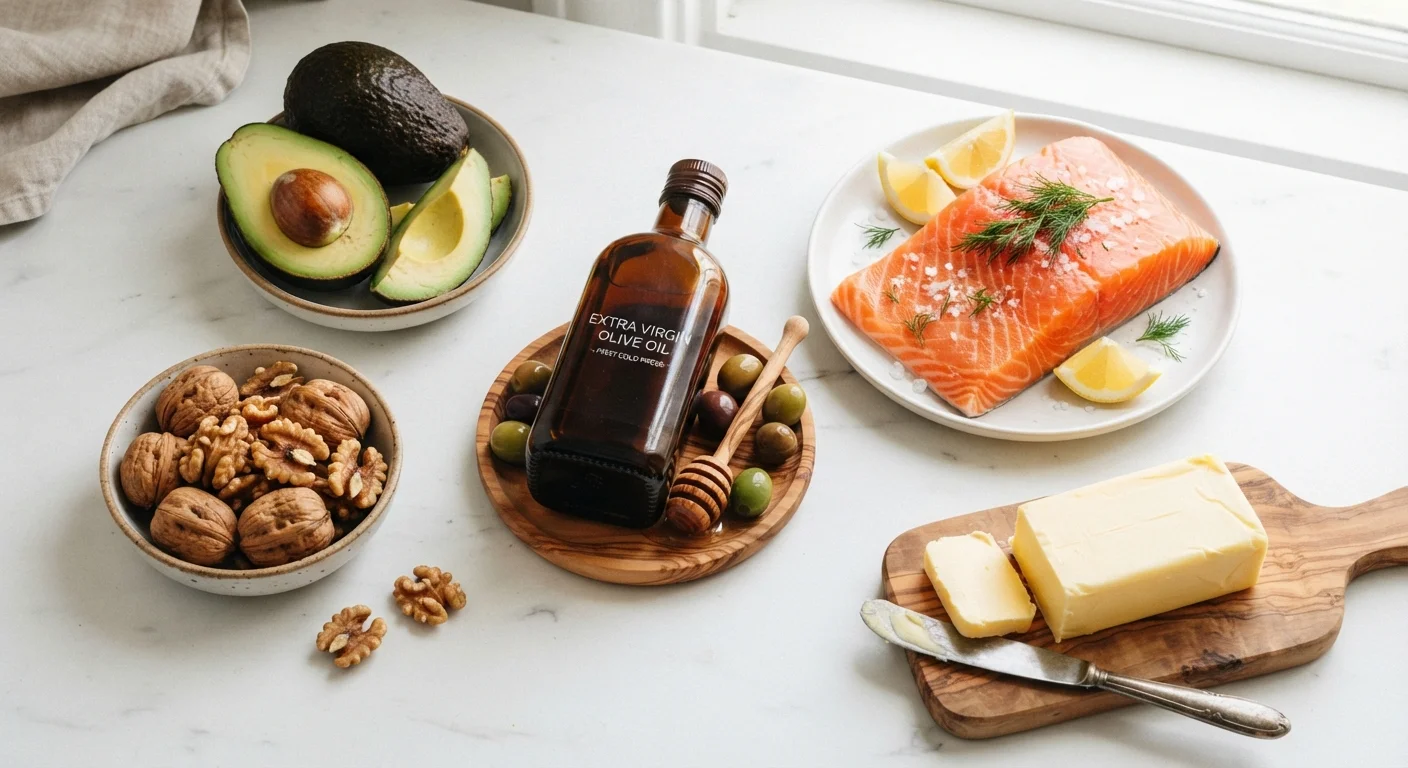
Why Fat Type Matters More Than Fat Amount
For decades, dietary fat was treated as a single villain. Today, nutrition science is clear that the type of fat matters far more than the total grams on a label. Fat is a required macronutrient — it supports cell structure, helps the body absorb fat-soluble vitamins (A, D, E, and K), and provides long-lasting energy. Understanding what distinguishes one fat from another gives you a much sharper tool for interpreting food choices. See our overview of what fat actually does in the body for broader context on macronutrients.
The three categories you'll encounter most — saturated, unsaturated, and trans fat — differ at the molecular level, and those differences translate into real distinctions in how they behave during cooking, how they're stored in food, and how they interact with cardiovascular health markers.
| Saturated fat texture | Solid at room temperature |
| Unsaturated fat texture | Liquid at room temperature |
| Primary saturated fat sources | Butter, red meat, full-fat dairy, coconut oil |
| Primary unsaturated fat sources | Olive oil, avocados, nuts, fatty fish |
| Artificial trans fat status (U.S.) | Largely eliminated from food supply (U.S. FDA partial hydrogenation ruling) |
| Label "0g trans fat" threshold | Less than 0.5g per serving (U.S. FDA Nutrition Facts labeling rules) |
| Fat-soluble vitamins fat helps absorb | A, D, E, and K |
Saturated Fat: Solid at Room Temperature
Saturated fat gets its name from its chemistry: its carbon chain is fully "saturated" with hydrogen atoms, leaving no double bonds. This structure makes it solid at room temperature — think butter, coconut oil, and the white fat marbled through red meat. Common food sources include beef, pork, full-fat dairy products, palm oil, and coconut oil.
Saturated fat raises LDL (low-density lipoprotein) cholesterol in the blood, which is associated with increased cardiovascular risk according to long-standing research and major dietary guidelines in the United States. Most health authorities — including the American Heart Association and the U.S. Dietary Guidelines Advisory Committee — recommend limiting saturated fat intake, though exact targets are best discussed with a healthcare provider based on individual circumstances.
It's worth noting that not all saturated fats are chemically identical, and research on specific subtypes is ongoing. That said, the general guidance to moderate total saturated fat intake reflects a strong body of evidence and is not considered controversial in mainstream nutrition science.
Saturated fat
A type of dietary fat whose carbon chain is fully bonded with hydrogen atoms, giving it a solid texture at room temperature. Common sources include butter, cheese, and fatty meats.
Unsaturated fat
Fat containing one or more double bonds in its carbon chain, making it liquid at room temperature. Includes both monounsaturated and polyunsaturated varieties found in oils, nuts, and fish.
Trans fat
A form of fat that can occur naturally in small amounts or be created artificially through partial hydrogenation of vegetable oil. Artificial trans fat has been largely removed from the U.S. food supply due to cardiovascular health concerns.
LDL cholesterol
Low-density lipoprotein, often called "bad" cholesterol. Elevated LDL levels in the blood are associated with a higher risk of cardiovascular disease.
HDL cholesterol
High-density lipoprotein, often called "good" cholesterol. Higher HDL levels are generally associated with a lower risk of cardiovascular disease.
Partial hydrogenation
An industrial process that adds hydrogen to liquid vegetable oil to make it semi-solid. This process creates artificial trans fat as a byproduct and has been phased out of U.S. food production.
Omega-3 fatty acids
A subtype of polyunsaturated fat found in fatty fish, walnuts, and flaxseed. Extensively studied for potential benefits in reducing inflammation and supporting heart health.
Unsaturated Fat: The Liquid Fats
Unsaturated fat contains one or more double bonds in its carbon chain, which creates a bent molecular shape — preventing tight packing and keeping the fat liquid at room temperature. There are two main subtypes:
- Monounsaturated fat (MUFA) — has one double bond. Found in olive oil, avocados, and most nuts. Associated in research with supporting healthy LDL and HDL (high-density lipoprotein) cholesterol balance.
- Polyunsaturated fat (PUFA) — has multiple double bonds. Includes omega-3 and omega-6 fatty acids. Found in fatty fish (salmon, mackerel), walnuts, flaxseed, and vegetable oils like sunflower and soybean. Omega-3s in particular have been extensively studied for their role in reducing inflammation markers and supporting heart health.
Replacing saturated fat with unsaturated fat — rather than simply removing fat — is generally what dietary guidelines have in mind when they recommend reducing saturated intake. The goal is substitution, not elimination.
Trans Fat: The One to Minimize
Trans fat occurs in two forms. Small amounts arise naturally in the fat of ruminant animals (beef, lamb, dairy), but the form of greatest concern was artificial trans fat — created through a process called partial hydrogenation, which converts liquid vegetable oil into a semi-solid for use in packaged foods and commercial frying.
Artificial trans fat raises LDL cholesterol and lowers HDL cholesterol simultaneously — a combination that nutrition researchers have consistently linked to elevated cardiovascular risk. The U.S. Food and Drug Administration determined that partially hydrogenated oils are no longer "generally recognized as safe" and phased them out of the U.S. food supply. As a result, artificial trans fat has been largely eliminated from packaged foods sold in the United States.
However, a product can still legally list "0g trans fat" on its label if it contains less than 0.5 grams per serving. Reading the ingredient list for the term "partially hydrogenated" remains a reliable way to check. For more on navigating ingredient lists, see how ingredient lists are structured.
Reading Fat on a Nutrition Label
On a standard U.S. Nutrition Facts label, "Total Fat" appears first, followed by indented sub-lines for saturated fat and trans fat. Unsaturated fats are not always listed separately — you can estimate them by subtracting saturated and trans fat grams from the total fat figure. Checking the "% Daily Value" for saturated fat helps you gauge how a single serving fits into an overall daily pattern.
Fat type and sugar type often appear together as label literacy topics — our guide on added sugar vs. natural sugar on a label covers the parallel distinction for carbohydrates. For a full walkthrough of every section of the Nutrition Facts panel, see reading a Nutrition Facts label without getting lost in the fine print.
This article is for general informational purposes only and is not a substitute for personalized medical or dietary advice. Consult a registered dietitian or qualified healthcare provider for guidance specific to your health situation.
The content on this site is for informational purposes only and is not a substitute for professional advice. Always consult a qualified professional for guidance specific to your situation.