

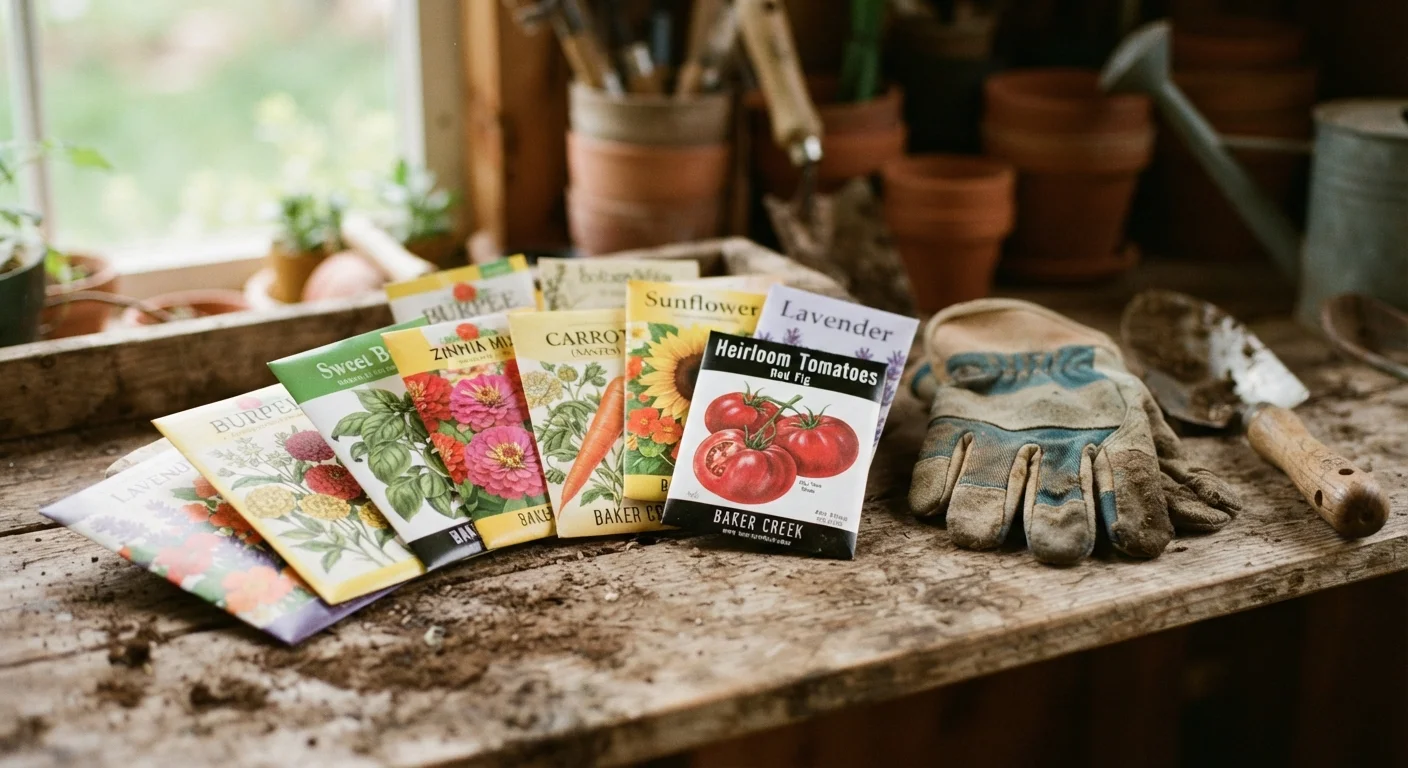
The Seed Packet Is Your Planting Instruction Manual
Pick up any seed packet and you're holding a surprisingly dense document. Growers—beginner and seasoned alike—often flip it over, spot a wall of fine print, and decide to wing it. That's a shame, because nearly every number and abbreviation on the label is a direct answer to a question you'd otherwise have to look up. Once you know the vocabulary, reading a seed packet takes about thirty seconds and saves a lot of guesswork.
This reference breaks down each field you'll encounter, what it actually means, and how to act on it. If you're still figuring out the bigger picture of your first growing season, The First-Time Gardener's Complete Starting Point is a good companion to this piece.
Days to Germination
The expected number of days between sowing and seedling emergence under typical growing conditions. It is usually given as a range rather than a fixed number.
Days to Maturity
The time from transplant or germination to when a crop is ready to harvest. This number helps gardeners match a variety to the length of their local growing season.
Thinning
The practice of removing excess seedlings so remaining plants have adequate space to develop. Proper spacing, as noted on the packet, reduces competition for water, light, and nutrients.
Open-Pollinated
Seeds produced by natural pollination whose offspring reliably inherit the parent plant's characteristics. Saved seeds from open-pollinated varieties will grow true to type.
Hybrid (F1)
A seed produced by crossing two distinct parent lines to achieve specific traits like disease resistance or uniformity. Seeds saved from F1 plants will not reliably reproduce the same plant.
Last Frost Date
The average date in spring after which freezing temperatures are unlikely in a given location. Seed packets often use this date as an anchor for sowing and transplant timing.
Key Fields on the Packet, Explained
| Planting depth rule of thumb | 2–3× the seed's diameter |
| Full sun definition | 6+ hours of direct sun per day |
| Typical vegetable seed viability | 2–5 years (stored cool and dry) |
| Days to maturity counted from | Transplant date or germination, not sowing date |
| Best source for local frost dates | Your county's cooperative extension service |
| Surface-sow crops (examples) | Lettuce, carrots, snapdragons — light aids germination |
Days to Germination
This range tells you how long to expect before seedlings break the soil surface under normal conditions — warm soil, consistent moisture, and appropriate light. It is not a countdown clock. Cool soil, dry spells, or shallow planting can all push germination to the longer end or beyond. If nothing has sprouted by the high end of the range, check moisture and soil temperature before assuming the seeds failed.
Days to Maturity
Often confused with days to germination, this number counts from transplant (for starts) or from germination (for direct-sown crops) to harvest-ready. A tomato labeled 75 days needs 75 days from the time its seedling goes in the ground, not from when you sow it indoors. Compare this number to the length of your growing season to know whether a variety is realistic for your region.
Planting Depth
A general rule in gardening is to plant a seed at a depth of roughly two to three times its diameter — and most packets simply codify this. Fine seeds like lettuce or carrots are often listed as surface sow or press lightly, meaning light is actually part of what triggers germination for them. Burying those seeds too deep is one of the most common first-timer mistakes.
Spacing and Thinning
Two numbers you'll often see side by side: spacing between seeds at sowing, and final spacing after thinning. Crowded plants compete for water, light, and nutrients. The packet isn't being conservative — giving plants their full allotment of space genuinely produces better yields. Thinning feels wasteful but it's productive. Several common gardening myths stem directly from ignoring these numbers.
Sun Requirements
Full sun, part shade, and full shade are defined terms, not vague suggestions. Full sun means at least six hours of direct sunlight per day; part shade typically means three to six hours. Placing a sun-loving crop in the wrong spot is a leading cause of poor germination and weak plants. Our guide to sunlight terms explains each classification in detail.
Sowing Window and Indoor Start Timing
Most packets frame timing around your area's last frost date — for example, direct sow 2 weeks after last frost or start indoors 6–8 weeks before last frost. Your local cooperative extension office publishes average last frost dates by zip code, making this the most reliable local reference available for free. If you want to get ahead of the season, starting seeds indoors walks through the full process.
Soil Notes
Many packets include a brief soil preference — well-draining, fertile, sandy loam. These aren't filler. Matching soil type to your crop is one of the highest-impact things you can do before sowing. Understanding what your garden soil actually needs can help you interpret and act on these notes.
Additional Label Details Worth Noting
Beyond the core planting fields, seed packets often carry a few more pieces of useful information:
- Lot number and packed-for date: Seeds have a shelf life. Most vegetable seeds remain viable for two to five years when stored cool and dry, but germination rates drop over time. The packed-for year tells you how fresh the batch is.
- Open-pollinated, heirloom, or hybrid (F1): Open-pollinated and heirloom varieties produce seeds you can save and replant true to type. Hybrid (F1) seeds are crosses bred for specific traits — vigor, disease resistance, uniformity — but seeds saved from them won't reliably reproduce the parent plant.
- Treated vs. untreated seed: Some seeds are coated with a fungicide or other treatment to improve germination in marginal conditions. The packet will disclose this. Untreated seeds are preferred for certified organic growing.
Seed Packet Dates Have a Purpose
The 'packed for' year printed on a seed packet indicates when the seeds were tested and packaged for sale — not necessarily when they were harvested. Always check this date when pulling older packets from storage. Running a simple germination test (placing 10 seeds on a damp paper towel in a warm spot for the listed germination period) can tell you roughly what percentage of remaining seeds are still viable before you commit them to garden beds.
Before you sow a single seed, working through a pre-season checklist ensures your soil, space, and schedule are ready to support what the packet is asking of you.
The content on this site is for informational purposes only and is not a substitute for professional advice. Always consult a qualified professional for guidance specific to your situation.