

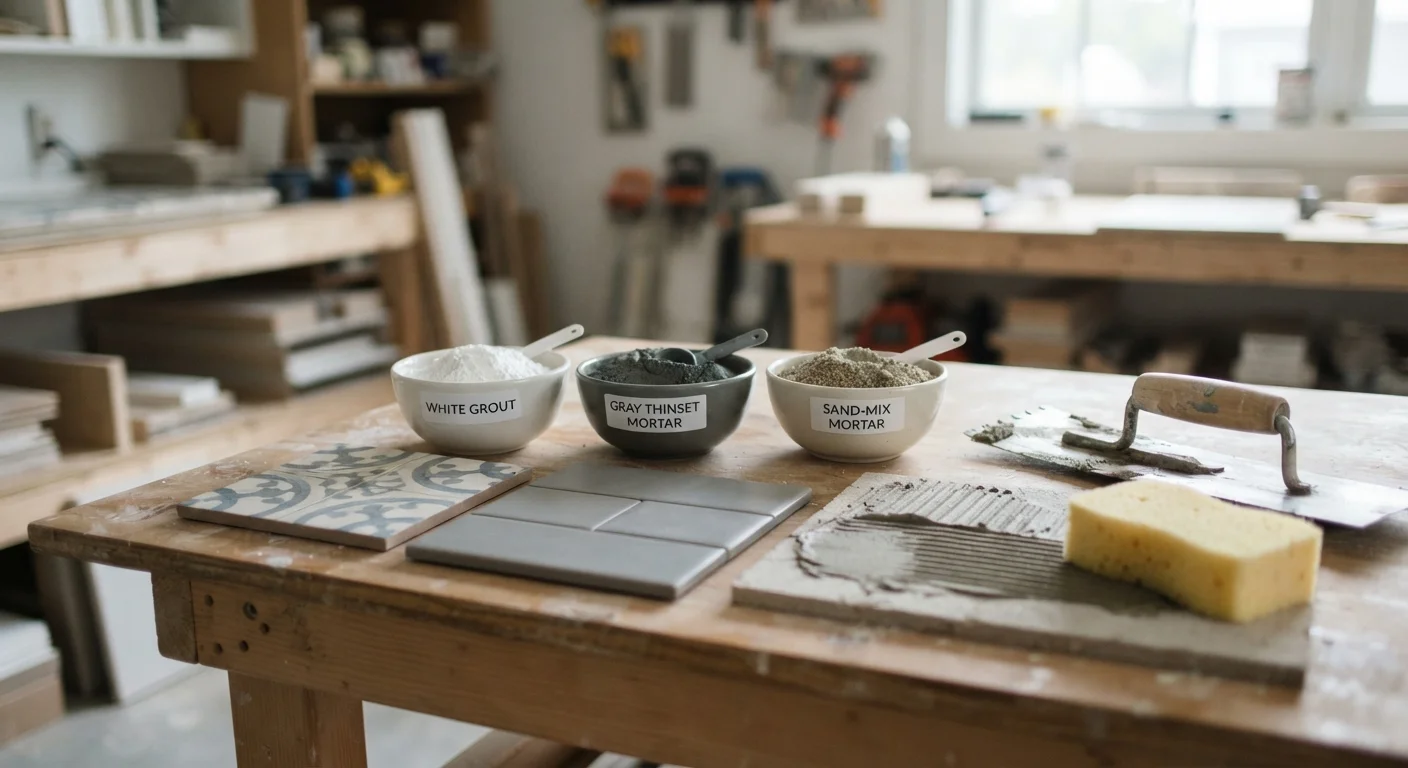
Why These Three Products Get Confused
Walk into any home improvement store's tile aisle and you'll find bags and buckets labeled grout, thinset, mortar, mastic, and more. For first-time DIYers, they can look nearly identical. The confusion is understandable — all three are cement-based powders mixed with water — but they are engineered for entirely different jobs, and using the wrong one can lead to cracked tiles, failed adhesion, or water damage over time.
This reference breaks down each material plainly: what it is, what it does, and when to reach for it. If you're planning a tile project as part of a larger renovation, see our bathroom remodel planning guide for the broader decisions to make before any materials are purchased.
| Purpose of thinset | Bonds tile to a substrate (floor, wall, backer board) |
| Purpose of grout | Fills joints between tiles after adhesive cures |
| Purpose of mortar bed | Creates a flat, buildable base layer beneath tile |
| Thinset cure time (typical) | 24 hours before grouting (Always check manufacturer label) |
| Sanded vs. unsanded grout | Sanded for joints ≥ 1/8"; unsanded for joints < 1/8" |
| Mastic adhesive limitation | Not for wet areas, floors, or tiles over ~4 inches |
Thinset: The Adhesive That Holds Tile to a Surface
Thinset mortar (also called thinset adhesive or tile adhesive) is the material used to bond tile to a substrate — meaning a floor, wall, countertop, or backer board. It is a blend of cement, very fine sand, and a water-retention additive that allows the adhesive to cure properly rather than dry out too quickly.
Thinset comes in two forms:
- Powder thinset is mixed with water on-site and gives you more working time. It's the standard choice for most floor and wall tile installations.
- Pre-mixed mastic is a ready-to-use adhesive sometimes grouped with thinset, but it is not the same thing. Mastic is not suitable for wet areas, floors, or tiles larger than about 4 inches.
Key rule: always use thinset (not mastic) for shower walls, bathroom floors, and anywhere moisture is a factor. Large-format tiles (12 inches or bigger) also require a medium-bed or large-format thinset to prevent lippage — the uneven edge-to-edge difference between adjacent tiles.
Thinset mortar
A cement-based adhesive mixed with fine sand and water-retaining additives, used to bond tile directly to a substrate. It is the standard tile adhesive for wet areas and floors.
Grout
A cement- or resin-based material used to fill the joints between tiles after they are set. It seals gaps, resists moisture, and finishes the appearance of a tile surface.
Mortar bed
A thick layer of sand-and-cement mix floated onto a floor or shower pan to create a flat, level base before tile installation. Also called a mud bed or float coat.
Substrate
The surface underneath the tile — such as plywood subfloor, concrete slab, or cement backer board — that the thinset bonds to. A sound, flat substrate is essential for a durable tile installation.
Lippage
The height difference between the edges of adjacent tiles, creating an uneven, step-like surface. It is most common with large-format tiles and can be reduced by using the correct thinset and proper back-buttering technique.
Epoxy grout
A two-part grout system made from resin and hardener rather than cement. It offers superior stain and moisture resistance but is harder to apply and costs more than standard grout.
Grout: The Filler Between Tiles
Grout is applied after tiles have been set and the thinset has fully cured — typically 24 hours minimum. Its job is to fill the joints between tiles, creating a unified surface and preventing debris, water, and bacteria from getting underneath.
There are three main types of grout:
- Unsanded grout is used for joints narrower than 1/8 inch (common on wall tiles). Its fine texture allows it to pack smoothly into tight spaces without shrinking away from tile edges.
- Sanded grout contains fine sand particles, making it stronger and less prone to cracking in wider joints (1/8 inch and above). It's the go-to for floor tiles and most standard installations.
- Epoxy grout uses a resin-and-hardener system instead of cement. It is highly stain-resistant and nearly impervious to moisture, making it ideal for commercial kitchens, countertops, and heavy-use floors. It is also significantly harder to work with and costs more.
Grout color affects the look of a finished tile installation dramatically. Lighter grout shows staining more easily; darker grout can fade over time. Sealing grout after installation is generally recommended in any area that sees regular moisture or foot traffic.
Mortar: The Foundation Layer
In everyday tile talk, mortar most often refers to a sand-and-cement mix used to create a flat, stable base — called a mortar bed or mud bed — before tile is installed. This technique predates modern backer boards and is still used today in custom shower pans and floor installations where a perfectly level surface must be built up.
Mortar beds require skill to float (level) correctly, and for most DIYers, pre-made cement backer board is a simpler and equally durable alternative for standard bathroom and kitchen tile projects. However, if you are working on a custom shower floor or a substrate that cannot be made flat any other way, a mortar bed may be the right call — in which case consulting a licensed tile setter is worth considering.
It's also worth noting that "mortar" is used loosely in conversation to mean thinset (as in "tile mortar"). Always read product labels carefully to confirm what you're actually buying. For a broader look at knowing when to call in a professional versus tackling a project yourself, our DIY vs. hiring a pro guide offers a practical framework.
Similarly, if your tile project is near a sink, tub, or wet wall, you may also need to think about sealing and caulking at joints and transitions. See our guide to caulking and sealing for when caulk — not grout — is the right material at an inside corner or fixture edge.
The content on this site is for informational purposes only and is not a substitute for professional advice. Always consult a qualified professional for guidance specific to your situation.