

Start here
Step 1: Add Up Your Take-Home Income
Next
Step 2: List Your Fixed Expenses
Then
Step 3: Estimate Your Variable Expenses
Build in savings
Step 4: Set a Savings Target
Make it balance
Step 5: Balance the Budget
Keep it alive
Step 6: Track and Adjust Every Month
Step 1: Add Up Your Take-Home Income
Before you allocate a single dollar, you need one firm number: how much money actually lands in your bank account each month. This is your take-home pay — also called net income — after federal and state taxes, Social Security, Medicare, and any workplace deductions like health insurance or retirement contributions have already been removed.
If you're paid bi-weekly, multiply one paycheck by 26, then divide by 12. If your income is unpredictable, budgeting on an irregular income requires a slightly different approach — use your lowest recent monthly figure as the baseline. Add any consistent secondary income (a side job, rental, or support payment), but leave out windfalls or overtime you can't count on. Write this total down. It's the ceiling everything else must fit under.
Take-home pay
The amount deposited into your account after all taxes and deductions are removed from your gross paycheck. This is the only figure that matters for budgeting.
Fixed expense
A cost that stays the same amount every month, such as rent, a car payment, or an insurance premium. Easy to plan for because it doesn't change.
Variable expense
A cost that changes from month to month, like groceries, gas, or dining out. Requires estimation based on past spending patterns.
Emergency fund
Money set aside specifically to cover unexpected costs — a car repair, medical bill, or job loss — so you don't have to go into debt when something goes wrong.
Net income
Another name for take-home pay — your earnings after taxes and other withholdings. Your budget should always be built on this number, not your gross salary.
Zero-based budget
A budgeting method where every dollar of income is assigned a specific purpose — expenses, savings, or debt — so that income minus all allocations equals zero.
Step 2: List Your Fixed Expenses
Fixed expenses are costs that stay the same every month regardless of what you do — rent or mortgage, car payment, insurance premiums, loan minimums, and any fixed subscriptions. Pull up your last two bank or credit card statements and list every recurring charge with a set dollar amount.
Total them up. This number won't change much, which is both its strength (predictable) and its limitation (hard to cut quickly). For a comprehensive starting list, see budget categories every household should account for. Knowing your fixed costs tells you the minimum your income must cover before you've even bought groceries.
Step 3: Estimate Your Variable Expenses
Variable expenses shift from month to month: groceries, gas, dining out, clothing, entertainment, household supplies, and similar day-to-day spending. Don't guess — look at actual bank and card statements from the past two or three months and calculate a realistic average for each category.
Most people underestimate these costs significantly. Irregular but predictable expenses — an annual car registration, a semi-annual dental cleaning, holiday gifts — should also be averaged into monthly figures. Divide the annual amount by 12 and set that aside each month so the expense doesn't blindside you. Tracking your spending carefully for even one month will sharpen these estimates dramatically.
Use Real Numbers, Not Round Guesses
When estimating variable expenses, pull actual figures from your bank or credit card statements rather than guessing. Most people underestimate what they spend on food and entertainment by 20–30%. Real numbers, even uncomfortable ones, produce a budget you can actually work with.
Step 4: Set a Savings Target
Savings belong in your budget as a line item, not as whatever happens to be left at the end of the month. If you treat savings as optional, they will regularly get crowded out by spending. A common framework — the 50/30/20 rule — suggests putting 20% of take-home pay toward savings and debt repayment. That's a reasonable target, but any consistent amount beats nothing.
For a first budget, start with a concrete short-term goal: one month of essential expenses in an accessible savings account. This emergency cushion is the foundation of financial stability. Once it's in place, you can layer in goals like retirement contributions or paying down higher-interest debt. See our saving and debt hub for practical approaches to both.
Step 5: Balance the Budget
Now do the math: take-home income minus fixed expenses, minus variable expenses, minus savings target. If the result is zero or positive, you have a workable budget. If it's negative, your planned spending exceeds your income and something has to give.
Start with variable categories — dining out, subscriptions, and entertainment are typically the most adjustable. Before cutting fixed costs, check whether you're using every service you're paying for. A simple formula like zero-based budgeting can help — you assign every dollar a purpose until nothing is unaccounted for. Resist the urge to balance the budget by simply eliminating your savings line. That just trades a budget problem for a financial vulnerability.
Don't Cut Savings to Balance the Budget
It can be tempting to zero out your savings line when expenses don't add up. Resist this — it leaves you one unexpected bill away from debt. Instead, reduce a discretionary spending category first. Even a small savings contribution each month builds the habit and the cushion you'll eventually need.
Step 6: Track and Adjust Every Month
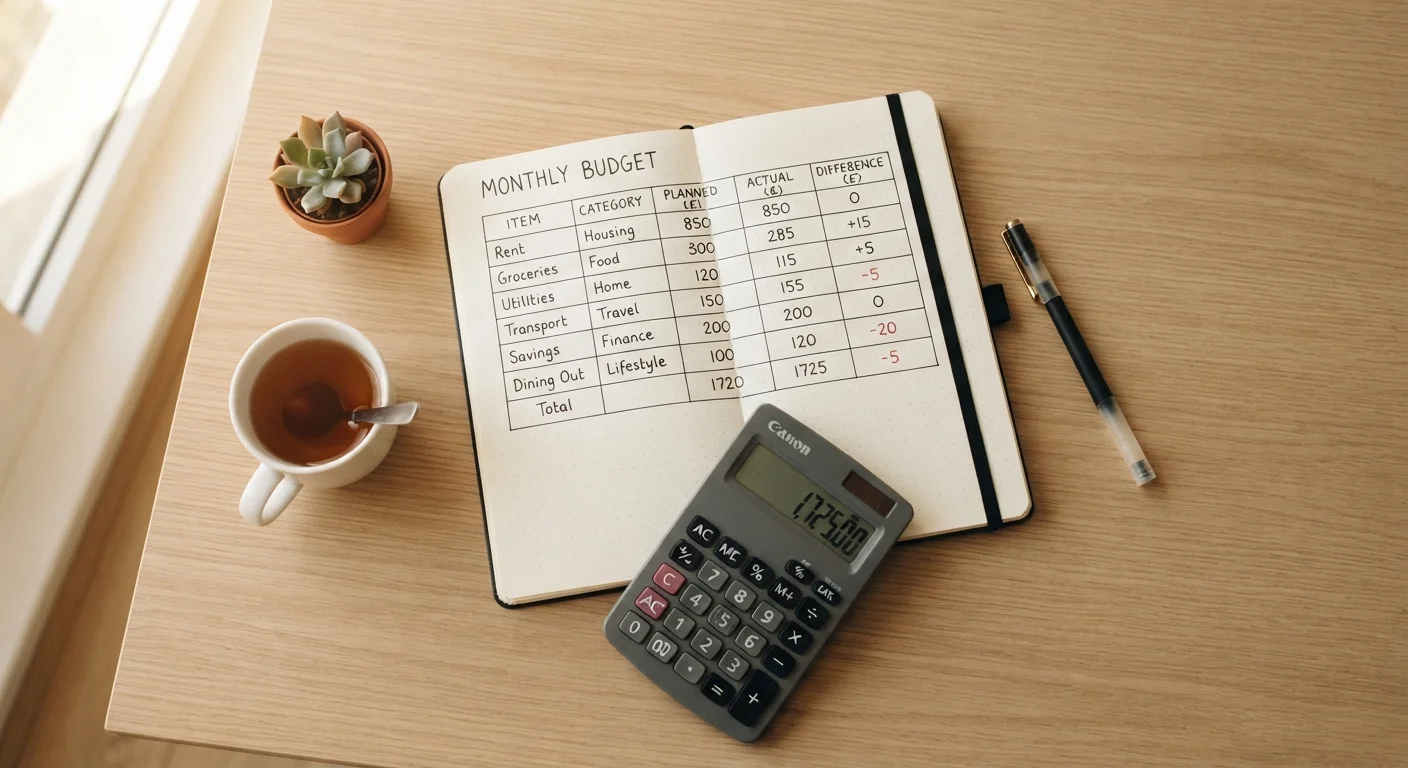
A budget written once and never revisited is just a piece of paper. Real budgeting happens when you compare what you planned to spend against what you actually spent — and make small corrections. Set a recurring time each month, even 15 minutes, to check your numbers. Did you overspend on groceries? Adjust next month's estimate or tighten another category to compensate.
Your first budget almost certainly won't be accurate. That's expected. The goal is to keep refining it until the numbers reflect your real life. Once you're comfortable with the basics, a monthly budget audit checklist can help you structure that review efficiently. And if your budget seems to keep falling apart despite your efforts, understanding why budgets fail early is the fastest way to fix the problem before it becomes a habit.
This article is for general informational purposes only and does not constitute personalized financial advice. Consider consulting a qualified financial professional for guidance specific to your situation.
Frequently Asked Questions
Start with your after-tax income, then subtract what you already spend on fixed costs like rent and utilities. From there, estimate flexible spending categories like groceries and gas. The goal is simply to know where your money goes before you try to change anything.
Always use your net income — the amount deposited into your account after taxes and deductions. Gross pay includes money you never see, so budgeting from it will leave you short every month.
A common starting guideline is 20% of take-home pay, though even saving 5–10% consistently is a meaningful step for first-time budgeters. Prioritize building a small emergency fund before tackling other savings goals.
Budget based on your lowest typical monthly income rather than an average. That way you're covered in lean months. For more detail, see approaches built specifically for variable earners.
No. A spreadsheet or even a pen-and-paper table works just as well for beginners. The method matters far more than the tool. Choose whatever you'll actually use each month.
Most first budgets underestimate variable spending, especially irregular costs like car repairs or annual subscriptions. Look back at three months of bank statements rather than guessing — actual numbers close the gap quickly.
The content on this site is for informational purposes only and is not a substitute for professional advice. Always consult a qualified professional for guidance specific to your situation.