

Our Verdict
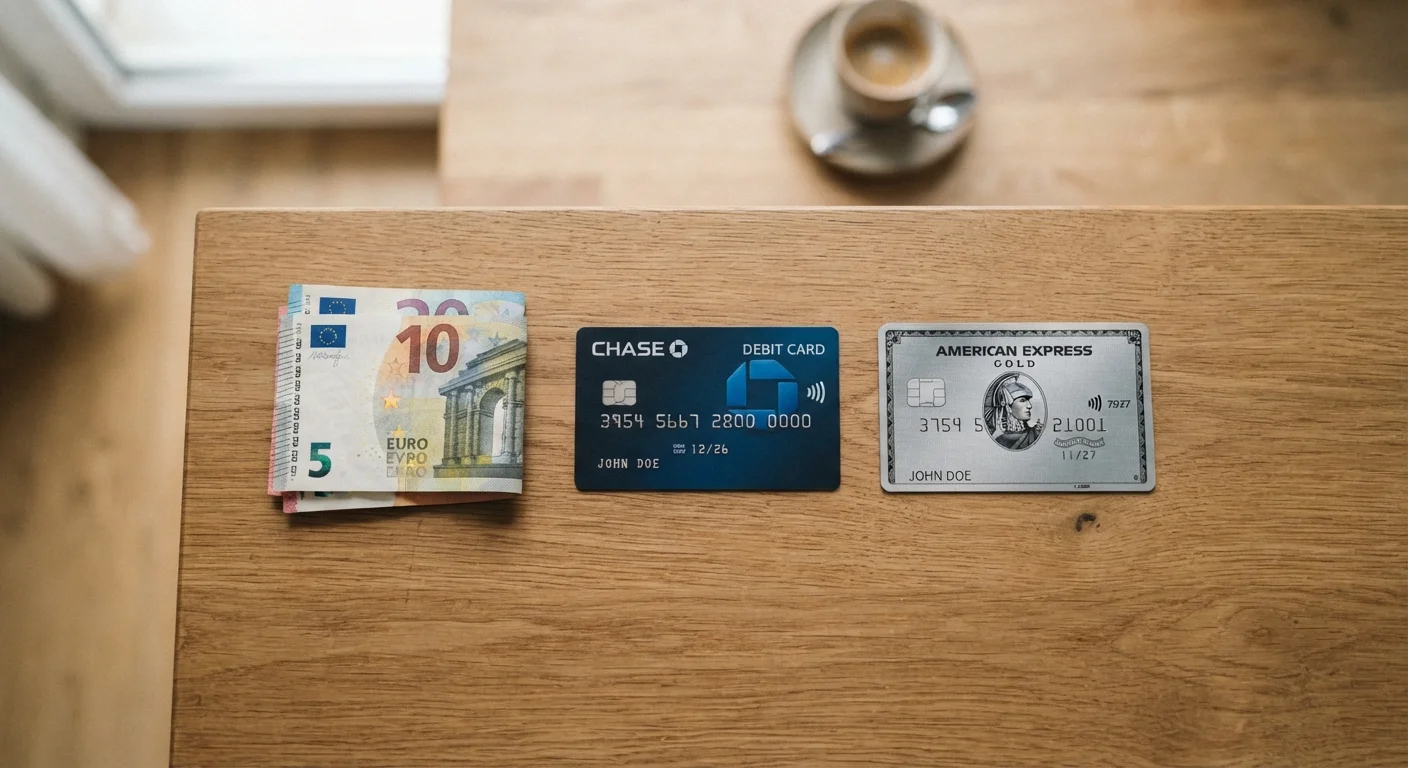
No single payment method wins for every situation. Cash is a powerful spending guardrail, debit keeps things simple and debt-free, and credit offers real financial benefits — but only if you can consistently avoid carrying a balance. Understanding each tool's strengths and weaknesses is the key to using them well.
| Best for | Recommended |
|---|---|
| Those who struggle with overspending or are working on a tight budget | Cash |
| Everyday spenders who want simplicity without debt risk | Debit |
| Disciplined spenders who pay their balance in full each month | Credit |
| Most households balancing spending control with financial flexibility | A combination approach |
How Each Payment Method Actually Works
Before comparing them, it helps to understand the mechanics of each option.
Cash is immediate and final. When you hand over bills, the money is gone. There's no bank intermediary, no processing delay, and no statement to review later. Cash is accepted almost everywhere, though increasingly less so at certain businesses.
Debit cards draw directly from your checking account. Transactions are processed electronically and typically settle within one to two business days. They feel like credit cards at the checkout line, but they're spending money you already have — not borrowing.
Credit cards are a short-term line of credit extended by a financial institution. You spend now and pay later, ideally in full when the statement comes due. If you carry a balance past the due date, interest — often at a high annual percentage rate (APR) — begins to accrue. Understanding how credit works is foundational to using it responsibly; see our overview in the Saving & Debt hub for broader context.
| Cash | Debit Card | Credit Card | |
|---|---|---|---|
| Spending source | Money on hand | Checking account balance | Borrowed credit line |
| Fraud liability | Full loss, no recourse | Up to $500 if delayed reporting | Capped at $50, often $0 |
| Debt risk | None | None (overdraft fees possible) | High if balance carried |
| Rewards potential | None | Rarely, minimal | Strong if paid in full |
| Spending control | Strongest — hard limit | Moderate — account balance cap | Weakest — flexible credit line |
| Accepted widely | Mostly, declining in some places | Very widely | Very widely |
| Purchase records | None (receipt only) | Bank statement | Card statement, detailed |
Consumer Protections and Fraud Liability
This is where the three options diverge most sharply.
Cash has zero fraud protection. If your wallet is stolen, that money is gone with no recourse. Cash also leaves no transaction record, which can make budgeting harder after the fact.
Debit cards carry federal protections under the Electronic Fund Transfer Act, but the timeline matters. Reporting a lost or stolen card within two business days limits your liability to $50. Wait longer — up to 60 days after your statement — and your liability can climb to $500. After 60 days, you may bear full responsibility. Because debit fraud hits your actual bank balance, it can disrupt bill payments and other pending transactions while the issue is being resolved.
Credit cards offer the strongest protections. Under the Fair Credit Billing Act, your maximum liability for unauthorized charges is $50, and many card issuers go further with zero-liability policies. Crucially, disputed charges sit on the card — not your bank account — while under investigation, leaving your cash untouched.
Debit Card Fraud Can Hit Harder Than You Think
Because debit fraud drains your actual checking account, it can cause cascading problems — bounced payments, overdraft fees, and delayed bill processing — even while your bank investigates. For purchases where fraud is more likely (online shopping, travel bookings, unfamiliar vendors), using a credit card reduces your real-world financial exposure significantly.
Spending Behavior and Budget Control
Research consistently suggests that people tend to spend more when using cards than when paying with cash — a phenomenon sometimes called the "pain of paying." Handing over physical money triggers a stronger psychological response than tapping a card.
For households actively working on spending control, cash and the envelope method can be a powerful combination. If you're curious how that system compares to digital tools, see our article on envelope budgeting vs. spreadsheet budgeting.
Debit cards occupy a middle ground. They can't put you into credit card debt, but they don't provide the same tactile spending friction as cash. Overdraft fees are also a real risk if you're not watching your balance closely.
Credit cards can actually support budgeting well for disciplined spenders — every purchase is itemized on a monthly statement, which makes category-level tracking straightforward. The danger lies in the flexibility itself: it's easy to spend beyond your means when payment feels deferred.
Rewards, Perks, and Hidden Costs
Cash offers no rewards and can actually cost you purchasing power over time if you're forgoing cashback or points you'd otherwise earn. On the upside, some small businesses offer a cash discount to avoid credit card processing fees — worth asking about.
Debit cards occasionally include modest rewards programs, but these are far less common and typically less valuable than credit card programs.
Credit cards can provide meaningful value through cashback, travel points, purchase protection, extended warranties, and rental car coverage — but only if you're not paying interest. If you carry a balance, interest charges will quickly erase any rewards earned. The math is unforgiving: a card earning 2% cashback loses all practical value if you're paying 20%+ APR on unpaid balances. That's how credit card debt can become a serious financial burden — a topic worth understanding through our article on good debt vs. bad debt.
Building a Payment Strategy That Works for You
Most households don't need to pick just one method — they need to know which method to reach for in which situation.
- Use cash for categories where you tend to overspend (dining out, entertainment, groceries) or when you're actively trying to stick to a strict budget.
- Use debit for routine, low-stakes transactions where you want simplicity and no debt risk.
- Use credit for larger purchases, recurring bills, online shopping, and travel bookings — anywhere fraud protection and purchase records are valuable — but only if you'll pay the balance in full each month.
If you're currently carrying credit card debt, prioritizing payoff before leaning on credit rewards makes financial sense. Our article on paying off debt while saving at the same time walks through how to balance those competing priorities.
This article is for general informational purposes only and does not constitute personalized financial advice. Consider consulting a licensed financial professional for guidance tailored to your specific situation.
The content on this site is for informational purposes only and is not a substitute for professional advice. Always consult a qualified professional for guidance specific to your situation.