

Start here
Why Reptiles Have Unique Care Requirements
Next
Choosing and Setting Up a Terrarium
Then
Heating and Lighting Essentials
Going deeper
Humidity, Substrate, and Enrichment
Final step
Feeding and Veterinary Care
Why Reptiles Have Unique Care Requirements
Reptiles — including lizards, snakes, tortoises, and geckos — are ectothermic, meaning they cannot generate their own body heat internally. Unlike dogs or cats, they depend entirely on their environment to reach and maintain the temperatures needed for digestion, immune function, and overall health. This single fact shapes every aspect of responsible reptile ownership.
Because their physiology is so environment-dependent, reptiles are less forgiving of husbandry mistakes than many other pets. A temperature that's too low can slow digestion to a halt; a humidity level that's too high or too low can lead to respiratory infections or difficult shedding. Before choosing any reptile, researching its native habitat is essential — a desert species and a tropical species have almost nothing in common in terms of care needs.
If you're weighing reptiles against other exotic pets, our overview of bringing home a pet bird offers a useful contrast in the demands different animals place on their owners.
Ectotherm
An animal that relies on external heat sources — like sunlight or a warm surface — rather than internal metabolism to regulate its body temperature. All reptiles are ectotherms.
Thermal gradient
A range of temperatures across the enclosure, from a warm basking zone to a cooler retreat, that allows a reptile to move between areas to control its own body temperature.
UVB lighting
A type of ultraviolet light that helps reptiles produce vitamin D3, which they need to absorb calcium and maintain healthy bones. Insufficient UVB is a leading cause of illness in captive reptiles.
Substrate
The material placed on the floor of a reptile enclosure. It affects humidity, allows natural behaviors like digging, and needs to be safe and appropriate for the species.
Thermostat
A device that automatically regulates a heat source to maintain a target temperature range, preventing dangerous overheating inside the enclosure.
Metabolic bone disease
A painful skeletal condition in reptiles caused by calcium deficiency, often resulting from inadequate UVB lighting or poor diet. It is preventable with proper husbandry.
Choosing and Setting Up a Terrarium
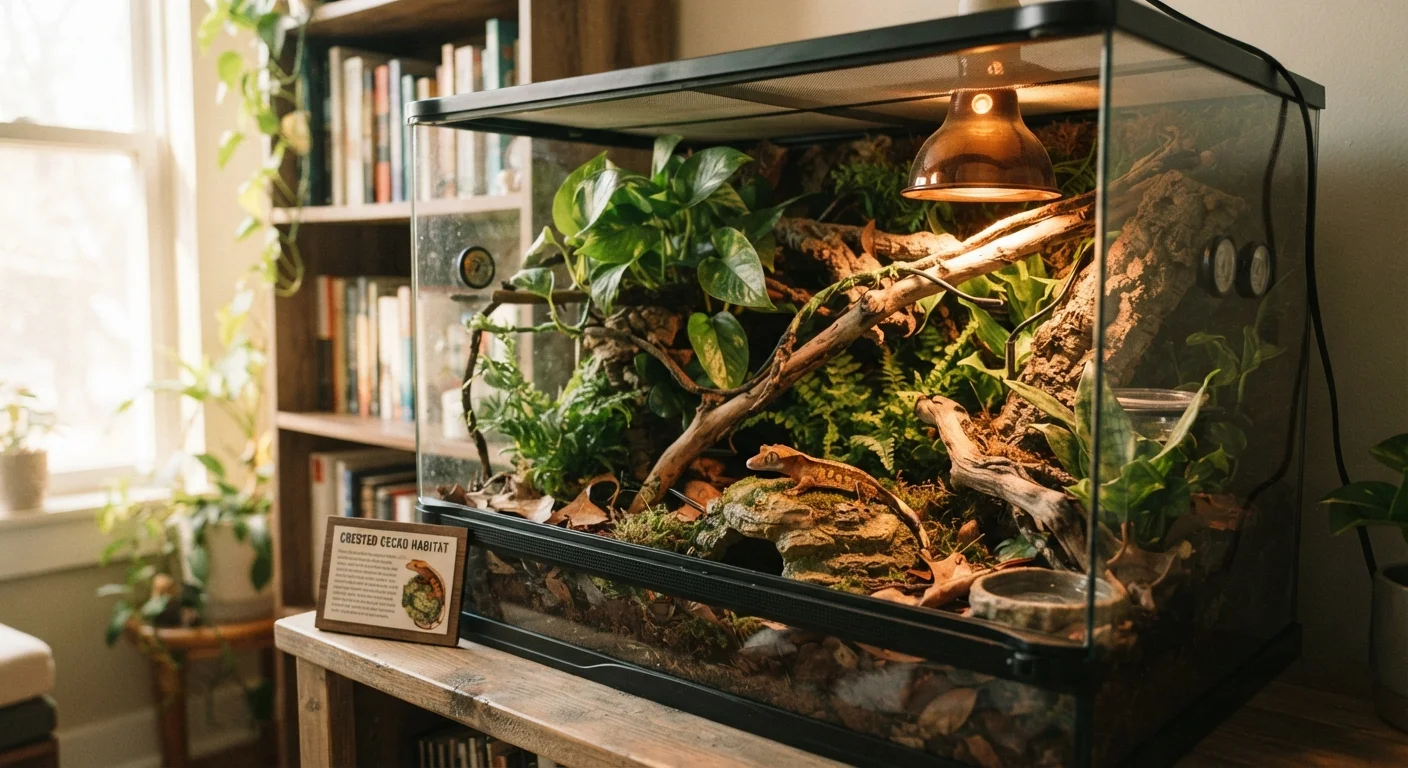
The terrarium — also called a vivarium or enclosure — is the most important investment you'll make for your reptile. Size matters from day one: an undersized enclosure restricts movement, limits thermal gradients, and causes chronic stress. As a general principle, longer and wider is better than taller for ground-dwelling species, while arboreal (tree-climbing) species need vertical height.
Glass terrariums with screened tops are the most common choice for beginners. Screen lids allow heat to escape and provide ventilation but may make humidity control harder in dry climates. PVC and wooden enclosures retain heat and humidity more effectively for tropical species but are typically a larger upfront investment.
Set Up the Terrarium Before You Bring Your Reptile Home
Run the heating and lighting system for at least 48 hours before introducing your reptile, and verify temperatures at both ends of the enclosure with a reliable thermometer. This gives you time to make adjustments without a live animal already under stress. A stable environment from day one makes the transition significantly smoother for your new pet.
Every terrarium should create a thermal gradient — a warm basking side and a cooler retreat side — so the reptile can move between zones to self-regulate its body temperature. A single temperature throughout the enclosure removes this ability entirely and causes health problems over time. Include at least one hide on each end of the enclosure so your animal can feel secure at any temperature zone it chooses.
Heating and Lighting Essentials
Heat sources fall into two categories: ambient heating (which warms the air) and surface heating (which warms objects the reptile contacts directly). Overhead basking bulbs, ceramic heat emitters, and radiant heat panels are common ambient options. Under-tank heating pads can supplement warmth but should never be the sole heat source, as reptiles cannot easily detect burns from below.
Thermostats are non-negotiable for any heating device — they prevent dangerous temperature spikes that can be fatal. A dimmer thermostat works for basking bulbs; a pulse or proportional thermostat is better suited for ceramic emitters and heat mats.
UVB lighting (ultraviolet-B radiation) is critical for most diurnal reptile species. Without adequate UVB, reptiles cannot synthesize vitamin D3, which is necessary for calcium absorption. The result — metabolic bone disease — causes painful skeletal deformities and is unfortunately common in reptiles kept under inadequate lighting. UVB bulbs degrade over time even when they still appear to glow, so replace them according to the manufacturer's schedule, typically every six to twelve months. Our article on common reptile health myths addresses other widely misunderstood aspects of reptile physiology.
Humidity, Substrate, and Enrichment
Humidity requirements vary enormously by species. A ball python needs 60–80% relative humidity, while a bearded dragon thrives at 30–40%. Hygrometers (humidity gauges) should be placed inside the enclosure to monitor levels accurately. Misting, humid hides, and water dishes all influence humidity, as does the type of substrate used.
Substrate — the material lining the floor of the enclosure — serves multiple functions: it retains moisture, allows natural behaviors like digging and burrowing, and contributes to aesthetics. Safe choices depend on the species. Coconut fiber and bioactive soil blends work well for tropical reptiles; tile or paper towels offer easy cleaning for drier species. Avoid substrates that could be accidentally ingested in dangerous quantities.
Mental stimulation matters too. Hiding spots, climbing structures, and varied terrain reduce boredom-related stress. For more ideas tailored to enclosure animals, see our guide on enrichment for caged pets.
Feeding and Veterinary Care
Reptile diets range widely: some species eat live or frozen insects, others eat whole prey animals, and many herbivorous and omnivorous reptiles need varied plant-based diets. Calcium and vitamin D3 supplementation — typically delivered by dusting prey items with powder — is standard practice for many insect-eating species to compensate for what captive diets lack.
Feeding frequency depends on species, age, and size. Young, growing reptiles generally eat more often than adults. Overfeeding is a real risk, particularly for sedentary captive animals, and can contribute to obesity and organ stress over time.
Reptiles are skilled at hiding illness, which makes routine veterinary care essential rather than optional. Annual wellness visits with a vet who has exotic-animal training allow early detection of parasites, respiratory issues, nutritional deficiencies, and other common concerns. Our resource on finding a vet for exotic pets explains what credentials to look for and what questions to ask.
This article is for general informational purposes only and is not a substitute for professional veterinary advice. Consult a qualified exotic-animal veterinarian for guidance specific to your reptile's species, age, and health status.
Frequently Asked Questions
Leopard geckos and bearded dragons are widely considered beginner-friendly because of their manageable size, relatively straightforward care needs, and docile temperaments. That said, 'easy' is relative — both still require precise temperatures and proper UVB lighting. See our <a href="/pets-animals/other-pets/leopard-gecko-vs-bearded-dragon-comparing-two-popular-starter-reptiles">comparison of these two popular species</a> for a full breakdown.
Use a digital thermometer with a probe — or an infrared temperature gun — to measure both the warm basking zone and the cooler end of the enclosure. Never rely on estimates or packaging claims alone. Accurate readings ensure your reptile can thermoregulate properly throughout the day.
Most diurnal (daytime-active) reptiles, including bearded dragons and many lizards, require UVB light to synthesize vitamin D3 and absorb calcium. Some nocturnal species, like leopard geckos, have lower UVB requirements but still benefit from a light cycle. Research your specific species before assuming UVB is optional.
Annual wellness exams are generally recommended for reptiles, even when they appear healthy. Reptiles often mask illness until symptoms are advanced, so proactive checkups with an exotic-animal vet are important. Find guidance on <a href="/pets-animals/other-pets/finding-a-vet-for-an-exotic-pet-what-owners-should-know">locating a qualified exotic vet</a> in your area.
Safe substrate choices depend on the species. Reptile carpet, paper towels, coconut fiber, and topsoil blends are commonly used. Avoid loose particle substrates like fine sand or wood shavings for young animals or species prone to accidental ingestion, as these can cause dangerous intestinal blockages.
Research suggests some reptiles, particularly bearded dragons and other larger lizards, can learn to associate their owners with positive experiences like feeding. While their social cognition differs greatly from mammals, many reptiles can become accustomed to handling and show reduced stress responses over time.
The content on this site is for informational purposes only and is not a substitute for professional advice. Always consult a qualified professional for guidance specific to your situation.