

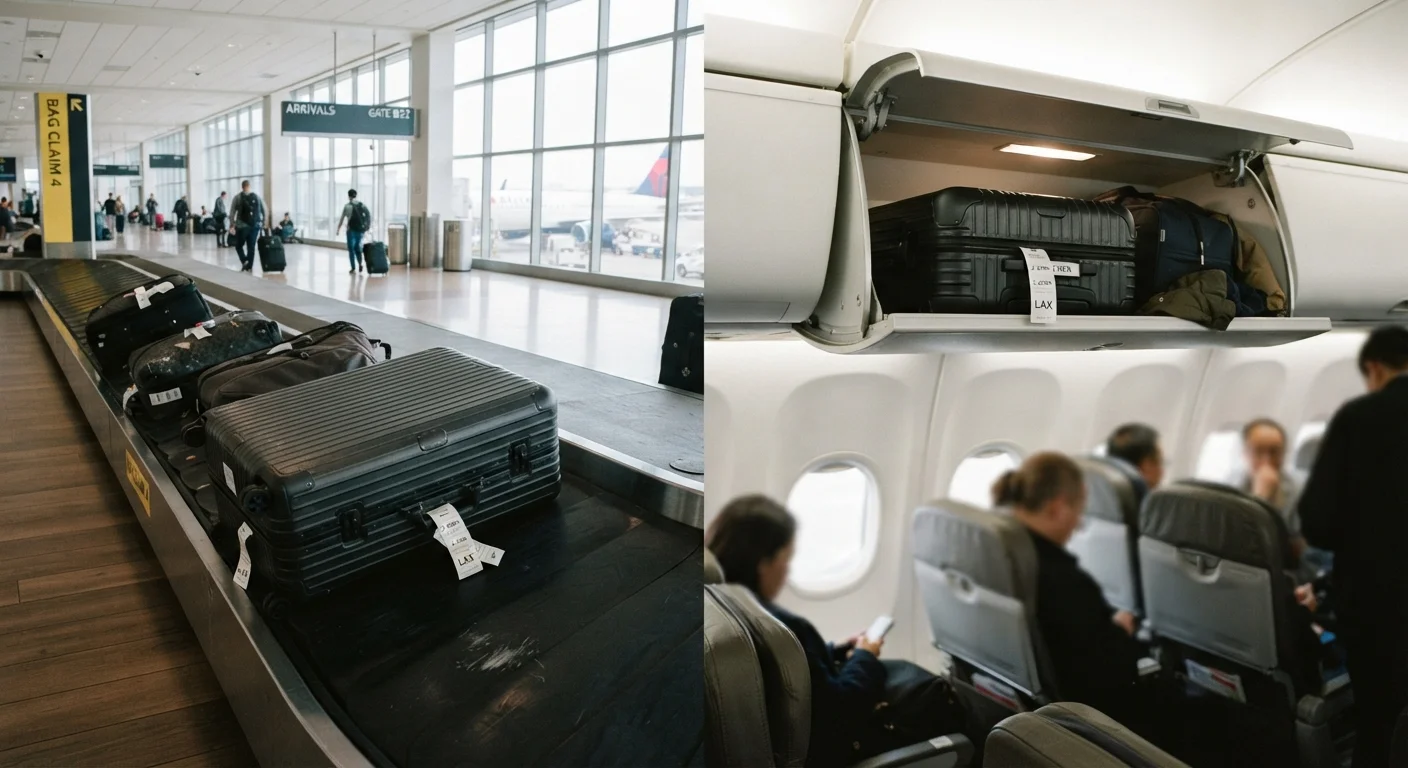
Option A
Checked Luggage
The spacious, hands-free option for longer or more complex trips.
Best for: Travelers packing for extended stays, carrying specialty gear, or checking items that can't go in a cabin bag.
Option B
Carry-On Only
The lean, fast approach for travelers who prize flexibility and speed.
Best for: Short-to-medium trips where travelers can pack light and want to avoid baggage fees and wait times.
The Real Cost Comparison
Cost is usually the first factor travelers consider, but the math isn't always straightforward. Most major U.S. carriers charge between $35 and $75 for a first checked bag each way. On a round trip, that's $70 to $150 before you've left the airport curb — and second bags cost more. Some airline-branded credit cards waive the first checked bag fee for the cardholder and sometimes companions, which can shift the calculation significantly.
Carry-on travel appears free at first glance, but that's not always true. Ultra-low-cost carriers sometimes charge for overhead bin bags while allowing only a small personal item (like a backpack under the seat) for free. Before you assume carry-on is the cheaper path, check the specific airline's fee schedule for your fare class.
For a broader look at where travel costs can surprise you, see the real trade-offs in budget travel.
| Criterion | Checked Luggage | Carry-On Only |
|---|---|---|
| Typical cost (domestic) | $35–$75 each way | Free on most major carriers |
| Baggage wait time | 20–45 minutes at carousel | None — exit immediately |
| Risk of lost/delayed bag | Higher — out of your control | Very low — bag stays with you |
| Packing capacity | 50 lbs / large volume | Typically 22 x 14 x 9 inches |
| Liquid restrictions | No TSA 3-1-1 limit applies | TSA 3-1-1 rule applies |
| Ease of transit (trains, buses) | Bulkier, harder to manage | Much easier to maneuver |
| Best trip length | Two-plus weeks or gear-heavy | Up to about one week |
Time, Convenience, and the Baggage Claim Factor
Time is where carry-on travel earns its most devoted fans. Skipping checked baggage means you walk off the plane and straight to ground transportation — no 20-to-45-minute wait at the carousel, no anxiety watching the belt loop around while your bag fails to appear. On short trips, that time savings can feel as valuable as any cost savings.
Checked luggage, on the other hand, offers genuine physical relief. You hand your bag off at check-in and don't lift it again until you're at your destination. For travelers with mobility considerations, those with children, or anyone navigating a complex multi-city itinerary, that freedom from hauling a bag through terminals and onto trains can make the trip measurably easier.
2.9 per 1,000
Mishandled bags per passengers boarded
U.S. DOT Air Travel Consumer Reports track mishandled baggage rates across domestic carriers; rates fluctuate year to year but have generally declined over the past decade.
$35–$75
Typical first checked bag fee (each way)
Major U.S. network carriers generally fall in this range for economy fares, though fees vary by carrier, fare class, and loyalty status.
45 min
Average time saved skipping baggage claim
Travel time studies and airport reporting suggest baggage claim adds roughly 20–45 minutes to the post-landing experience at busy U.S. airports.
One real risk with checked bags: mishandling and delays. The U.S. Department of Transportation publishes monthly airline baggage performance reports, and while the rate of truly lost bags is low, delayed bags — arriving on a later flight — happen with enough frequency to be worth planning around. If you check a bag, putting essentials like medications, a change of clothes, and chargers in your carry-on personal item provides a practical buffer.
Packing Realities: What Each Approach Demands
Choosing carry-on only is a commitment to disciplined packing — and that commitment pays off most when you've planned it through. Liquids must follow TSA's 3-1-1 rule (containers of 3.4 oz or less, in a single quart-sized bag), full-size toiletries stay home or get mailed ahead, and every item has to earn its place. For travelers who haven't done this before, carry-on bags often exceed limits in ways that surprise people — a worth-reading reality check before you pack.
Checked luggage gives you breathing room: full-size products, shoes that don't double as walking and dinner footwear, and room for souvenirs on the way home. The tradeoff is that you're responsible for those items leaving your hands, and standard airline liability for lost or damaged bags has limits. Consider photographing bag contents for high-value trips.
Whichever approach you take, a structured packing strategy makes both options work better. These packing strategies hold up across different trip types and are worth reviewing before any journey.
Carry-On Size Limits Are Not Uniform
Different airlines enforce different maximum dimensions and weight limits for carry-on bags, and some regional aircraft have smaller overhead bins than mainline jets. A bag that fits on one airline's wide-body might need to be gate-checked on a regional turboprop. Always check the specific airline's carry-on policy for your aircraft type before you pack — not just the general rule.
Trip Type Should Drive the Decision
There's no universally correct answer — trip context matters most. A three-day business trip to Chicago almost always favors carry-on only. A two-week European vacation with a mix of city and beach days often tips toward checked luggage. A ski trip with equipment, a destination wedding with formal attire, or travel with young children typically makes checked baggage not just convenient but necessary.
Flight routing also plays a role. Tight connections increase the risk that a checked bag gets misrouted. If your itinerary includes multiple connections or a mix of carriers, keeping your bag in the cabin eliminates one significant variable. On the other hand, a nonstop flight to a single destination is a lower-risk environment for checked baggage.
Before any trip, it's also worth running through a pre-trip preparedness checklist that covers documents, health essentials, and digital backups — items that should ride with you regardless of how you handle the rest of your luggage.
The content on this site is for informational purposes only and is not a substitute for professional advice. Always consult a qualified professional for guidance specific to your situation.