

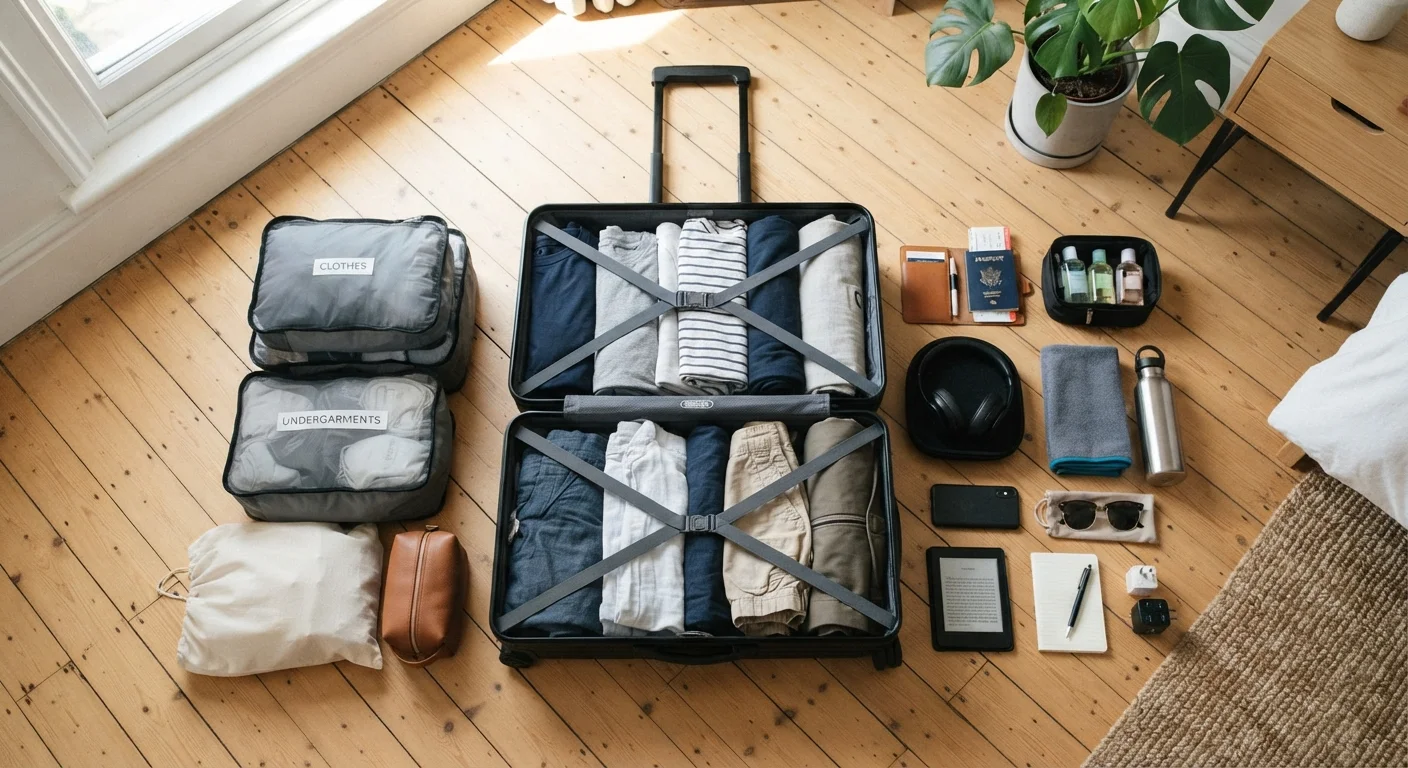
Start With the Right Mindset: Pack for the Trip You're Actually Taking
The single most common packing mistake isn't forgetting something — it's bringing too much for a version of the trip that never happens. Before you open your suitcase, ask yourself honestly: what will I actually do each day? A beach week in Florida doesn't need the same kit as a hiking trip in Colorado or a three-city European itinerary.
Anchoring your packing decisions to a realistic daily schedule — rather than a "just in case" mindset — is the foundation that makes every other principle work. Think in activities, not outfits. Think in days, not items.
For a deeper look at how to match your strategy to different trip formats, see our packing strategies for different trip types.
The Capsule Wardrobe Principle: Do More With Less
A capsule travel wardrobe means selecting pieces that mix and match across multiple outfits from a small base of items. The core rule: choose a palette of two or three neutral colors so that tops, bottoms, and layers all work together. One pair of dark pants that reads casual during the day and dressed-up at dinner is worth three pairs that only work in one context.
Fabrics matter enormously here. Merino wool, nylon blends, and moisture-wicking synthetics resist odor, dry quickly, and pack down small — meaning you can re-wear items comfortably and skip a checked bag entirely on many trips. This also has real financial implications: flying carry-on only can eliminate checked-bag fees that add up quickly across a multi-leg trip.
Roll, Fold, or Cube? Organizing Your Bag Like a Pro
Rolling clothes — especially knits, jeans, and t-shirts — generally reduces wrinkles and compresses the item into a tighter cylinder that fills corner space in a bag more efficiently than flat folds. Structured items like blazers and dress shirts pack better flat or layered with tissue paper to preserve shape.
Packing cubes are one of the most practical organization tools available regardless of bag size. They let you group items by category (tops, bottoms, toiletries) so that unpacking at a hotel or Airbnb takes seconds rather than minutes. Compression cubes go further by forcing air out, shrinking a cube's footprint by roughly a third — useful for bulky layers or an extra pair of shoes.
Before you zip anything, weigh your bag. A simple luggage scale costs very little and could save you from overweight bag fees at check-in. Our guide on why carry-ons get so heavy breaks down exactly where those surprise ounces accumulate.
Liquids, Toiletries, and the Art of Traveling Light on Products
Toiletries are one of the heaviest and most frequently overpacked categories. A practical rule: if your accommodation is likely to provide it (shampoo, conditioner, body wash, hair dryer), don't bring it. Solid toiletries — shampoo bars, solid conditioner, toothpaste tablets — are increasingly widely available and sidestep TSA liquid rules for carry-on travel entirely.
For liquid toiletries, decant only what you'll use. A two-week trip doesn't need a full-size bottle of anything. Reusable silicone bottles in 1–2 oz sizes keep you compliant with the TSA's 3-1-1 rule (liquids in containers of 3.4 oz or less, in one quart-sized clear bag, one bag per traveler) without wasting product or space.
Smart packing choices ripple into your overall travel budget. For a full framework on keeping trip costs manageable, see our guide to building a travel budget that holds up on the road.
The content on this site is for informational purposes only and is not a substitute for professional advice. Always consult a qualified professional for guidance specific to your situation.