

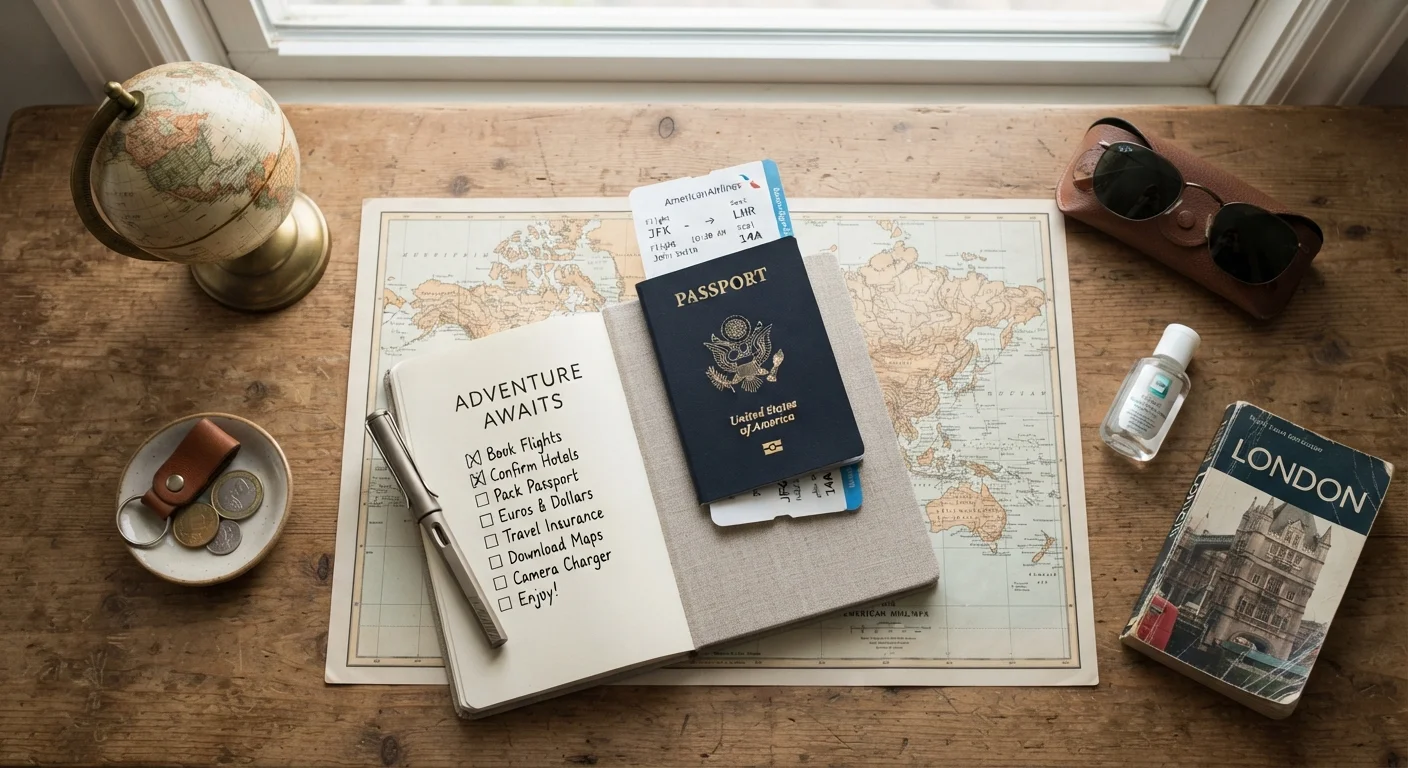
Start here
Start With Your Passport
Next
Understand Entry Requirements for Your Destination
Then
Sort Out Health and Insurance Prep
Also important
Get Your Money Situation Ready
Finish strong
Build a Realistic Pre-Trip Checklist
Start With Your Passport
Your passport is the single non-negotiable document for international travel, and it takes longer to get than most first-timers expect. The U.S. State Department's processing times shift throughout the year — sometimes weeks, sometimes months — so checking the current estimates at travel.state.gov well before you want to travel is the right first move.
A few things to confirm right now:
- Do you have a passport? If not, budget time and the application fee to get one. You'll need a birth certificate, government-issued ID, a passport photo, and a completed DS-11 form.
- Is your current passport valid? Many countries require at least six months of remaining validity beyond your departure date — a passport that isn't expired might still be rejected at a foreign border.
- How many blank visa pages remain? Some countries require at least two blank pages for stamps.
If your passport needs renewing, don't wait until you've booked flights. Expedited service is available for an extra fee but is not instant. For a broader look at everything the planning process involves, see our full trip-planning overview.
Passport validity
Many countries require your passport to remain valid for at least six months beyond your travel dates — even if it hasn't technically expired yet.
Visa
An official authorization from a foreign country allowing you to enter. Some must be obtained before departure; others can be issued at the border or airport on arrival.
eTA (Electronic Travel Authorization)
A pre-travel permission required by some countries that is applied for online before your trip — distinct from a visa but still required for entry.
Travel insurance
A type of insurance that can cover costs from trip cancellations, medical emergencies, lost luggage, and emergency evacuation when traveling abroad.
Foreign transaction fee
A fee some banks and credit card issuers charge — typically 1–3% — on purchases made in a foreign currency or processed through a foreign bank.
Travel advisory
An official safety rating issued by the U.S. State Department for specific countries, ranging from normal precautions to 'do not travel,' based on current conditions.
Understand Entry Requirements for Your Destination
A valid passport gets you out of the country — but it doesn't automatically get you into the one you're headed to. Entry requirements vary significantly by destination and can include visas, electronic travel authorizations (eTAs), proof of onward travel, or specific health documentation.
The only reliable sources for this information are the official embassy or consulate website of your destination country and the U.S. State Department's country information pages at travel.state.gov. Third-party travel sites can summarize requirements helpfully, but they shouldn't be your final word — rules change, and the consequences of getting it wrong are serious.
Questions to answer for every destination:
- Is a visa required for U.S. citizens? If so, must it be obtained before departure or is visa-on-arrival available?
- Does the country require an eTA or similar electronic authorization?
- Are there vaccination or health documentation requirements?
- Are there any active travel advisories from the U.S. State Department?
Our deeper explainer on how visas, eTAs, and border entry rules work walks through each term in plain language if you're new to this. If you're considering Mexico specifically, what to research before booking a beach resort in Mexico covers the entry and safety context worth reviewing first.
Register Your Trip With the State Department
The Smart Traveler Enrollment Program (STEP) is a free service that lets you register your trip with the nearest U.S. Embassy or Consulate. This makes it easier for the embassy to contact you in an emergency and for family to reach you if something happens. It takes only a few minutes at step.state.gov.
Sort Out Health and Insurance Prep
Health preparation for international travel goes beyond packing a first-aid kit. Two separate questions deserve attention: what vaccinations or health precautions your destination recommends, and what happens if you get sick or injured while abroad.
Health precautions: The CDC's Traveler's Health site (wwwnc.cdc.gov/travel) organizes destination-specific recommendations for vaccines and disease prevention. Your own doctor or a travel medicine clinic can review your vaccination history and flag anything you should address before departure. Consult a qualified healthcare professional — this article is general information, not medical advice.
If you take prescription medications, plan ahead. See our guide on traveling internationally with medications for documentation and border considerations.
Travel insurance: Most U.S. health insurance plans provide limited or no coverage abroad, and Medicare generally does not cover international care at all. Travel insurance with medical and emergency evacuation coverage can protect against costs that would otherwise land entirely on you. Read any policy carefully — coverage terms, exclusions, and claim processes vary widely. For the full planning context on a first trip, including safety prep, see our pre-trip safety and preparedness checklist.
Get Your Money Situation Ready
Financial logistics are easy to overlook until you're standing at a foreign ATM with a blocked card. Handle these steps before you leave:
- Notify your bank and card issuers of your travel dates and destination. Banks flag unfamiliar foreign transactions as potential fraud and may freeze your card mid-trip without advance notice.
- Understand your card's foreign transaction fees. Some cards charge 1–3% on every purchase abroad; others waive these fees entirely. Check before you go.
- Know your ATM withdrawal limits and fees. Daily withdrawal limits vary by account. Many overseas ATMs also charge their own usage fee on top of what your bank charges.
- Carry some local currency for arrival. Having enough cash for a taxi, transit fare, or a meal before you locate an ATM is simply practical — but avoid exchanging large amounts at airport currency counters, where rates and fees are typically less favorable.
For broader context on managing a travel budget, the budgeting basics hub is a helpful starting point for thinking through trip costs before you commit.
Don't Rely on a Single Payment Method
Traveling with only one card or only cash is a significant risk. Cards can be lost, stolen, or blocked; ATMs can be out of service. Bring at least two cards from different networks and a modest amount of local cash as backup. Keep them in separate places rather than all in one wallet or bag.
Build a Realistic Pre-Trip Checklist
Once you've handled the foundational items above, the final step before booking is turning everything into a concrete to-do list with deadlines — not a vague mental note. First-time international travelers often underestimate how much admin is involved, and a checklist makes the load feel manageable.
A practical framework to work through:
- 6+ months out: Confirm or apply for your passport. Research visa and entry requirements. Check CDC travel health recommendations and schedule any necessary appointments.
- 2–3 months out: Book flights and accommodation. Purchase travel insurance. Complete visa applications if required.
- 4–6 weeks out: Notify your bank. Make copies of all key documents. Research local transportation and currency. Check the U.S. State Department advisory for your destination.
- 1 week out: Confirm all bookings. Charge and pack electronics. Organize medications with any required documentation.
If you're heading abroad solo for the first time, our solo travel first-timer's overview covers the safety habits and planning steps specific to that experience. Families traveling with children will find a different set of considerations in our guide on international travel with kids. The Travel Tips hub is also a solid place to keep building your knowledge across packing, safety, and smart habits.
Frequently Asked Questions
The U.S. State Department recommends applying at least six months before your planned travel date. Routine processing times fluctuate, and expedited service carries an added fee with no absolute guarantee of a specific turnaround. Check the current processing estimates at travel.state.gov before deciding which service level you need.
It depends entirely on your destination. Many countries allow U.S. passport holders to enter visa-free for short stays, while others require a visa or an electronic travel authorization obtained in advance. Always verify current requirements through the official embassy or consulate of your destination country.
Most domestic health insurance plans offer limited or no coverage outside the United States. Medicare generally does not cover care abroad. Travel insurance with a medical coverage component can help bridge this gap — review any policy's terms carefully before purchasing.
Having a small amount of local currency on hand when you arrive is useful for tipping, transit, or small purchases before you find an ATM. However, airport currency exchange counters often charge high fees. Using a no-foreign-transaction-fee debit or credit card at a local ATM abroad is frequently a more cost-effective option.
Bring your passport, any required visas, travel insurance documentation, copies of your itinerary, and emergency contact information. Store digital copies of key documents in a secure cloud account. Carrying physical photocopies separately from originals is also a common precaution.
For most first-time international travelers, travel insurance is worth serious consideration. Policies can cover trip cancellations, medical emergencies, lost luggage, and evacuation costs that would otherwise be paid entirely out of pocket. Review what any policy does and does not cover before committing.
The content on this site is for informational purposes only and is not a substitute for professional advice. Always consult a qualified professional for guidance specific to your situation.