

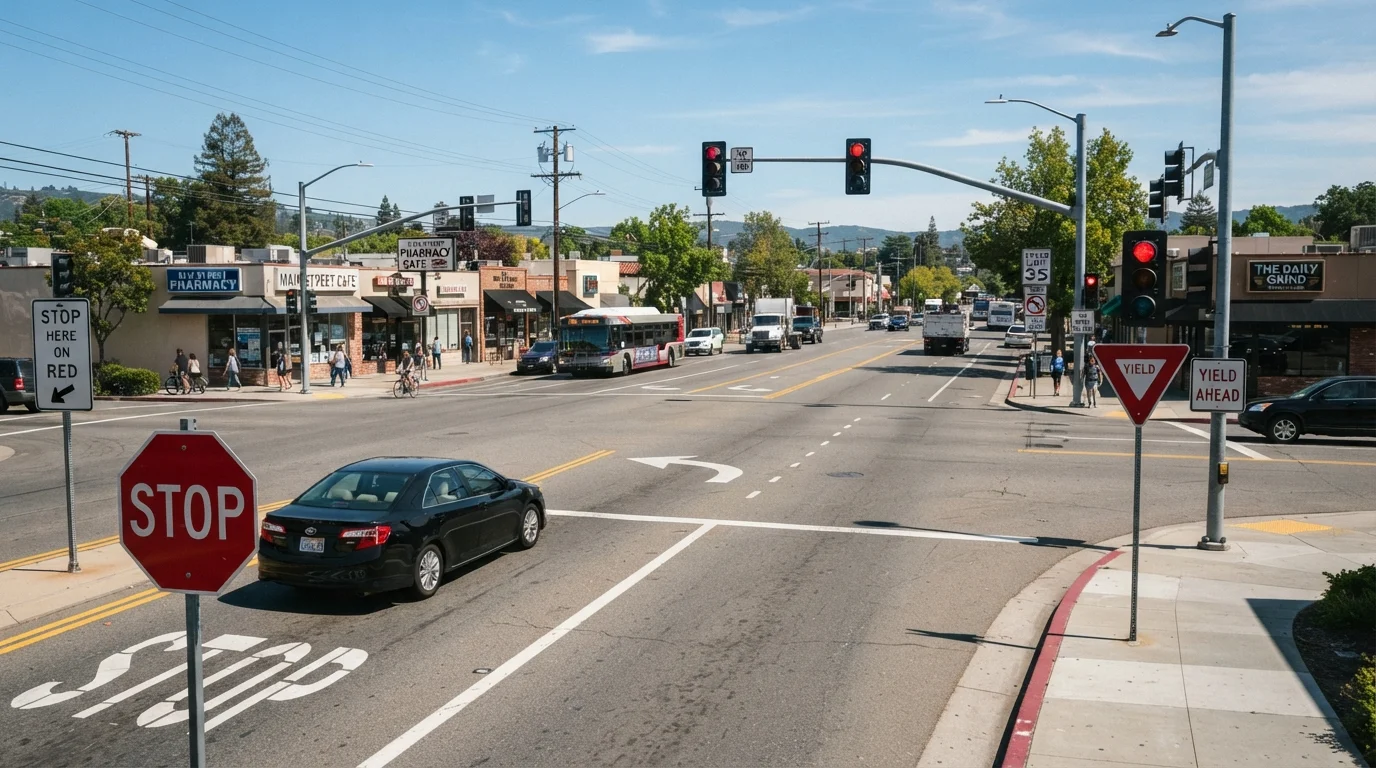
How U.S. Signs Are Organized
Every traffic sign on American public roads is governed by the Manual on Uniform Traffic Control Devices (MUTCD), a federal standard that specifies color, shape, size, and placement. That standardization is intentional: a driver crossing from Texas into Montana should never be surprised by a new visual language. Signs fall into three primary categories — regulatory, warning, and guide — each with its own color family and shape logic.
| Governing Standard | Manual on Uniform Traffic Control Devices (MUTCD) (Federal Highway Administration) |
| Regulatory Sign Color | White background with black or red text |
| Warning Sign Shape | Diamond (yellow or orange background) |
| Guide Sign Color | Green, blue, or brown rectangle |
| Stop Sign Shape | Red octagon — the only octagonal sign in the U.S. |
| Solid Yellow Center Line | No passing permitted on your side of the road |
Understanding this system lets you decode an unfamiliar sign instantly. A red octagon will always mean Stop. A yellow diamond will always signal a hazard ahead. A green rectangle will always carry route or distance information. Shape and color work together so the message registers before you've even read the text — which matters when you're traveling at highway speed.
For a broader look at how sign knowledge fits into overall safe driving, see the Complete Road Safety Handbook for American Drivers.
Regulatory Signs: What the Law Requires
Regulatory signs communicate legal requirements. Ignoring them isn't just unsafe — it can result in citations, points on your license, or worse. Key examples:
- Stop (red octagon): Come to a complete stop before the stop line or crosswalk. You must yield to all crossing traffic and pedestrians before proceeding.
- Yield (downward-pointing red-and-white triangle): Slow or stop as needed, then merge when it is safe. You do not have an unconditional right to proceed.
- Speed Limit (white rectangle, black text): The posted number is the maximum under ideal conditions — not a target. Adverse weather legally and practically requires a lower speed.
- Do Not Enter / Wrong Way (red): You are approaching a one-way road from the wrong direction. Stop immediately and reverse course.
- No Turn on Red: Even where turns on red are generally permitted by state law, this sign overrides that permission at the specific intersection.
MUTCD
The Manual on Uniform Traffic Control Devices is the federal standard that defines the design and use of all traffic signs, signals, and markings on U.S. public roads. It ensures consistency across all 50 states.
Regulatory Sign
A sign that communicates a legal requirement or prohibition. Failure to comply can result in a traffic citation. Stop, yield, and speed limit signs are all regulatory signs.
HOV Lane
A High-Occupancy Vehicle lane reserved for vehicles carrying a minimum number of occupants, typically two or more. Marked by diamond symbols on the pavement and specific overhead or roadside signs.
Advisory Speed
A recommended — not legally mandated — speed posted on yellow signs near curves, ramps, or other geometrically challenging road features. Exceeding it meaningfully raises crash risk even if it doesn't violate the posted speed limit.
Protected Turn
A turn made during a green arrow signal phase, during which oncoming traffic is held by a red light. Drivers making protected turns legally have the right of way over crossing traffic.
Pavement Marking
Lines, symbols, or words painted or applied to a road surface that convey traffic rules, lane boundaries, or warnings. They carry the same legal authority as posted signs.
When conditions change — rain, snow, or fog — regulatory speed limits may not reflect a safe operating speed. See how conditions change the driving rules for practical guidance.
Warning Signs and Pavement Markings
Warning signs are typically diamond-shaped with a yellow or orange background. They alert you to a condition ahead — not a rule, but a hazard requiring a change in behavior. Common examples include curve ahead, merge, pedestrian crossing, and railroad crossing (the round advance warning sign before the X-shaped crossbuck).
School and work zones use orange warning signs, which often carry temporarily reduced speed limits that are legally enforceable.
Pavement markings carry legal weight equal to posted signs:
- Solid white line: Marks the edge of the roadway or separates lanes traveling in the same direction — do not cross.
- Broken white line: Lane division; crossing is permitted when safe.
- Solid yellow line (your side): No passing permitted.
- Broken yellow line: Passing permitted when clear.
- Double solid yellow: No passing in either direction.
- White stop line: The point at which you must stop at a signal or sign.
- Diamond symbol on pavement: Reserved lane — typically HOV (high-occupancy vehicle) or bus.
Nighttime driving makes pavement markings harder to see. Review why darkness is harder than most drivers assume for strategies that help.
Guide Signs and Signs You Might Misread
Guide signs — green, blue, or brown rectangles — provide navigation and informational support. Green signs carry route numbers and distance. Blue signs indicate services (gas, food, lodging, hospitals). Brown signs mark recreational areas and cultural landmarks.
Several signs trip up even experienced drivers:
- Flashing yellow arrow: You may turn, but must yield to oncoming traffic and pedestrians. It is not a protected green arrow.
- Flashing red light: Treat as a stop sign — full stop required.
- Flashing yellow light: Slow down and proceed with caution; no full stop required.
- Advisory speed signs (yellow): These recommend a safe speed for a curve or ramp. They are not the same as regulatory speed limits, but ignoring them significantly increases crash risk.
Urban intersections stack several of these sign types simultaneously. Highway vs. city driving safety habits explains how the sign-reading demands differ across environments.
Staying sharp about what your vehicle is communicating matters too — not just the road. The signs your car needs attention that aren't dashboard lights covers the cues drivers often overlook.
The content on this site is for informational purposes only and is not a substitute for professional advice. Always consult a qualified professional for guidance specific to your situation.