

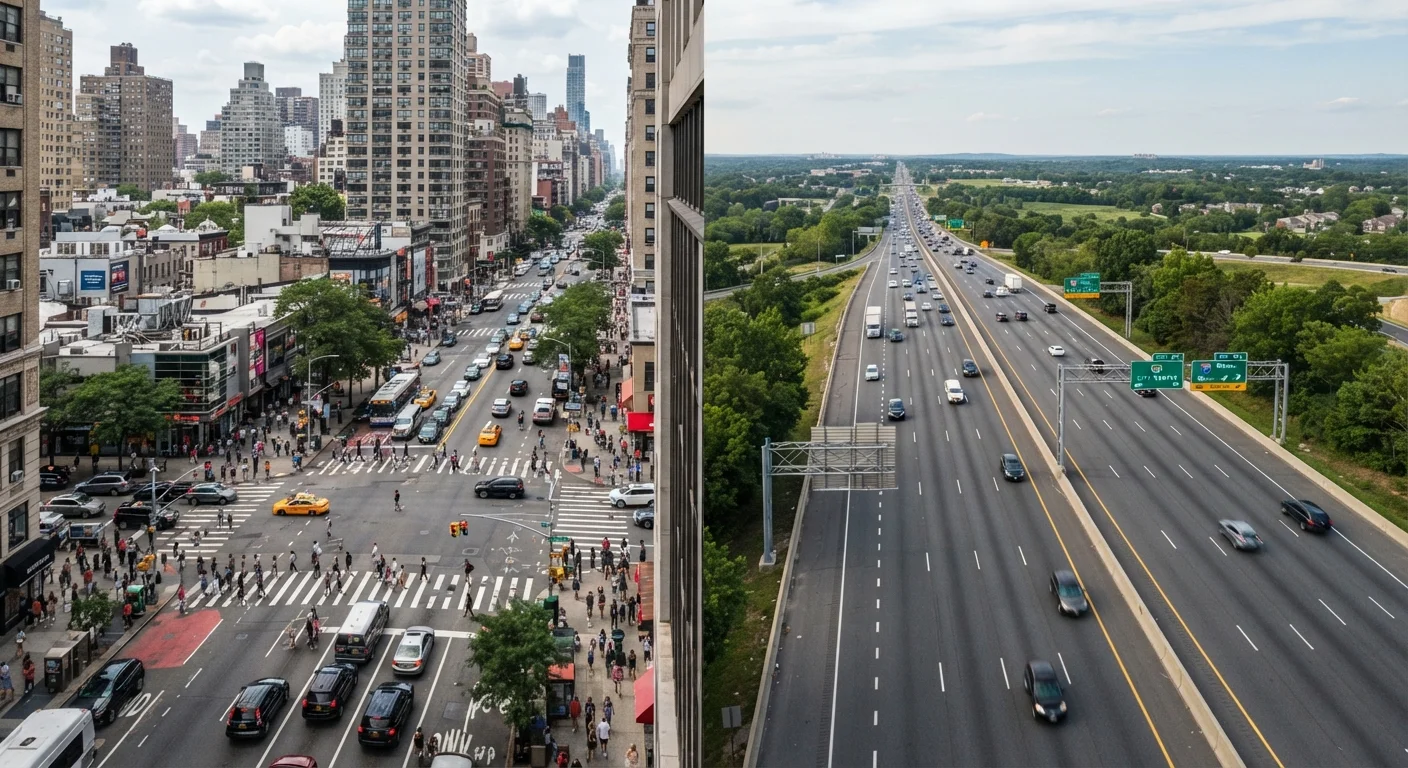
Option A
Highway Driving
High-speed, long-distance travel with controlled access and predictable flow.
Best for: Drivers covering long distances quickly, where sustained attention and fatigue management matter most.
Option B
City Driving
Low-speed, high-complexity navigation through dense, unpredictable environments.
Best for: Drivers navigating stop-and-go traffic, pedestrians, cyclists, and frequent intersections.
Why the Environment Changes Everything
Most drivers treat safety as a single, fixed set of behaviors — look both ways, follow the speed limit, don't tailgate. But the actual risks you face behind the wheel shift substantially depending on where you're driving. A busy urban block and an open interstate are almost entirely different operating environments, and the habits that keep you safe in one can be insufficient — or even misapplied — in the other.
Understanding those differences isn't just useful trivia. It's a practical foundation for defensive driving — the discipline of anticipating hazards before they become emergencies. The goal here is to break down exactly how safety thinking should shift depending on which road you're on.
| Criterion | Highway Driving | City Driving |
|---|---|---|
| Primary hazard type | High-speed impact, fatigue, long stopping distances | Intersection conflicts, pedestrians, cyclists |
| Recommended following distance | 3–4+ seconds at speed | 2–3 seconds in slow traffic |
| Hazard scan frequency | Every 12–15 seconds, broader horizon | Constantly, close-range and 360° |
| Fatigue risk | High — monotony accelerates drowsiness | Lower — frequent decisions maintain alertness |
| Lane change complexity | High-speed merges require long planning | Frequent but shorter, slower moves |
| Pedestrian/cyclist risk | Minimal to none (controlled access) | Constant, at intersections and mid-block |
| Speed consistency | Sustained highway speeds | Frequent stops and starts |
| Aggressive driving triggers | Tailgating, improper passing | Gap competition, signal violations, impatience |
Highway Driving: Speed, Distance, and Sustained Focus
Highways and interstates are engineered for speed and flow. Access is controlled, traffic generally moves in one direction, and there are no pedestrians or cyclists to watch for. On the surface, this sounds simpler. In practice, the high speeds involved compress your reaction time and amplify the consequences of any mistake.
Following distance becomes critical. At 70 mph, a vehicle travels roughly 103 feet per second. Standard guidance recommends at least a 3–4 second gap between your vehicle and the one ahead — enough space to react and brake without a collision. Many drivers underestimate how much space that actually requires at speed.
Lane discipline and merging strategy matter more. Highway lane changes at high speed require earlier signaling, a longer look-ahead, and awareness of vehicles in your blind spots that are also moving fast. Abrupt moves that might be manageable in slow city traffic can trigger multi-car chain reactions at 65 mph.
Fatigue is a major, underappreciated threat. Highway monotony — steady speed, minimal stimulation, low decision frequency — accelerates driver fatigue far faster than city driving. Studies by the National Highway Traffic Safety Administration (NHTSA) have consistently identified drowsy driving as a significant contributor to fatal crashes, with highways representing a disproportionate share. Taking a break every two hours is a widely recommended practice for long-distance trips. For more on how darkness compounds fatigue on highways, see night driving risks.
~50%
Share of fatal crashes on rural roads and highways
NHTSA data consistently shows rural and highway roads account for roughly half of all U.S. traffic fatalities despite lower traffic volume than urban areas.
103 ft/sec
Distance traveled at 70 mph per second
At highway speeds, a vehicle covers the length of a typical house lot in under one second, illustrating why following distance is so consequential.
~40%
Urban crashes occurring at intersections
Federal Highway Administration research indicates a significant share of urban crashes involve intersection conflict points, underscoring the need for active scanning habits.
City Driving: Complexity, Conflict Points, and Close Quarters
Urban driving involves a far higher density of potential hazards per mile. Intersections, crosswalks, bus stops, bike lanes, delivery vehicles, and unpredictable pedestrian behavior all create what traffic engineers call conflict points — places where the paths of different road users cross or intersect.
Intersection management is the defining skill. A large share of urban crashes occur at or near intersections. This includes not just red-light violations but also failure to yield, misjudging gaps, and reduced visibility caused by parked vehicles or roadside structures. Approaching every intersection with reduced speed and active scanning — even on a green light — is a habit that pays consistent dividends.
Vulnerable road users require dedicated attention. City streets are shared with pedestrians, cyclists, and motorcyclists who are significantly more exposed than vehicle occupants. Checking mirrors and blind spots before every turn, watching for pedestrians stepping off curbs between intersections, and giving cyclists adequate passing clearance are all legally and practically important. Our guide on sharing the road with vulnerable users covers these obligations in detail.
Aggression and frustration escalate differently in cities. Stop-and-go traffic, competition for gaps, and close quarters can fuel impatience that tips into aggressive behavior. Road rage and aggressive driving are measurably more common in dense urban corridors, and recognizing the early signs in your own behavior is a critical skill.
Building consistent city habits — like routine mirror checks and structured intersection approaches — pays dividends in any environment. Safe driving habits worth building from the start outlines the foundational behaviors that transfer across all road types.
City Driving and Distraction Risk
Urban environments generate a higher volume of visual stimuli — storefronts, signage, pedestrian activity — which can pull a driver's attention in multiple directions simultaneously. This makes phone use and other distractions especially dangerous in city settings. Even a two-second glance at a screen while moving at 25 mph covers more than 70 feet — more than enough distance for a pedestrian to step off a curb or a vehicle ahead to brake suddenly.
Applying the Right Mindset for Each Environment
The most important takeaway from this comparison is the idea of deliberate mental shifting. Experienced drivers don't apply one generic attention strategy to every road — they adapt. Entering a city after a long highway stretch requires consciously raising your scan frequency, reducing your speed expectations, and re-engaging with the dense, close-range environment. Moving from city streets to an on-ramp requires expanding your attention horizon and thinking in terms of speed management and lane positioning over the next several miles.
Weather adds another variable to both environments — rain, snow, and fog change stopping distances and visibility in ways that compound the baseline risks of both highway and city driving. The principles in driving in adverse weather conditions apply across both settings but interact differently with each context.
For a broader framework that ties together all of these scenarios, The Complete Road Safety Handbook for American Drivers provides a comprehensive reference covering hazard awareness, traffic law, and smart habits for the full range of driving environments.
The content on this site is for informational purposes only and is not a substitute for professional advice. Always consult a qualified professional for guidance specific to your situation.