

Why Knife Skills Matter More Than You'd Think
Most home cooks learn to chop by watching someone else do it — a parent, a cooking show, or trial and error. The result is often a grab-and-hack approach that's slower, inconsistent, and riskier than it needs to be. Good knife technique isn't about speed or culinary theatrics. It's about control: producing uniform pieces that cook evenly, finishing prep in less time, and keeping your fingers intact while you do it.
If you're just finding your footing in the kitchen, the beginner's kitchen guide is a useful starting point before diving into technique. For everyone else, what follows are the fundamentals that make a real difference at the cutting board.
~350,000
Annual ER visits from knife-related injuries in the U.S.
The Consumer Product Safety Commission estimates several hundred thousand Americans visit emergency rooms each year due to knife injuries, the majority occurring at home.
8 inches
Most versatile chef's knife length for home cooks
Culinary educators widely recommend an 8-inch chef's knife as the single most useful tool for the majority of home cooking prep tasks.
The Right Grip: Pinch vs. Handle
Most people grip a knife by wrapping their fingers around the handle. It feels natural, but it gives you less control than the pinch grip — the grip used by nearly every trained cook.
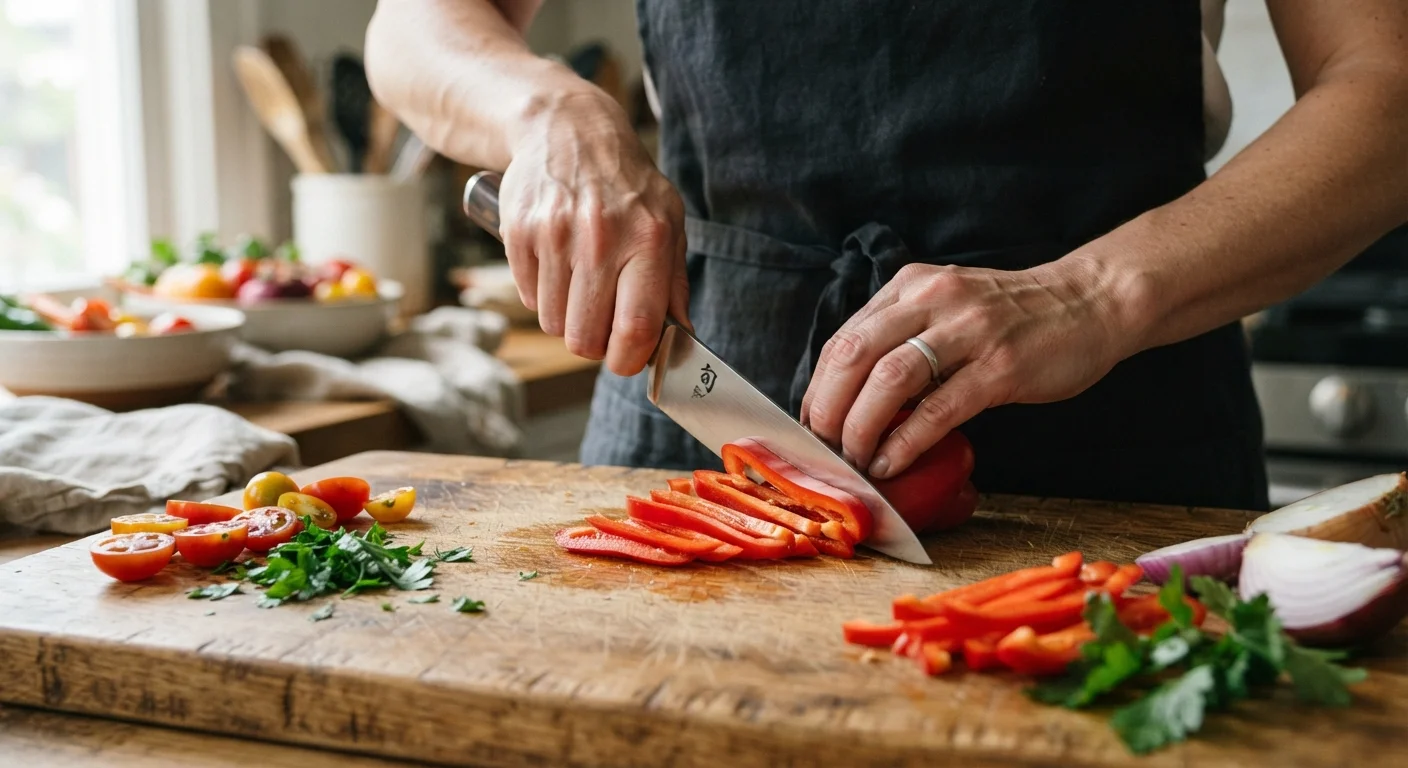
To use the pinch grip, place your thumb and the side of your bent index finger directly on either side of the blade, just above the handle. Your remaining three fingers wrap around the handle. This positioning lowers the center of control to the blade itself rather than the handle, which dramatically improves precision and reduces fatigue on longer prep tasks.
When learning the pinch grip, practice with the knife unplugged from any food first — just grip, reposition, and grip again until it feels natural before you start cutting.
Muscle memory for grip is easier to build without the distraction of managing an ingredient at the same time. A few minutes of dry practice accelerates the learning curve significantly.
If your wrist tires quickly during chopping, check whether you're gripping the handle too tightly. A relaxed, controlled grip — not a white-knuckle clench — is what efficient cutting actually requires.
Tension in the hand travels up the forearm and leads to fatigue and imprecision. Experienced cooks hold the knife firmly but not rigidly.
For a deeper look at this and other foundational techniques, see the complete knife skills guide.
The Guiding Hand: Your Most Important Safety Tool
Your non-dominant hand does just as much work as the one holding the knife — it guides the food and protects your fingers. The technique is called the claw grip: curl your fingertips under so your knuckles face forward, and let the flat side of the blade rest lightly against your knuckles as you cut. This keeps your fingertips safely out of the blade's path on every stroke.
The claw also gives you directional control. By inching your guiding hand backward with each cut, you set the thickness of each slice consistently without measuring. This is the habit that separates cooks who are fast from cooks who are sloppy.
Essential Cuts Every Cook Should Know
You don't need to master a culinary school's worth of cuts. Four will handle the vast majority of home cooking:
- Slice: A single smooth stroke through the ingredient. Draw the blade forward or backward in one fluid motion rather than pressing straight down.
- Chop: A rougher, less precise cut used for aromatics like garlic or onion where exact size doesn't matter much. A rocking motion — keeping the tip of the blade on the board while raising and lowering the heel — works well here.
- Dice: A three-step process: trim the ingredient into planks, cut the planks into sticks, then cut the sticks crosswise into cubes. Consistent dice means your food cooks at the same rate.
- Mince: Very fine chopping, typically used for garlic, ginger, or fresh herbs. After rough chopping, place your non-knife hand flat on the spine of the blade and rock it back and forth across the pile.
Before starting any prep session, it helps to run through a quick checklist — see this kitchen prep checklist for a practical routine that keeps things organized.
Keeping Your Knife Sharp and Safe
A dull knife is genuinely more dangerous than a sharp one. When a blade won't bite cleanly, you compensate with extra force, which increases the chance of it slipping off the food. Sharpness allows the blade to do the work with minimal pressure.
Home cooks should learn to distinguish between two maintenance tools: a honing steel (or honing rod) realigns the blade's edge and should be used regularly — even before each session — while a sharpener (whetstone or pull-through device) removes metal to restore a dulled edge and is needed less frequently, perhaps a few times per year depending on use.
Storage matters too. A knife block, magnetic strip, or blade guard protects the edge between uses. Tossing knives loose in a drawer dulls them quickly and creates a hazard when reaching in. For a broader look at kitchen tools that earn their place, see this guide to kitchen equipment.
Building Better Prep Habits
Technique lives in the hands, but good habits live in how you set up. A few practices make every prep session safer and smoother:
- Stabilize your cutting board. Place a damp kitchen towel or a non-slip mat beneath it. A board that shifts under pressure is a genuine hazard.
- Create a flat base. Before cutting any round ingredient — an onion, a potato, a lemon — slice off one side to give it a stable flat surface. This single habit prevents a large proportion of kitchen slips.
- Work with appropriate knife size. A large chef's knife (typically 8 inches) is the workhorse for most tasks. Reaching for a paring knife to halve a butternut squash, or a chef's knife to peel a garlic clove, creates unnecessary difficulty.
- Keep your workspace clear. Clutter around the cutting board means accidents have more places to happen. Move scraps into a bowl as you go.
Cross-contamination at the cutting board is also a real food safety concern — especially when moving between raw proteins and produce. The food safety habits guide covers what to watch for and how to prevent it.
The content on this site is for informational purposes only and is not a substitute for professional advice. Always consult a qualified professional for guidance specific to your situation.