

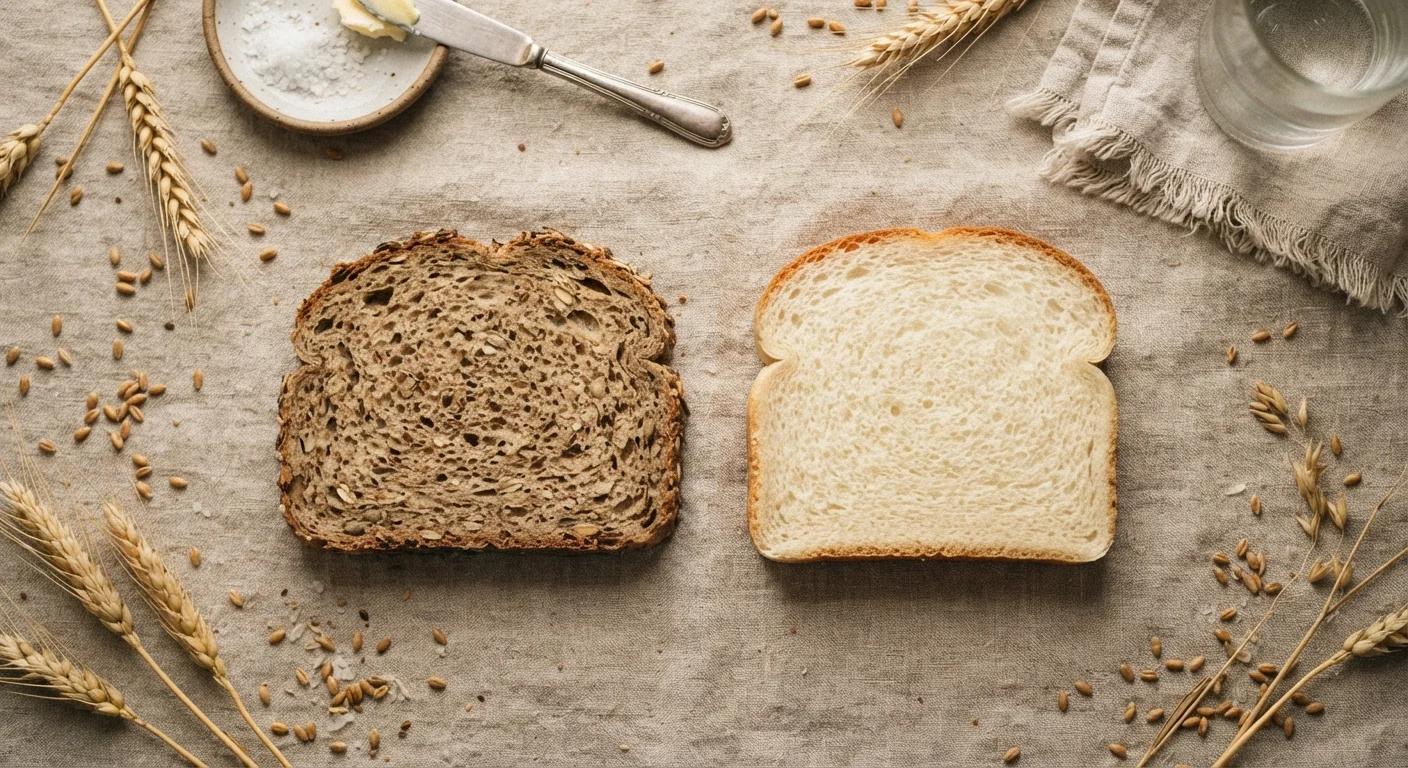
Option A
Whole Grains
The nutritionally complete, minimally processed option.
Best for: People seeking more fiber, vitamins, and minerals from everyday grain-based foods like bread, pasta, and cereals.
Option B
Refined Grains
The widely available, longer-shelf-life alternative.
Best for: Situations where texture, palatability, or shelf stability are priorities, though with meaningful nutrient trade-offs.
What Happens to a Grain During Milling
A whole grain kernel has three distinct layers: the outer bran, the nutrient-dense germ, and the starchy inner endosperm. When grain is refined — as happens when whole wheat becomes white flour — industrial milling strips away the bran and germ, leaving only the endosperm.
That process dramatically changes what ends up in your food. The bran layer is the primary source of dietary fiber as well as several B vitamins and minerals. The germ contributes vitamin E, healthy fats, additional B vitamins, and antioxidants. What remains — the endosperm — is largely starch and a small amount of protein. The result is a lighter, finer flour with a longer shelf life (the oils in the germ can go rancid), but a significantly reduced nutrient profile.
This is not a small difference. According to the Whole Grains Council, refining wheat can remove more than 70% of its B vitamins, around 90% of its vitamin E, and the majority of its fiber and trace minerals. Understanding this helps explain why nutrition guidance from major health bodies consistently encourages Americans to make at least half their grains whole grains.
| Criterion | Whole Grains | Refined Grains |
|---|---|---|
| Kernel layers retained | Bran, germ, and endosperm | Endosperm only |
| Dietary fiber | High — largely intact | Low — most removed |
| B vitamins | Naturally present | Mostly removed; some added back via enrichment |
| Vitamin E | Present (from germ) | Largely removed; not restored |
| Minerals (magnesium, zinc) | Well preserved | Substantially reduced |
| Glycemic response | Generally slower glucose absorption | Generally faster glucose absorption |
| Shelf life | Shorter (germ oils can oxidize) | Longer |
| Common examples | Oats, brown rice, whole wheat bread | White bread, white rice, regular pasta |
Enrichment: A Partial Fix
Because refining removes so many nutrients, the U.S. government requires that certain B vitamins — thiamin, riboflavin, niacin, and folic acid — along with iron be added back to refined grain products in a process called enrichment. You'll see this reflected on labels as "enriched wheat flour."
Enrichment genuinely matters from a public health standpoint. The mandatory addition of folic acid to enriched grains since 1998 has been linked by the CDC and other public health agencies to a meaningful reduction in neural tube defects. That's a real and significant benefit worth acknowledging.
However, enrichment has clear limits. Fiber is not restored. Neither are many of the minerals — including magnesium and zinc — or the vitamin E and phytochemicals found in the germ. So while enriched refined grains are nutritionally better than unenriched ones, they remain meaningfully different from whole grains in ways that matter for everyday health.
>70%
B vitamins lost during wheat refining
The Whole Grains Council estimates that milling removes more than 70% of several B vitamins found in the original whole wheat kernel.
~7%
Americans meeting whole grain recommendations
Research published in nutrition journals suggests that only a small fraction of U.S. adults consistently meet the Dietary Guidelines recommendation of making at least half their grains whole grains.
21–25g / 30–38g
Daily fiber recommended for adult women / men
The Institute of Medicine's Adequate Intake levels for dietary fiber; most Americans consume well below these targets, and whole grains are a significant potential contributor.
For more on how to decode these details when you're shopping, reading ingredient lists is a skill that pays dividends in the grain aisle.
Health Implications: What the Research Suggests
A substantial body of research links whole grain consumption with reduced risk of several chronic conditions. Observational studies and reviews published by institutions including Harvard's T.H. Chan School of Public Health and the American Heart Association suggest associations between higher whole grain intake and lower rates of cardiovascular disease, type 2 diabetes, and certain digestive conditions. These associations hold up across diverse populations and dietary patterns.
The likely mechanisms include fiber's role in slowing glucose absorption, supporting gut microbiome health, and promoting satiety — all of which can influence metabolic and cardiovascular health over time. The vitamins, minerals, and phytochemicals preserved in whole grains also contribute independently to these outcomes.
It's important to note that most of this evidence is epidemiological — meaning it observes patterns in populations rather than proving direct causation in individuals. Still, the consistency and scale of the evidence is considered strong enough that major health organizations, including the Dietary Guidelines for Americans, recommend making whole grains a regular part of a balanced diet.
These findings also connect to broader patterns around food processing. How added sugars differ from natural sugars is another dimension of processing worth understanding, since refined grain products often also carry higher added sugar loads.
Practical Label-Reading Tips
Grain labeling in the U.S. can be misleading. Terms like "multigrain," "made with whole grain," "wheat bread," and "7-grain" don't tell you whether whole grains are the primary ingredient. A product can be mostly refined flour with a small whole grain addition and still use those phrases on the front of the package.
The most reliable approach is to check the ingredient list. The word "whole" should appear before the grain name — "whole wheat," "whole oats," "whole grain corn" — and that ingredient should appear first or very close to first on the list. Understanding Nutrition Facts labels can also help you compare the fiber content per serving across grain products, which is one of the clearest indicators of whole grain content.
What 'Enriched' Means on a Label
When you see 'enriched wheat flour' on an ingredient list, it means specific B vitamins and iron were added back after milling — a federal requirement for most refined grain products sold in the U.S. This is nutritionally meaningful, particularly for folic acid, but enrichment does not restore fiber or all the micronutrients removed during processing. Whole grain flour does not require enrichment because those nutrients were never removed.
For shoppers applying these ideas in real time, a grocery store nutrition walkthrough can help you navigate the bread, cereal, and pasta aisles with more confidence.
This article is for general informational and educational purposes only and is not a substitute for professional medical or dietary advice. Consult a qualified healthcare provider or registered dietitian for guidance specific to your health needs.
The content on this site is for informational purposes only and is not a substitute for professional advice. Always consult a qualified professional for guidance specific to your situation.